This prediction and prediction 5 are two halves of the same uncomfortable truth, so I'll connect them here.
Prediction twelve: as the hype matures into pragmatic deployment, AI automates up to 90% of certain job tasks — entry-level coding, customer interactions, document review — making traditional methods in those areas uncompetitive.
My favorite spin-off was 'AI-Powered Outsourcing': specialized AI outsourcing departments and services that drastically reduce the need for human labor on repetitive tasks, with industry-specific marketplaces of legal, finance, and HR modules.
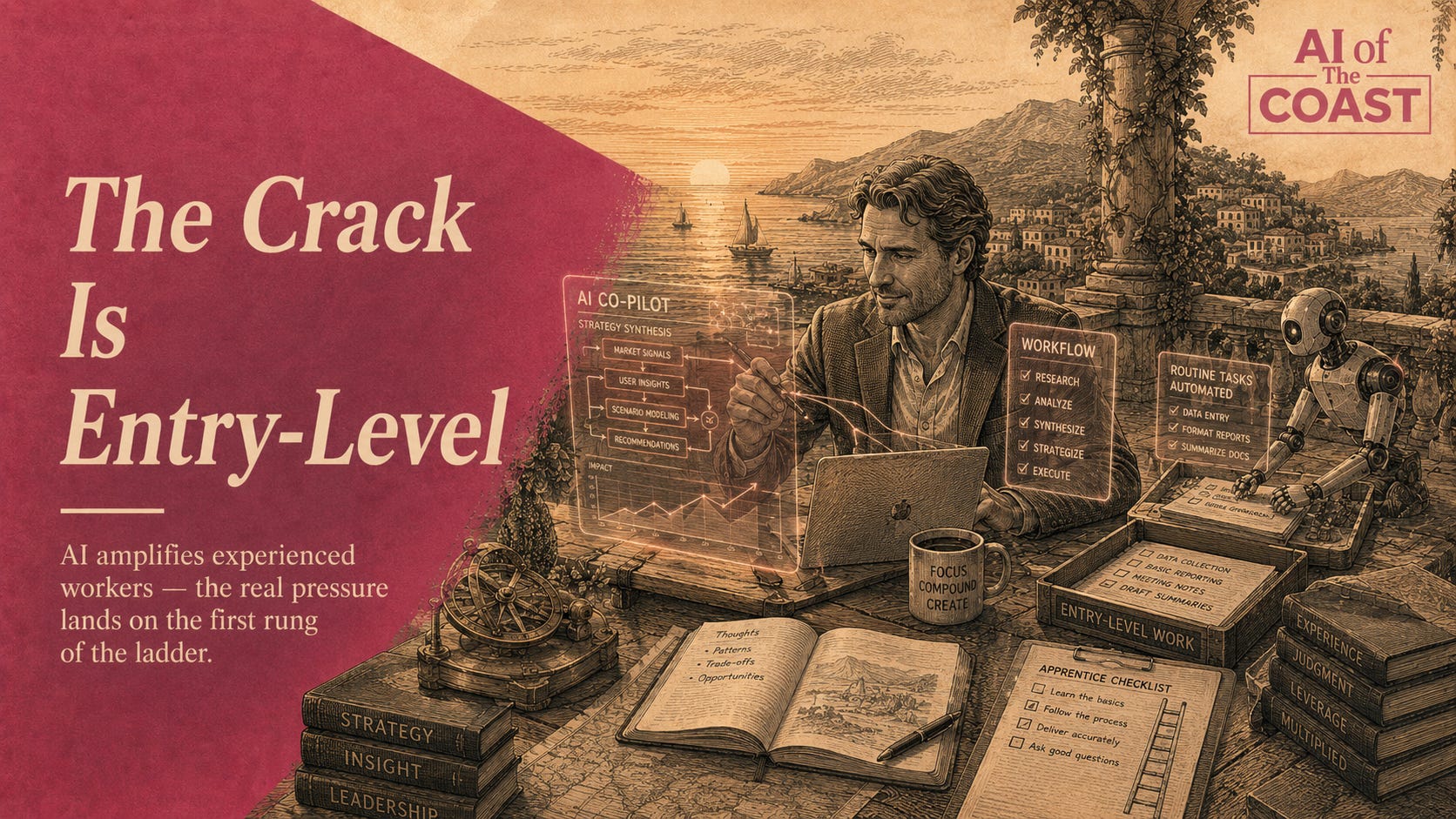
The 90% automation call: landed
The specific tasks I named are exactly the ones AI now dominates.
Entry-level coding: AI coding assistants write or co-write the majority of new code at many firms, and the 2026 adoption stats (Stack Overflow, GitHub, DORA, McKinsey) confirm AI-assisted development is the norm, not the exception.
Document review: AI scribes and summarization tools produce the largest measured time savings in knowledge work, with healthcare documentation as the flagship case.
Customer interactions: AI handles the high-volume, repetitive tier as a default.
The 'traditional methods become uncompetitive' framing held — firms still doing this work manually are simply more expensive than firms that automated it.
AI outsourcing: real, and reshaping the BPO industry
My 'AI-Powered Outsourcing' concept — AI replacing the traditional outsourcing-department model for repetitive tasks — is materializing as the genuine disruption of the business-process-outsourcing industry.
The logic I laid out (hyper-personalized, end-to-end-integrated, industry-specific automation marketplaces) is the direction BPO is being forced to move.
The companies whose entire business was offshoring repetitive cognitive labor to lower-cost regions are now competing against AI that does the same work at near-zero marginal cost. That's the structural squeeze I described, arriving on schedule.
The part I have to say out loud: this is the missing-rung machine
Here's where I connect it to prediction 5 — and where I refuse to sugarcoat.
The 90% automation of entry-level tasks isn't a neutral efficiency story. Entry-level coding, junior document review, first-tier customer work — these aren't just tasks. They're how humans entered professions and climbed.
When AI does 90% of them, the entry-level job doesn't get more interesting. It gets eliminated or compressed to a fraction of its former headcount.
I framed this in January 2025 as 'human talent reallocation' to higher-value roles — and for the people already established, that reallocation is real and good.
But the cohort that would have started in those entry-level seats faces a structural problem I underweighted: you can't reallocate to a senior role you never got to begin.
The 90% automation I correctly predicted is, viewed from the other side, the mechanism removing the bottom rung of the career ladder across multiple white-collar fields.
Both things are true at once. The efficiency gain is real and I called it. The generational discontinuity is real and I should have weighted it more heavily. A good forecaster names the second-order effect, not just the first.
The next 12 months: the BPO reckoning and the apprenticeship counter-move
My forecast for May 2027: the traditional BPO and outsourcing industry hits its first real contraction directly attributable to AI — not a productivity story, a headcount story.
Firms whose value proposition was cheap repetitive cognitive labor lose contracts to AI-native competitors, and the offshore-BPO employment model that absorbed millions of entry-level workers globally starts to shrink.
This is one of the most under-discussed labor consequences of the automation I predicted, and it lands hardest outside the headlines — in the economies built on outsourced back-office work.
The counter-move worth watching: the smartest firms turn the missing rung into a deliberate strategy.
If everyone else stops hiring juniors because AI does junior work, the firm that builds a real human-apprenticeship-alongside-AI pipeline will own the senior talent of 2030 while competitors discover their pipeline ran dry.
The scarce asset stops being the AI. It becomes the human who has been deliberately grown alongside it.
Grade: hit on the automation, hit on the AI-outsourcing disruption, with a mandatory honesty tax — I called the 90% and underweighted what removing the bottom 90% does to the people who used to live there. The prediction was right. The framing was too comfortable.
Sources: original forecast (Jan 6 2025); 2026 AI coding adoption stats (Stack Overflow, GitHub Octoverse, DORA, McKinsey); healthcare AI scribe time-savings data; BPO industry disruption analysis; the author's own prediction 5 on workforce evolution; entry-level labor-market data 2025-26.