


The GPU gets the mythology. But a GPU cluster without optical interconnect — without the fiber that carries signals between chips at the speed of light across the rack, the row, the building, the campus — is a room full of extraordinarily expensive islands. The signal must move. Trillions of parameters have to communicate across meters and milliseconds. That requires glass. Specifically, it requires more glass than the United States currently manufactures — and more distributed glass than any single hyperscale campus has ever needed.
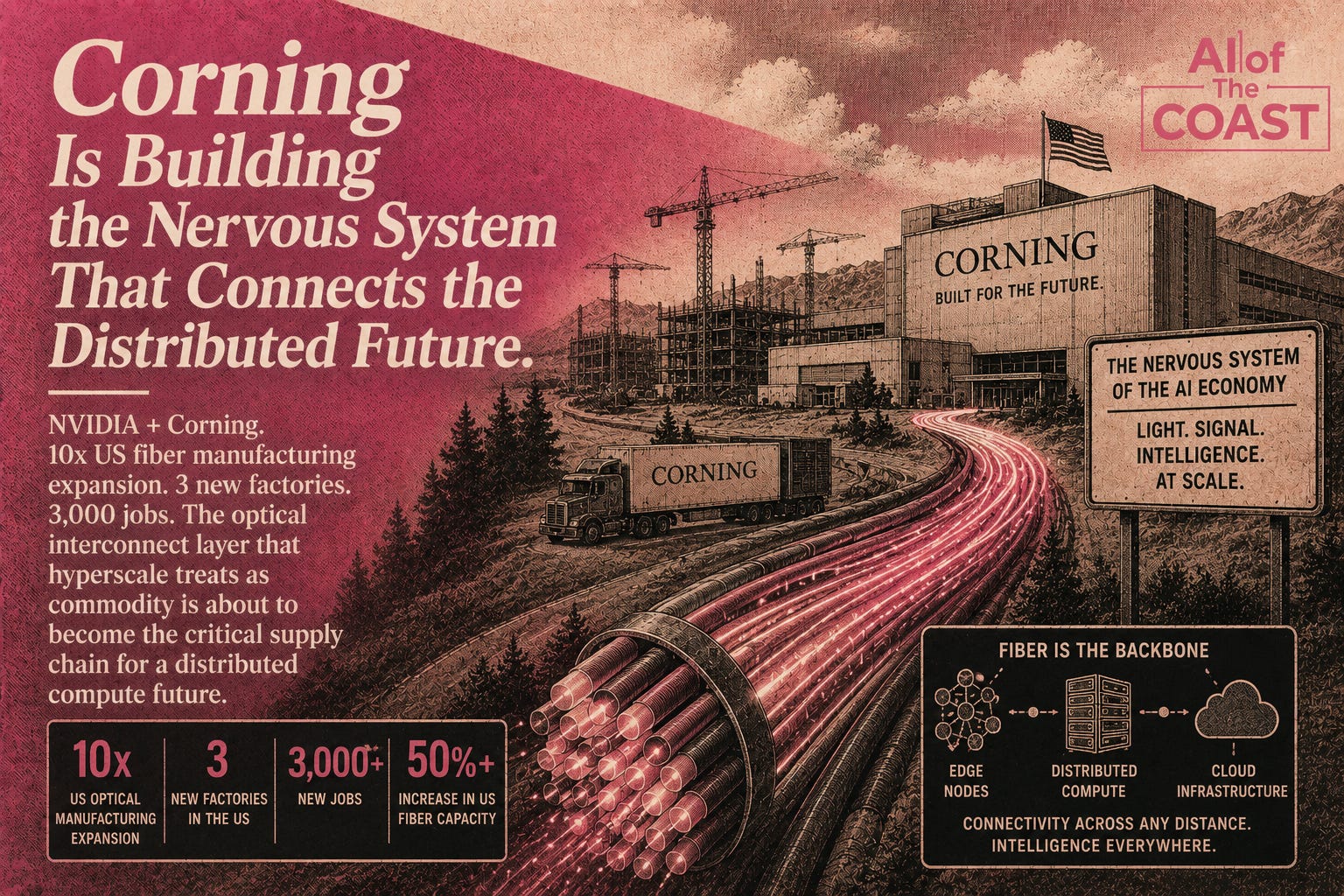
NVIDIA and Corning announced this week: US-based optical connectivity manufacturing expanding by 10x. US fiber production capacity growing by more than 50%. Three new facilities in North Carolina and Texas. More than 3,000 new manufacturing jobs with decade-long commitment behind them. Corning — the company that made fiber optic cable for the internet, Gorilla Glass for your phone, and glass for Edison’s lightbulbs — does not make capital commitments like this speculatively.
“This partnership is proof that AI is not just a technology story. It is a manufacturing story.” — Wendell Weeks, Corning CEO, 1851. He means it in the industrial sense. So do I, in the distributed sense.
The obvious read: this expansion serves the hyperscale campus buildout. Virginia, Texas, Ohio — the data center corridors that have been consuming fiber to interconnect their GPU clusters. That’s true. But it is the less interesting half of the story.
The more structurally significant read: a distributed modular compute architecture requires optical connectivity not just within a campus but between geographically dispersed nodes. A DDC network spread across industrial sites, logistics hubs, carrier facilities, and edge deployments across a region needs the same ultra-dense fiber connectivity that hyperscale clusters use internally — but distributed across miles of geography rather than hundreds of meters of raised floor. The fiber expansion that NVIDIA and Corning are planning is not just for the centralized model. It is building the substrate for the distributed one.
The railroad analogy haunts every infrastructure cycle. The 1990s fiber boom annihilated its investors. The fiber itself carried the internet for 25 years. This expansion has a structural difference: NVIDIA is pulling demand-contracted signals into the supply chain. The factories are being built against named backlog. This is not 1999’s hallucinated future. It is a supply constraint being solved against a queue of already-purchased GPU clusters that need to talk to each other.
The Modular Answer
The modular distributed compute architecture has a fiber dependency that is, per-unit, more demanding than hyperscale — not less. Each DDCU node requires high-bandwidth optical connectivity to function as part of a distributed compute fabric. The challenge isn’t connectivity within a building; it’s connectivity between buildings, between sites, across the distributed geography of edge deployment. The Corning expansion is building the substrate that makes this architecture physically possible at national scale. The centralized model uses fiber to connect GPUs across 200 meters of raised floor. The distributed model uses fiber to connect nodes across 200 kilometers of geography. Both need the same glass. Only one of them has already built all the campuses it’s going to build.
Data centers gave Corning its next life — though the last time fiber demand looked this certain, in 1999, the picture unfolded poorly.