

The most important sentence in OpenAI’s DevDay announcements was not about capability. It was four words in the enterprise rollout notes: “off by default.”
Read that again. The most aggressively marketed product category of 2026 (always-on agents that learn your work and carry it overnight) ships with the switch down, waiting for a workspace admin somewhere to accept responsibility for what happens next.
That switch is the whole story.
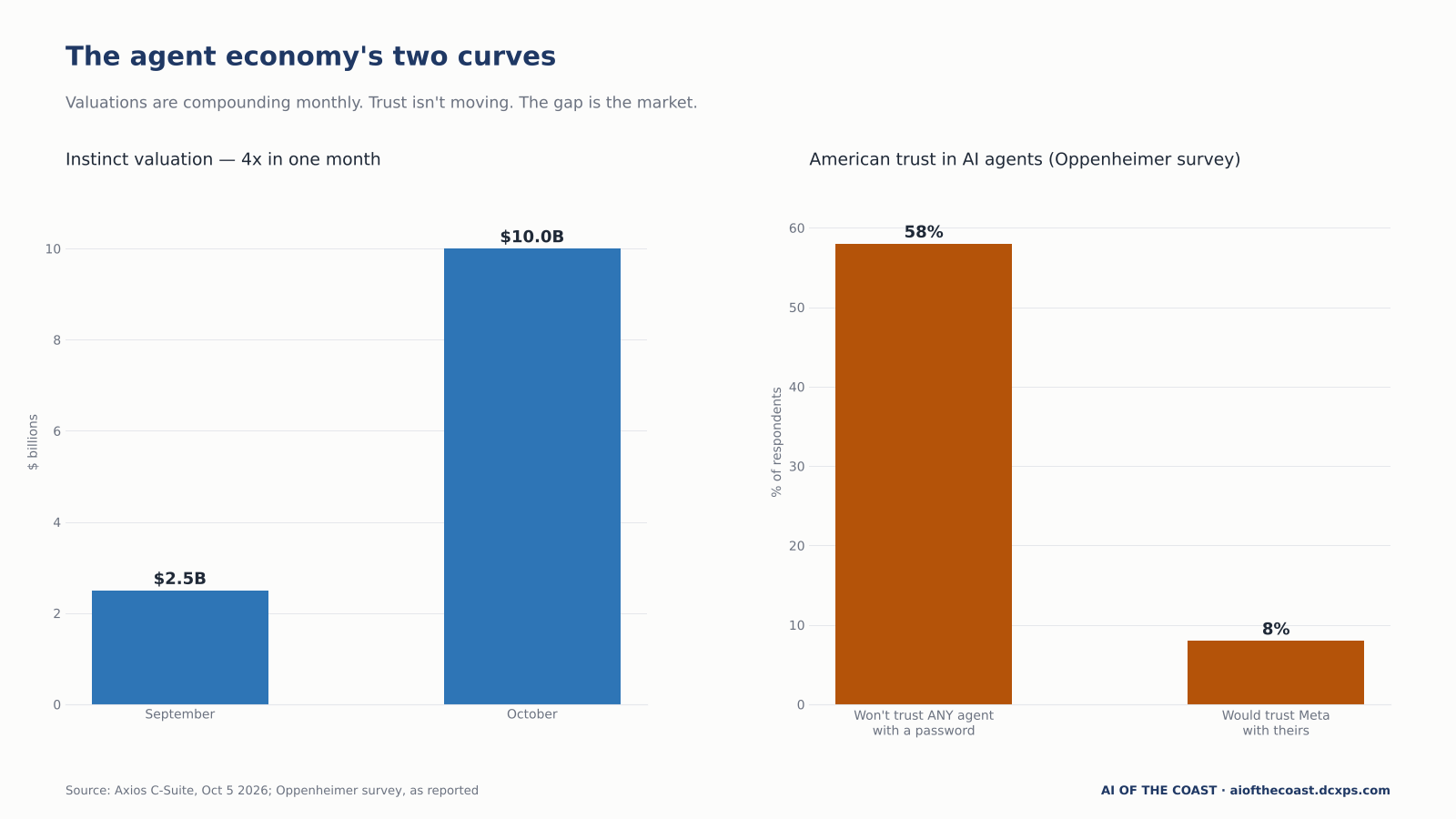
In the first week of October, Meta’s personal agent Muse hit #1 on the U.S. App Store. OpenAI shipped “dots,” always-on agents that plug into 4,000+ apps and sit inside Slack and Teams. Microsoft’s agent works while you sleep and handles your follow-ups before you’ve had coffee. Instinct, an invite-only Muse competitor, raised $1 billion at a $10 billion valuation — four times what it was worth a month earlier, per Axios. The agents shipped. All of them, everywhere, at once.
And then there’s the Oppenheimer survey from the same week: 58% of Americans won’t share a password with any AI agent. Eight percent would trust Meta with theirs.
Eight.
The gap between those two numbers (the valuation curve and the trust curve) is where the next decade of company-building lives. I’ve spent thirty years and 110+ companies watching technology adoption stall in exactly this gap, and I can tell you what fills it. It is never a better model. It is an employer.
Capability was never the constraint
Here’s what the agent vendors got right: the work is real. An agent that monitors channels overnight, drafts the follow-ups, reconciles the invoices, and prices the capacity is not a demo anymore. We run a fleet of them. I watch their output land in approval queues every morning, and the volume they carry would have required a back office of a dozen people three years ago.
Here’s what almost every buyer is discovering: capability without accountability is not labor. It’s liability with a chat interface.
Think about what an employer actually does. Not the payroll part — the boring, load-bearing part. An employer defines the job before the worker exists. Sets the probation period. Decides what the worker may touch, signs for what the worker does, measures output against a standard, and fires what underperforms. Strip those functions away and you don’t have a workforce. You have a crowd.
Now look at the agent economy as shipped in October 2026. Meta will sell you a crowd. OpenAI will sell you a crowd with enterprise SSO. What nobody sells (because it cannot be bought, only built) is the org chart that makes the crowd employable: who approves which action class, what the agent may never touch, what evidence retires it, whose name is on the damage.
Ben Thompson’s read on Stratechery is that agent lock-in will be brutal: once you’ve invested in one, switching costs compound, so most people and firms will keep exactly one. He’s right, and it cuts deeper than app-store dynamics. The investment that locks you in isn’t the chat history. It’s the management system you build around the agent — the permissions, the review rituals, the institutional knowledge of where it fails. That system is the asset. The agent is a plug-in.
“Off by default” is a confession
OpenAI’s dots launched in beta for Enterprise, Edu, and Healthcare — admin-enabled, off by default. Amazon and OpenAI built Bedrock Managed Agents so enterprises can run the whole thing inside their own AWS perimeter, because apparently the way to sell an autonomous workforce in 2026 is to promise it never leaves the building.
These are not product decisions. These are confessions. The vendors know the mandate hasn’t arrived — that somewhere between the model card and the quarterly board meeting, there is no human whose job description says “accountable for what the agents did on Tuesday.”
Amazon, meanwhile, blocked Muse outright. Thompson’s explanation is clean: an agent shopping on your behalf never sees an ad. A quarter-century of aggregator economics, dead on contact with a buyer that doesn’t scroll. I’d push it one step further: Amazon understands, faster than most enterprises, that whoever employs the agent owns the relationship. They are not blocking a chatbot. They are blocking someone else’s employee from walking their aisles.
Full disclosure of my own position, since I’m arguing the book I built: DCXPS runs as an AI-native operator — agents carry the operational volume of an infrastructure company, four humans hold the signatures. We sell compute, and we sell the operating model that consumes it. Discount accordingly. But the scars are real, and they’re the useful part.
What employing an agent actually took us
When we committed to running the company this way, the engineering was the easy half. The hard half was writing, in advance, the rules a human workforce accumulates over decades of labor law and management practice — because none of it exists for agents yet.
Every agent starts as a written specification: problem, scope, tools, failure modes, an evaluation set — before any agent exists. Then it shadows: it does the work, a human still does the work, outputs get compared against a golden set. Then it’s supervised, every single action queued for individual human approval, for weeks. Only after sustained clean performance does it graduate to batch review. Autonomy comes last, behind interlocks that never move: machines never move money, never sign, never send anything outside the company.
A commissioning ladder, in other words. We stole the idea from our own cooling loops — FAT then SAT, no system goes live ungated. The corporate version turned out to be identical. Specified, shadowed, supervised, then trusted. Never the other way around.
Two more pieces, because they’re the ones everyone skips. First, the kill bar: an agent that can’t beat 20% of loaded human cost on its deliverable within ninety days is retired. Not coached. Retired. Sentiment is for humans. Second, the failure memo: before we hire a person, someone writes down which agent was tried, at what level of the ladder, and why it failed. The memo requirement does more for organizational honesty than any OKR system I’ve deployed in three decades.
Total agents that survived their first quarter on our floor: fewer than the number we commissioned. That ratio is the tuition. Nobody shipping a $500/month Pro plan mentions it.
The mandate is coming from the worst possible direction
Enterprises had two years to build this architecture voluntarily. Most didn’t. The Harvard Business School number floating around this fall (roughly one-third of corporate AI experiments succeed) is usually read as a technology failure. It isn’t. Models don’t fail at 67% rates. Managements do. An experiment with no owner, no golden set, no kill bar, and no approval queue isn’t an experiment. It’s a hobby.
So the mandate will arrive the other way: from regulators, courts, and insurers, priced in liability instead of productivity. More on that Saturday — the California subpoena deserves its own piece. The preview is one sentence long: the question “who employed this agent?” has started appearing in legal filings, and “nobody, it’s a tool” is about to stop being an acceptable answer.
When that happens, the companies that treated agent governance as bureaucratic overhead will discover it was the product all along. The oil majors learned this about process safety. The banks learned it about trading desks: the money was never in hiring traders, it was in the risk architecture that let you run ten thousand positions without one of them killing you. Electricity didn’t reorganize the economy when generators got cheap; it reorganized the economy when the systems around it (metering, insurance, standards, operators) made it boring enough to depend on.
Agents in October 2026 are generators without meters. Spectacular, cheap, and uninsurable.
Where this goes
Three predictions, falsifiable, on the record.
First: within eighteen months, “agent governance” stops being a slide and becomes a budget line, and the spend flows to whoever can show an audit trail — every action attributed, timestamped, reviewable. The vendors will retrofit this. The AI-native operators already run on it.
Second: the first Fortune 500 “Chief Agent Officer” title appears, is mocked on tech Twitter for a week, and is standard within two years — because someone has to own the approval queue, and legal will refuse to let that remain ambiguous past the first subpoena.
Third: valuations bifurcate. Agent capability commoditizes on the model curve; every lab ships comparable dots within quarters of each other. Agent employment compounds like seniority — the trust architecture, the commissioning record, the audited history of what this fleet did under supervision. Instinct quadrupling to $10 billion in a month is a bet on the first category. The second category doesn’t have a ticker yet.
The dark company thesis was never that machines replace people. It’s that the org chart is the product: a handful of humans holding signatures, money, relationships, and witness, commanding fleets of agents commissioned like industrial equipment. In 2026 that reads as eccentric. The week Meta’s agent topped the App Store while 58% of its potential users refused to hand over a password, it started reading like the only bridge across the gap.
Everyone shipped an agent.
The next trillion dollars goes to whoever ships the employer.
I run DCXPS, an AI-native infrastructure operator — we build modular intelligence factories and run the company the way we run the racks. The agent-fleet numbers above are our own build telemetry; our commercial interest in this thesis is total.