

In August I wrote that the queue is the product — that compute capacity is worthless until it clears interconnection, and that the 86% of queued projects that never energize are already priced into the survivors. Two months of data later, I have to extend the thesis, because the market found a new place to store its fiction.
The queue was where projects went to die quietly. The pipeline is where they now die in public.
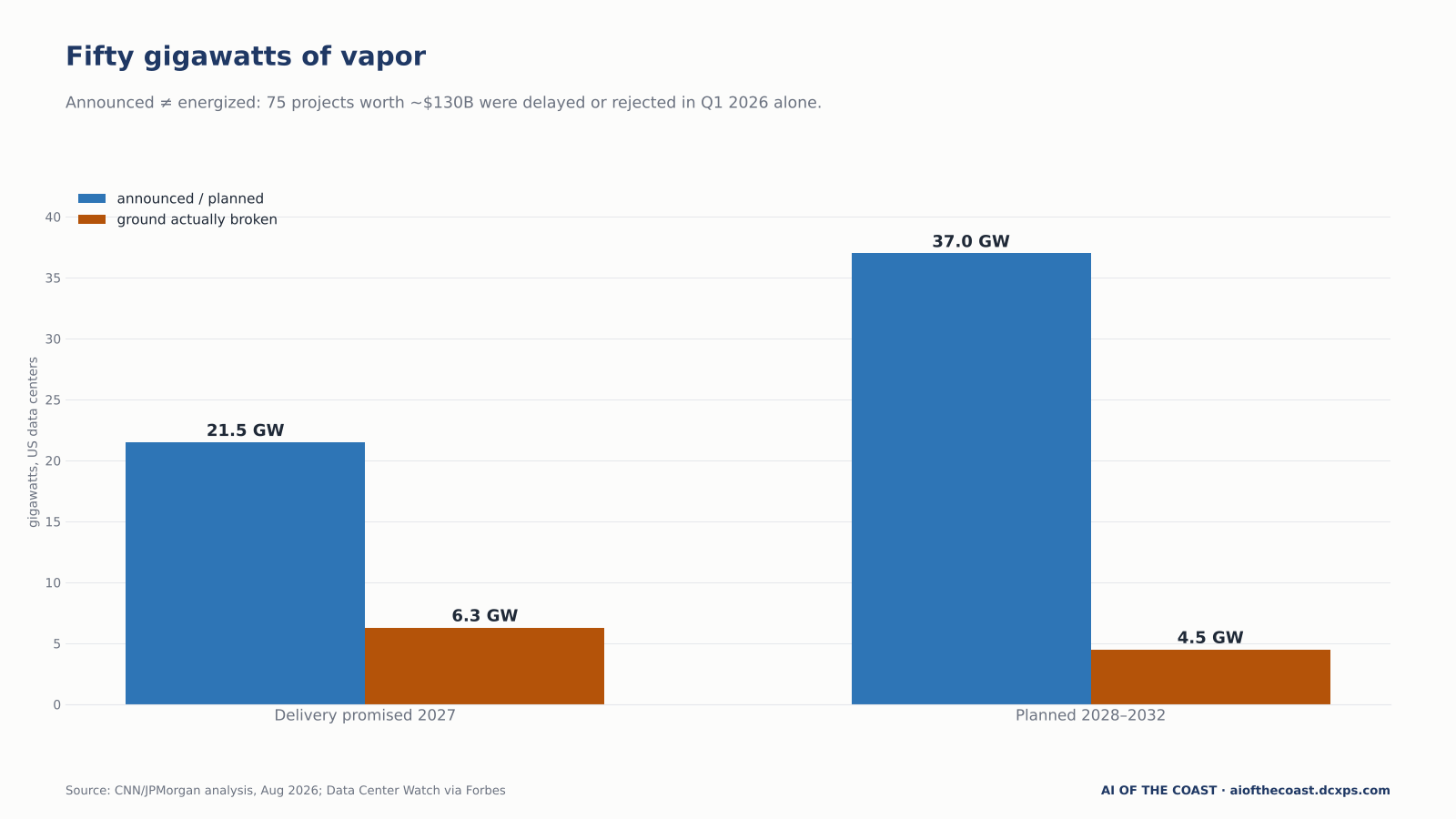
Here is the 2027 picture, per a CNN/JPMorgan analysis from August: 21.5 gigawatts of U.S. data center capacity announced for delivery next year. Ground broken on 6.3 GW. Roughly 60% of next year’s promised capacity does not physically exist as so much as a foundation pour — and 2027 is the near year. For 2028–2032, 37 GW sits planned without firm completion dates against 4.5 GW under construction. Add it up across the horizon and more than 50 GW of announced American AI capacity is, as of this autumn, vapor: press releases with land options attached.
The conversion data is uglier than the aggregates. GlobalData rated just 6% of the projects announced in 2025 (thirty-one of them) as high-likelihood to execute. Sightline Climate tracked 30–50% of the 2026 build slate as delayed or canceled by May. Data Center Watch counted 75 projects worth about $130 billion delayed or rejected in the first quarter alone, concentrated in Virginia, Georgia, and Texas — the three states that were supposed to be the easy ones.
An industry that announces ten and energizes one has not discovered a growth problem. It has discovered that announcements were the product being manufactured.
You cannot buy your way out of physics
The standard explanation for the gap is capital. The standard explanation is wrong, and the people closest to the problem keep saying so. Hyperscaler spending hasn’t been revised down — Alphabet, Amazon, Meta, and Microsoft are tracking toward roughly $650 billion of combined AI infrastructure spend this year. TD Cowen’s Maria Chen put the real constraint in one sentence: “You cannot buy your way out of physics.”
The physics comes in three flavors, and I’ve personally been beaten up by all three.
Grid time. Interconnection waits run four to seven years in Northern Virginia, Phoenix, and Dallas. PJM reported in July that AI-era projects entering service in 2025 took over seven years from application. Against an 18–24 month silicon cycle, a seven-year power timeline means the facility you design today energizes three GPU generations late. Nobody’s demand forecast survives that.
Equipment time. Transformer lead times stretch to five years, against 24–30 months before 2020. Switchgear, busways, batteries (the components that are less than 10% of construction cost) now gate the other 90%+ of capex. The U.S. imported over 8,000 high-power transformers from China in 2025, up from fewer than 1,500 in 2022, and tariffs added 15–25% to equipment costs while domestic suppliers remain, by most estimates, two to three years from absorbing the gap. JLL has shell-and-core construction at $11.3 million per megawatt, up from $7.7 million in 2020. The industry is paying 47% more per megawatt to stand in a longer line.
And now, political time — the one the spreadsheets never model. Maine’s House voted 82–62 for a data center moratorium through 2027. The complaints writing those votes are specific: water, noise, grid strain, and the awkward arithmetic that a $1 billion facility delivers 50 to 100 permanent jobs. The industry’s social license was an assumption. Assumptions don’t survive rate hikes.
The rate hike has a receipt now
Because here’s the August document that will be quoted in hearings for years: Monitoring Analytics (PJM’s independent market monitor, not an activist group) published its first-half State of the Market report and did the attribution math. Existing and forecast data center load accounts for 9% of PJM’s wholesale power price ($10.48 per megawatt-hour) through July. Across the last four capacity auctions, data center load growth added a combined $29.4 billion in capacity market revenue, a line the monitor says “will continue to grow until the issues associated with the addition of large data center loads are addressed.”
Total wholesale cost in PJM, first seven months of 2026: $116.53/MWh, up 46% year over year. Fifty-six point seven billion dollars, up from $38 billion.
I wrote in August about who gets the queue repriced first. This is the second repricing, and it lands on voters. Once an official market monitor publishes a dollar figure connecting data centers to household electricity bills, every moratorium motion in every county gets its footnote. The backlash stops being anecdote and becomes policy with citations. Expect the announced-to-energized conversion rate to get worse before it gets better — not because the demand isn’t real, but because the social contract for gigascale grid draw was never actually signed by the people now paying for it.
Daniel Henn at Grid Strategies summarized the era: “The constraint has fundamentally shifted.” It has. From silicon, to grid, and now to consent.
Underwrite the conversion rate
If you allocate capital in this sector, the actionable discipline is almost embarrassingly simple: stop underwriting announcements and start underwriting conversion. A pipeline is not capacity. The number that matters for any developer, any REIT, any neocloud backlog, any sovereign AI strategy is announced-to-energized percentage and the months in between — and almost nobody reports it, for the same reason restaurants don’t publish their health inspections unprompted.
Ask five questions of any project. Does the site have existing interconnection or a signed agreement, not a queue position? Are the transformers and switchgear contractually allocated, with dates, from a supplier who has met dates before? Is the local political consent documented (rates, water, noise) or assumed? Does the design survive a GPU refresh without re-engineering power and cooling? And who, by name, has commissioned a facility of this class on schedule before?
Score the 50 GW of vapor against those five and you’ll find what the Q1 cancellation data already told you: the bottleneck isn’t money, it’s the stack of lead times, and the only way around a lead time is to not need the thing it gates.
That’s the structural read, and, disclosure, it’s the one I’m commercially committed to. The reason we build modular intelligence factories on brownfield sites with existing electrical infrastructure is precisely that it swaps the seven-year constraint for the ~8-month one: deploy where the substation, the grid connection, and often the retired power plant already exist, with the unit manufactured in parallel rather than constructed in sequence. Our first unit runs that playbook, and I’ve published the receipts in this newsletter before — 392 GPUs, roughly 450 kW of IT load, closed-loop liquid cooling, roughly eight months from order to commissioning. I’m not claiming modular is the only answer. Gas turbines behind the fence, nuclear PPAs, and genuine off-grid builds are all rational responses to the same physics. What’s not rational is the default: announcing a gigawatt and discovering the transformer lead time afterward.
The sorting
Step back far enough and the last two months resolve into a sorting mechanism. On one side: announced gigawatts, held by whoever can win a press cycle. On the other: energized megawatts, held by whoever can navigate interconnection, procurement, and county commissions simultaneously. The market has been pricing the first category as if it were the second for about three years now. The 75 canceled projects, the 6% execution rating, the Maine vote, and the market monitor’s $29.4 billion are the beginning of the correction — not of demand, but of credibility.
Electricity went through the identical sort a century ago. Thousands of announced power companies, a few hundred that ever generated, a handful that learned to operate — and the capital, after enough burned fingers, learned to tell the difference. The ones who could energize inherited the load growth of the entire twentieth century.
Fifty gigawatts of vapor will condense into some much smaller number of actual megawatts, owned by operators who treated physics as the spec rather than the surprise.
The queue was the product.
Conversion is the business.
I run DCXPS — we build modular intelligence factories on existing power, which makes me a direct beneficiary of the thesis above. The PJM, JLL, Sightline, GlobalData, and Data Center Watch figures are theirs; the scar tissue about lead times is mine.