

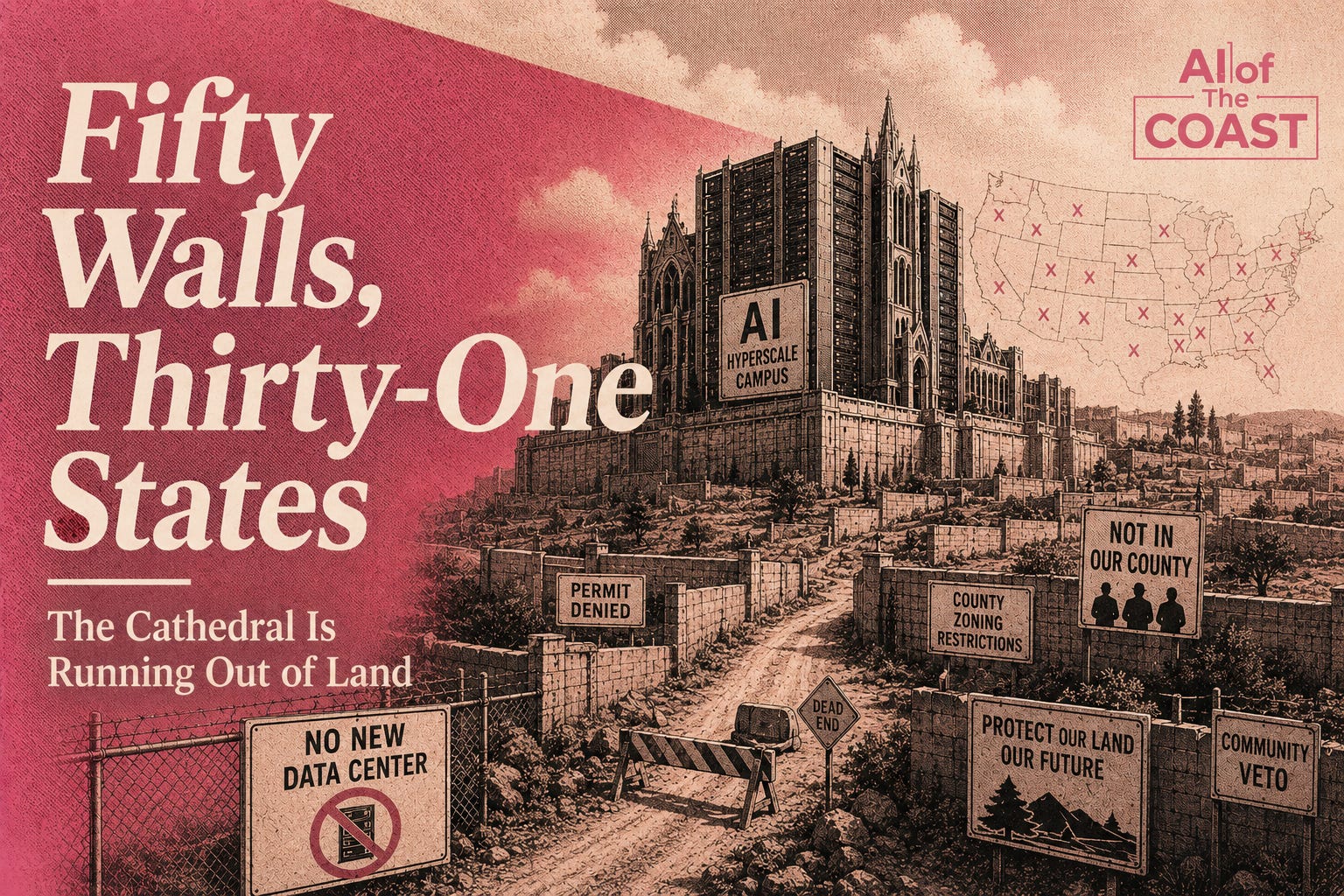
I have watched the shape of this moment arrive in four different industries. Rideshare companies grew until taxi commissions organized. Crypto miners expanded until utilities and legislators noticed the bills. Short-term rental platforms scaled until cities legislated back. The pattern is always the same, and it always surprises the industry experiencing it: technology scales faster than political accommodation, and then, suddenly, all at once, the accommodation ends.
For hyperscale AI data centers, that moment is now, distributed across 31 states and counting.
Interconnected Capital, tracked by investor Kevin Xu, maintains a live dashboard of data center development restrictions. The current count: 50 separate initiatives to limit, restrict, or block new data center construction. Bipartisan — Xu describes data centers as a “bipartisan punching bag.” The left objects on environmental grounds: water consumption in drought-stressed regions, carbon footprint, grid strain. The right objects on economic grounds: electricity rate increases, rural industrial encroachment, subsidies flowing to coastal technology companies. The objection meets itself from both directions and forms a wall that lobbying cannot dissolve.
When the opposition has no party affiliation, you cannot play the political arbitrage game. The objection is local, practical, felt in the utility bill. That kind of resistance doesn’t evaporate on an election cycle.
The practical complaints are not abstract or ideological. A 500 MW hyperscale campus consumes millions of gallons of water for cooling in regions where water is not abundant. It employs thousands during construction and then relatively few people permanently. It adds enormous demand to local grids, measurably raising rates for every ratepayer in the interconnect who was not consulted. It occupies vast tracts of land that counties had other plans for. The community absorbed the impact without a voice, and now the community is the voice.
The industry’s response — site selection arbitrage, incentive package optimization, permitting before the opposition organizes — worked when permissive jurisdictions were abundant. Fifty initiatives across 31 states means the arbitrage pool is actively, measurably contracting. The hyperscale model’s expansion premise is meeting a hard geographic constraint that is bipartisan, distributed, and accelerating.
The Modular Answer
A 5MW modular DDCU deployment at an existing industrial site has a political profile that is categorically different from a 500MW hyperscale campus. Smaller footprint. Negligible visual impact. Fraction of the water consumption. Grid draw that the local utility can absorb without rate increases. No new construction footprint visible from the county road. Employment at industrial scale, not the construction boom and bust cycle of a campus build. The community impact is livable. The local politics are navigable. The permitting timeline is months, not years of NIMBYism battles. The 50-initiative backlash is not a headwind against modular compute. It is a structural tailwind — the political system eliminating the centralized model’s geographic expansion option, one county resolution at a time.
The cathedral model requires vast, politically contentious, geographically fixed campuses that take years to permit, years to build, and then cannot move when the regulatory environment changes. The modular model deploys in months, at existing industrial sites, with a footprint too small to organize against. The geography is making the architectural argument that the physics, the grid, and the power bills were already making.
Fifty fronts. Thirty-one states. The tent was always faster than the cathedral. Now it’s the only architecture that can still find a place to stand.