
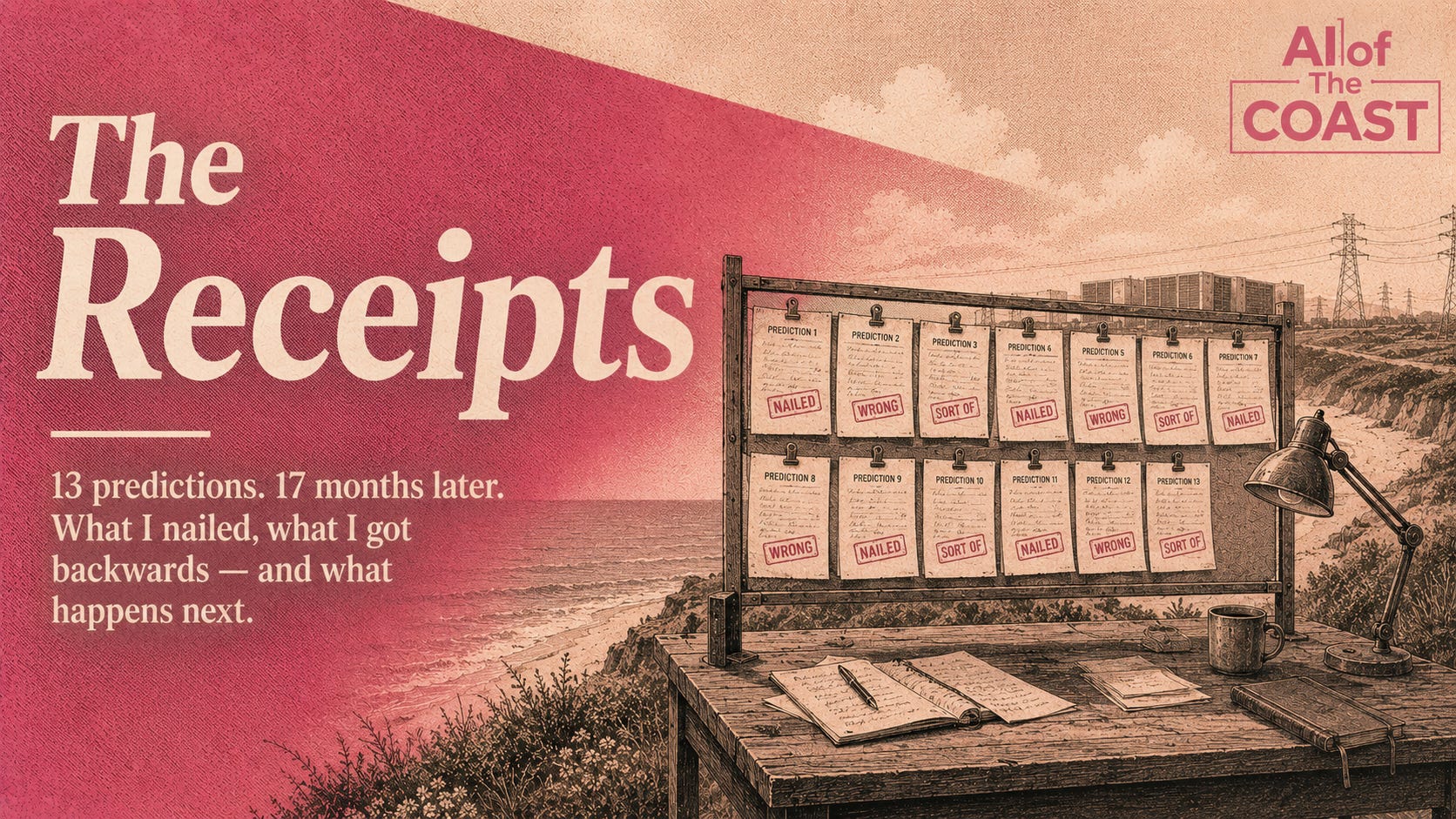
On January 6, 2025, I sat on a beach — off the coast, naturally — and published thirteen predictions for where AI was actually headed. Not the hype. Not the doom. The structural reality.

Most prediction posts are written to be forgotten. The forecaster bets that nobody keeps the receipts. I’m doing the opposite. I’m pulling every one of those thirteen calls back into the light, scoring it against seventeen months of hard data, and telling you — to my own discredit where it applies — exactly where I was right, where I was right for the wrong reason, and where I was simply wrong.
Then I’m doing the harder thing. For each one, I’m extending the call twelve months forward, to May 2027, with new sources on the table. Because a forecast you won’t re-grade is just decoration.
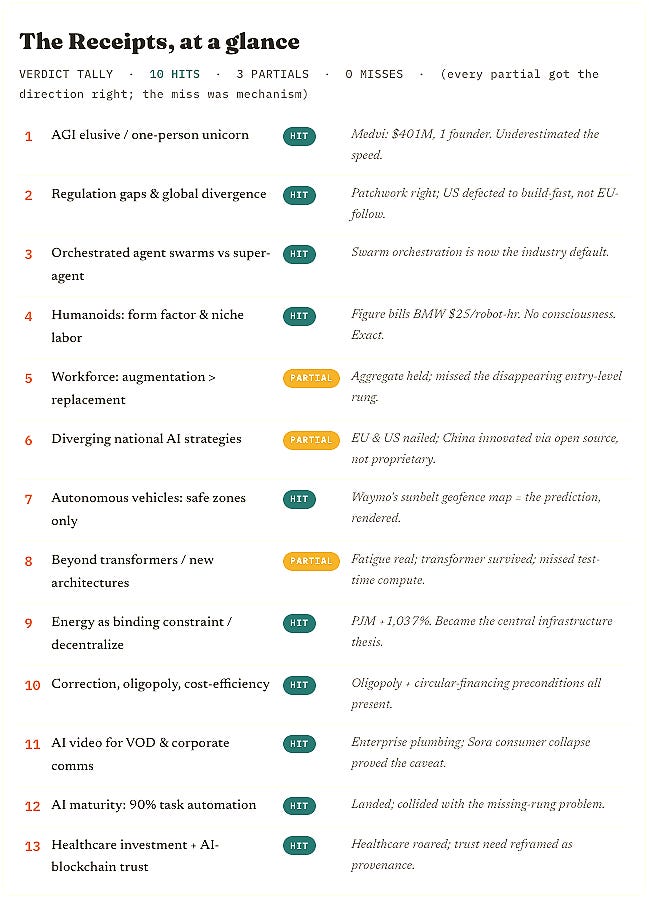
The honest headline: I was substantially right on the structural direction nearly across the board. Where I missed, I missed on mechanism — China’s open-source vector, the test-time-compute shift — and on second-order human cost, like the entry-level rung quietly vanishing. Direction is the easy 70% of forecasting. Mechanism and consequence are the hard 30%. That’s where the next thirteen predictions get sharper.
Here’s the scorecard. Then the receipts, one by one.
The Receipts, at a glance
Prediction 1 Revisited: I Said AGI Wouldn’t Arrive in 2025. I Was Right. I Also Underestimated the One-Person Unicorn.
In January 2025 I told you AGI stays elusive and the real money is in vertical agent swarms run by a single founder. Seventeen months later, the AGI part aged fine. The one-person-unicorn part aged like a prophecy I didn’t have the nerve to fully believe.
Let me start with the part I got wrong by being too cautious.
In my January 6, 2025 forecast, prediction number one had two halves. Half one: true AGI — the unified, human-adaptable kind — does not show up in 2025. Half two, my favorite, the thing I buried under a header called ‘My Favourite’: vertical stream agent swarms, specialized micro-agents each owning a slice of an industry vertical, coordinated by a thin human layer on top, eventually enabling the 1-person billion-dollar startup.
I hedged on the second half. I called it a ‘middle path.’ I should have called it the road.
The AGI half: correct, and not even close
Nobody serious is claiming AGI shipped in 2025. The AAAI 2025 presidential panel surveyed 475 researchers and 76% said scaling current approaches is unlikely to even get us to AGI. What we got instead was exactly what I described: brutally competent narrow systems. GPT-5 in August 2025. Gemini 3. Claude crossing $30B in annualized revenue by April 2026 on the back of enterprise coding agents, not general intelligence. The systems got jaw-droppingly good at specific things and remained, definitionally, not general.
That was the easy call. Predicting AGI won’t arrive next year is the safest bet in technology. I’ll take the point, but I won’t celebrate it.
The one-person unicorn: the call that actually mattered
Here’s where it gets interesting, and where I want to be honest with you about my own timidity.
When I wrote about ‘enabling a single founder to operate at a level once reserved for large organizations,’ I framed it as a 2025-to-2027 trajectory. A direction. A thing that would emerge. I did not expect to be naming a specific company with specific revenue this fast.
Meet Matthew Gallagher. In September 2024 — months before I published — he launched Medvi, a GLP-1 telehealth startup, out of his Los Angeles home with $20,000, zero employees, and more than a dozen AI tools doing the code, the ad creative, the customer service. By the end of 2025: $401 million in revenue. 250,000 customers. A 16.2% net profit margin. The company is now tracking toward $1.8 billion in 2026.

For context: Hims & Hers did $2.4 billion last year with 2,442 employees and a 5.5% margin. Gallagher is running roughly three times the margin with a headcount of one.
Is Medvi a ‘pure’ one-person billion-dollar company? Not yet. It uses contractors, fulfillment partners, a regulated pharmacy supply chain. The purists will quibble. Let them. The structural point I made in January 2025 is now undeniable: the cost of execution collapsed, and a single operator orchestrating agents can now reach revenue that used to require a building full of people.
The receipts piled up faster than the skeptics could object
Dario Amodei was asked at Anthropic’s May 2025 developer conference when the first one-person billion-dollar company arrives. One word: ‘2026.’ He gave it 70-80% odds. Sam Altman has a running bet in a CEO group chat on the same question. Sequoia is rewriting its underwriting models around what it calls ‘agentic leverage.’ By early 2026, 36.3% of new ventures were solo-founded, and those solo ventures were reporting 77% first-year profitability versus roughly 40% for traditional startups.
Pieter Levels runs a multi-million-dollar portfolio alone. Danny Postma’s HeadshotPro: $3.6M ARR, solo. Base44 hit 250,000 users and sold to Wix for $80 million within six months of launch. The pattern I called a ‘middle path’ became the default operating model for a whole category of software business.
The tooling cost? $100 to $500 a month for a stack that replaces a 2024 team. That’s the number that should keep incumbents awake.
What I’d change about the original call
One thing. I anchored the swarm vision to orchestration platforms — the idea that you’d buy a ‘swarm OS’ and assemble agents. That’s not quite how it played out. The winning solo operators didn’t buy a unified swarm platform. They duct-taped Cursor, Claude, ChatGPT, Zapier, and a CRM into a personal operating system. The orchestration happened in the founder’s head, not in a product. The market for a true ‘agent orchestration layer’ is still wide open — and still mostly hype, with autonomous agents failing roughly 70% of real multi-step tasks when left fully unsupervised.
That’s the gap. The dream is autonomous swarms. The reality is a very smart human conducting a very capable orchestra and catching the wrong notes before they reach the customer.
The next 12 months: from solo unicorns to solo conglomerates
My forecast for May 2027: the first genuinely defensible one-person company crosses $1 billion in revenue, and Amodei collects his bet — or comes embarrassingly close. But the more important shift is structural, not symbolic.
Watch for the solo operator to stop being a single product and become a portfolio. The same founder who can run one agent-powered business can run five. We’ll see ‘personal holding companies’ — one human, a dozen AI-run product lines, each a former full-team business. Y Combinator’s batches are already 40%+ agent-infrastructure companies feeding this exact pattern.
And watch the failure rate become the story. When 70% of unsupervised agent tasks fail, the moat isn’t the agents — it’s the human judgment layer that knows which 70% to catch. The winners of 2027 won’t be the founders with the best agents. They’ll be the ones with the best taste about when to override them.
Cathedrals are for worship. Tents are for war. The one-person unicorn is the ultimate tent: no overhead, no committee, no three-week procurement cycle. Just a founder, a fleet of agents, and the nerve to ship before the incumbents finish their planning meeting.
I was right in January 2025. I just wasn’t bold enough. Won’t make that mistake twice.
Sources: original forecast (aiofthecoast.dcxps.com, Jan 6 2025); PYMNTS/NYT on Medvi (Apr 2026); Anthropic developer conference (May 2025); Sequoia ‘agentic leverage’; Scalable.news solo-founder data (2026); Gartner (Tom Coshow) on agent reliability; YC W26 batch composition.