

The keynotes promised a coherent, optimistic future. The hallways, the roundtables, and the side events told a more complicated story — one about a $300 billion industry whose infrastructure is already obsolete.
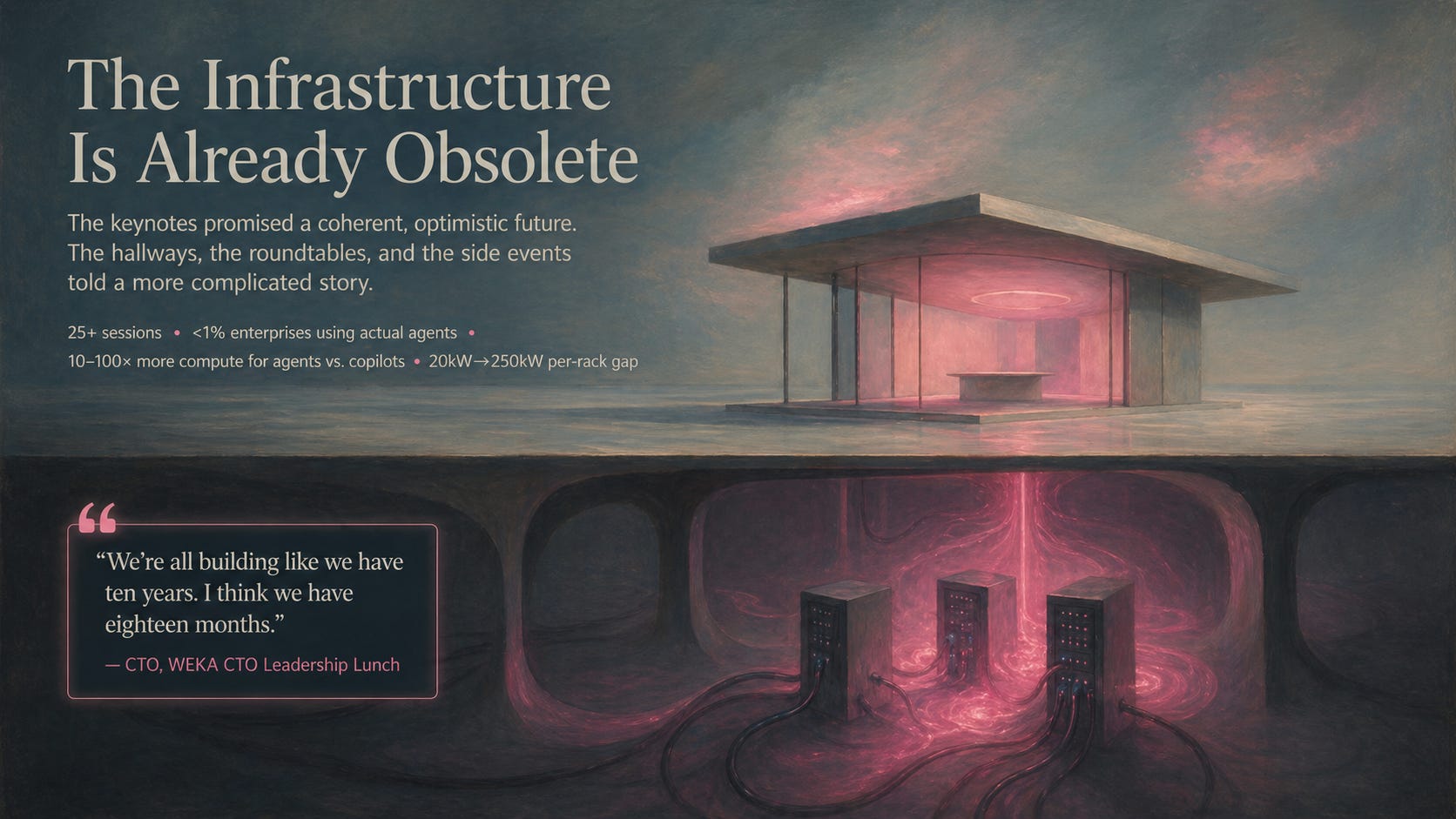
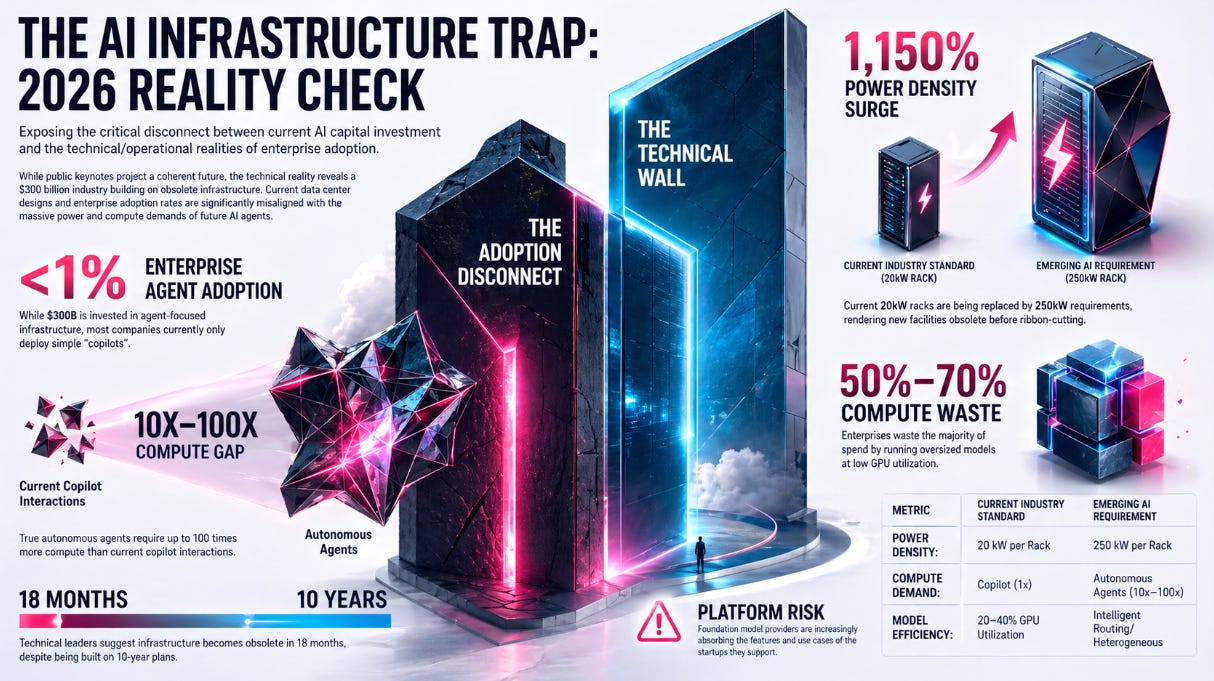
25+ sessions · <1% enterprises using actual agents · 10–100× more compute for agents vs. copilots · 20kW→250kW per-rack gap
“We’re all building like we have ten years. I think we have eighteen months.” — CTO, WEKA CTO Leadership Lunch
After attending more than 200 technology conferences across three decades and four continents, the signals are familiar. There is the moment the agenda becomes irrelevant. The moment when what matters is no longer on stage but between sessions — in the hallways, the lunches, the evening receptions where people say what they actually think.
At HumanX 2026 at Moscone Center in San Francisco, that moment arrived approximately forty-five minutes into Day One.
THE FIVE-LAYER FRAMEWORK — AND WHAT IT LEAVES OUT
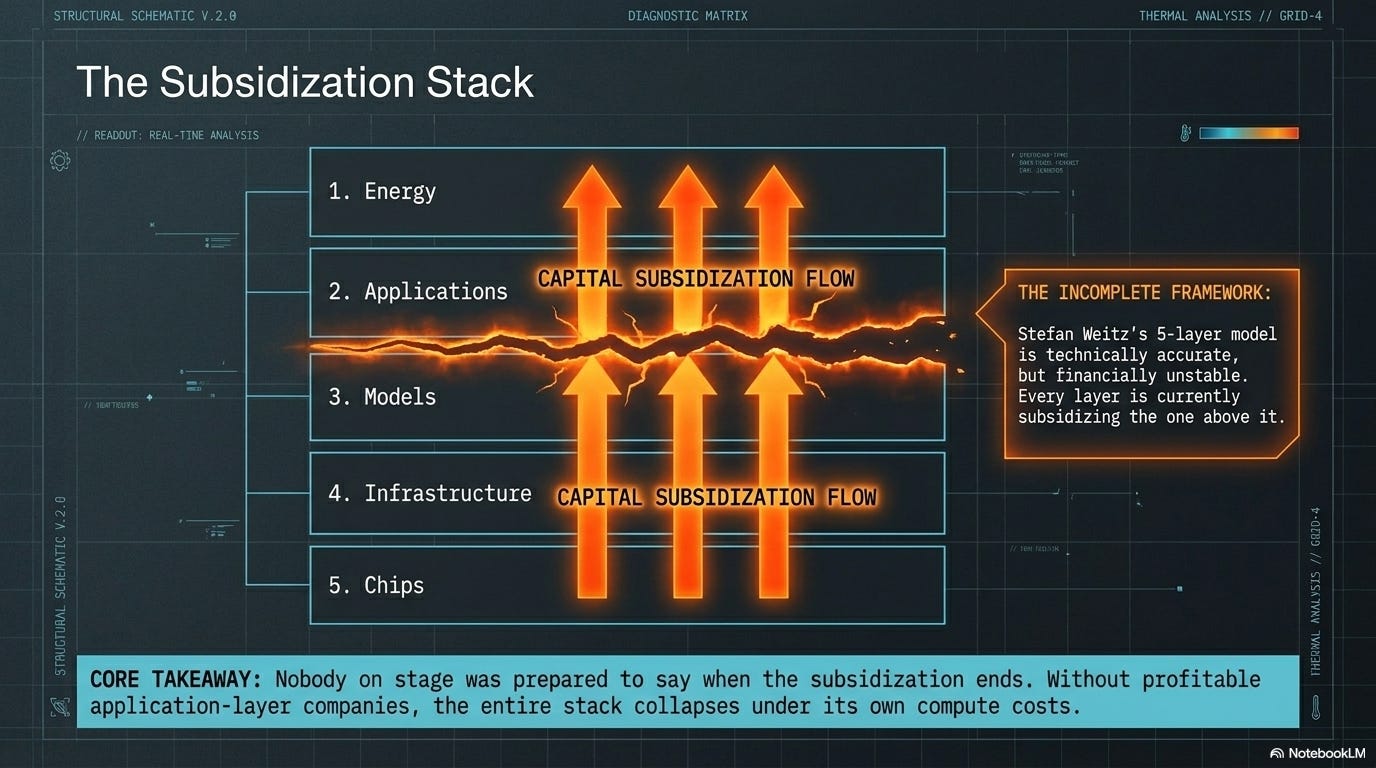
Stefan Weitz opened the conference with a framework organizing the AI industry into five layers: Chips, Infrastructure, Models, Applications, and Energy. NVIDIA was in the room. Fei-Fei Li was on stage. Al Gore appeared. The Kaleidoscope theater was at capacity. The framework was clean, well-structured, and broadly accurate.
It was also incomplete in one critical respect: every layer in that stack is currently subsidizing the one above it, and nobody on stage that morning was prepared to say when the subsidization ends.
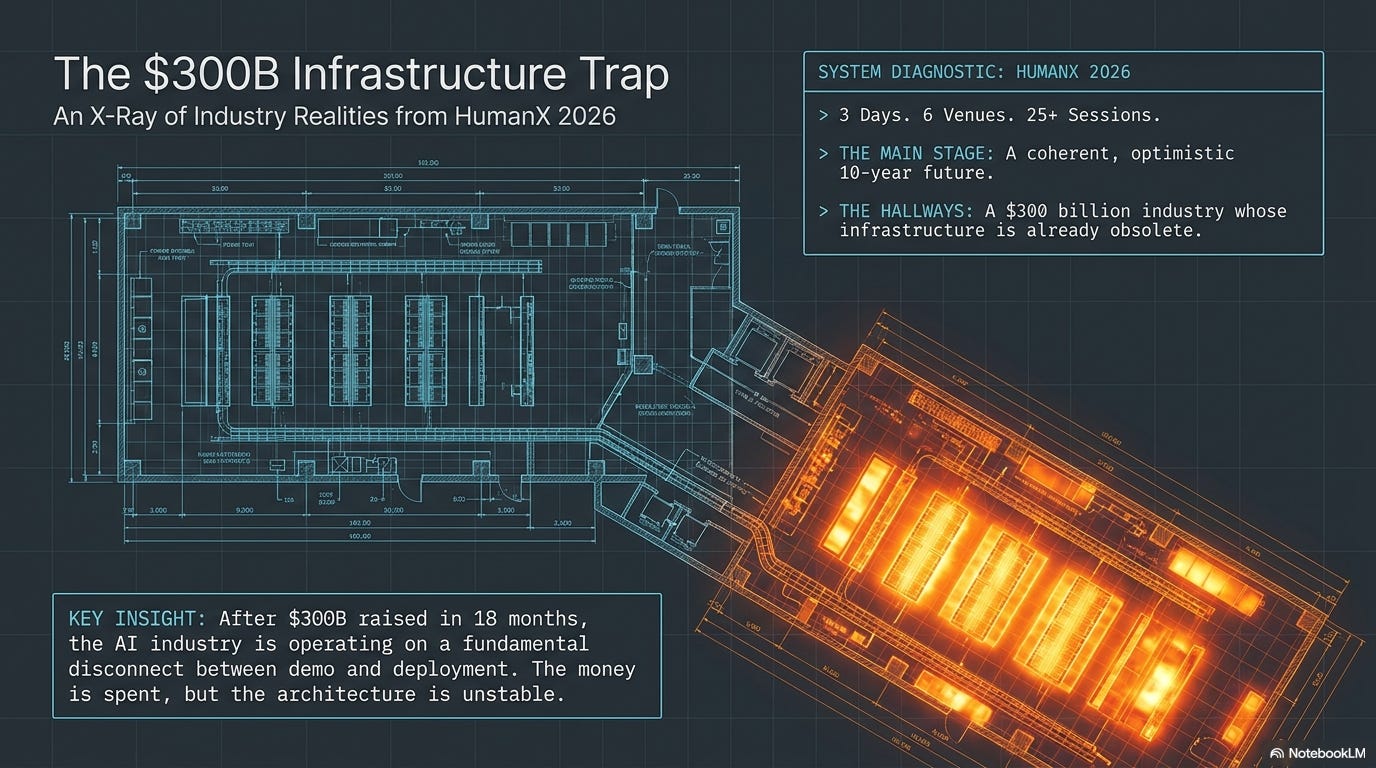
THREE DAYS, SIX VENUES, ONE PATTERN
Over three days at Moscone Center, I covered more than 25 sessions across the Kaleidoscope theater, the Grove, the Loop, the Pitch Deck showcase, and the Agentic AI Pavilion. I also attended six side events: the PwC “Scaling Smart” reception, the AI Collective investor session, the WEKA CTO Leadership Lunch, the LiveKit Voice AI Happy Hour, and the After Dark party at San Francisco City Hall.
The on-stage narrative across all of it was coherent and directionally consistent: AI is transforming every industry, the infrastructure is scaling to meet demand, the applications are arriving, and the capital is positioned correctly. The hallway narrative was different.
THE DISCONNECT BETWEEN DEMO AND DEPLOYMENT
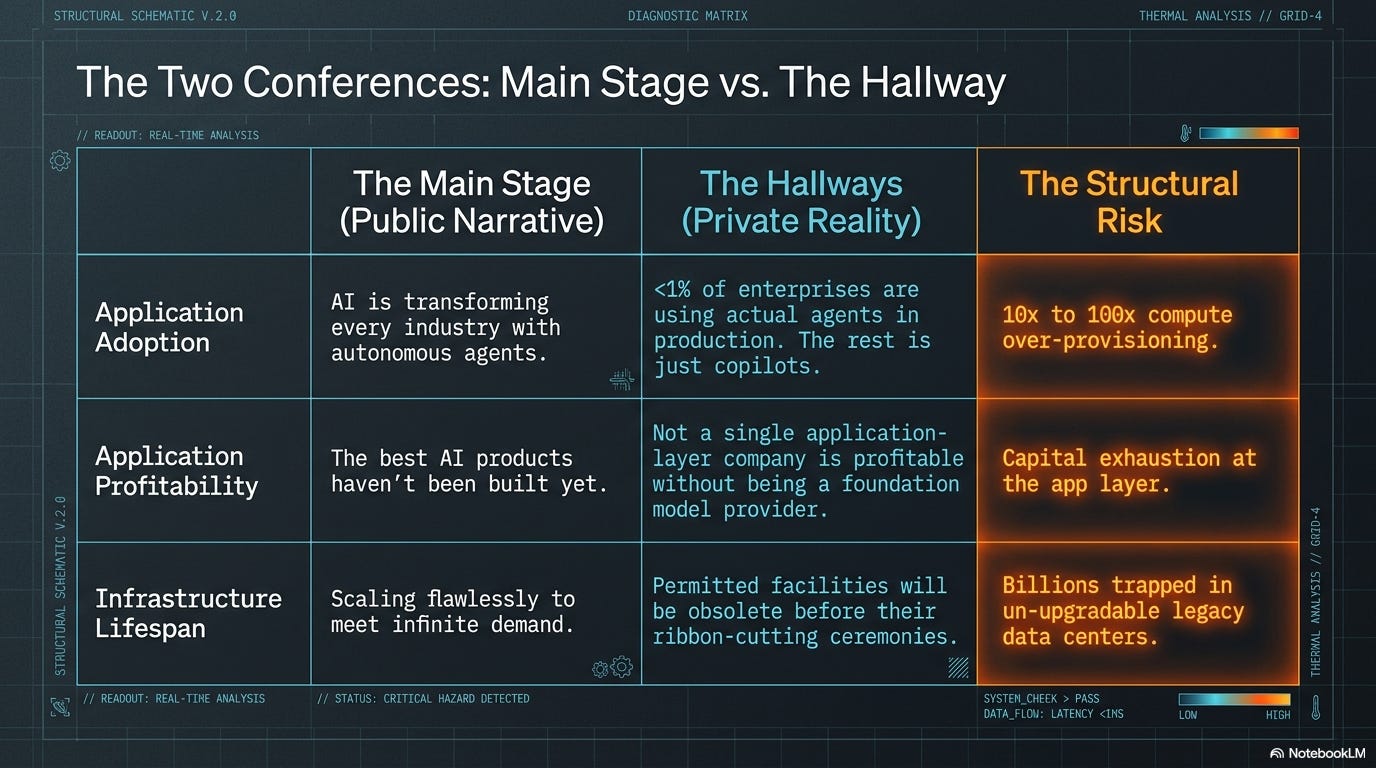
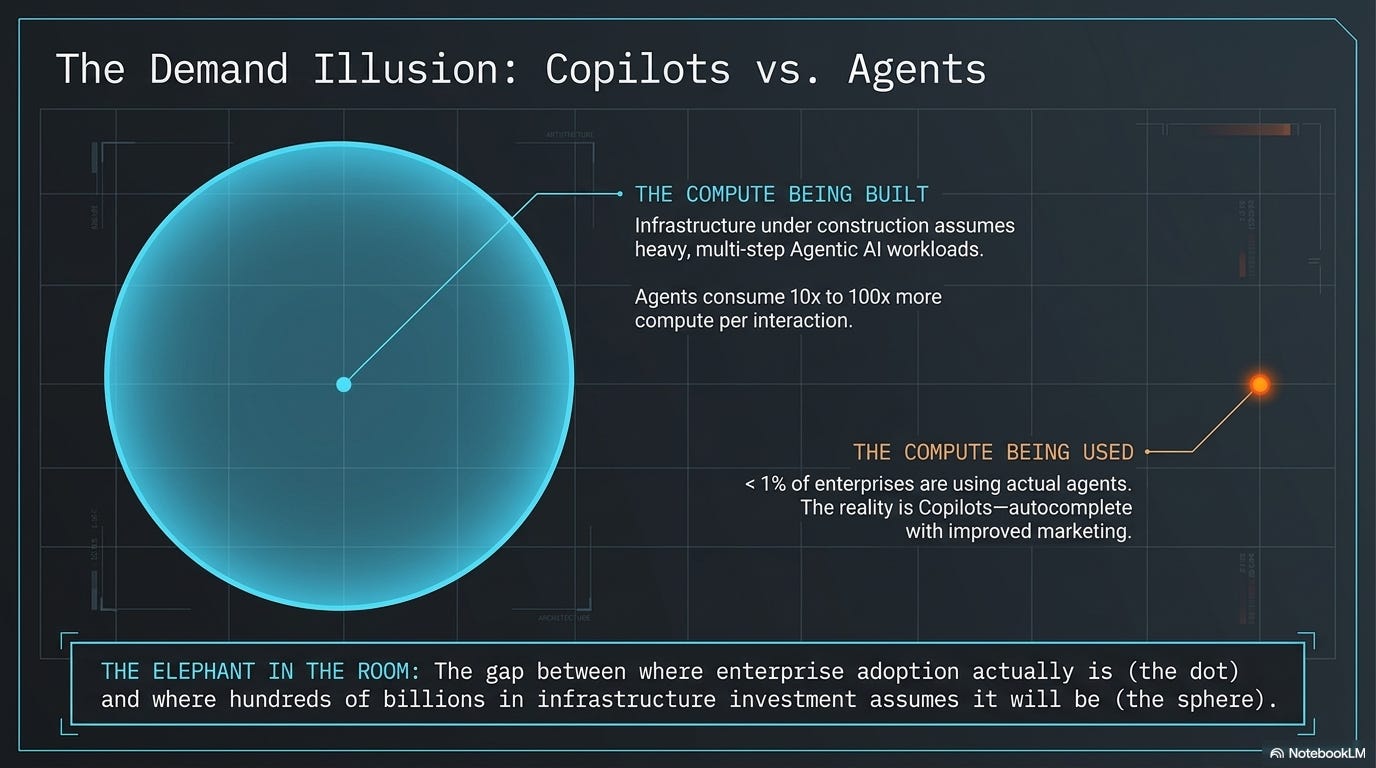
The most-cited figure in private conversation at HumanX 2026 was never spoken from any main stage: less than 1% of companies are currently using actual AI agents in production. What the industry is largely running is copilots. Autocomplete with improved marketing and a larger model behind it.
This matters structurally because agents — the use case that the entire infrastructure investment cycle is premised on — consume 10 to 100 times more compute than copilot interactions. The gap between where enterprise adoption actually is and where hundreds of billions in infrastructure investment assumes it will be is the elephant in every room at Moscone Center. It was not on any slide.
MIKE KRIEGER’S FRAMING — AND ITS CONVENIENT TIMING
Mike Krieger — the Instagram co-founder now leading Anthropic Labs — declared from the main stage that “the best AI products haven’t been built yet.” Coming from the architect of one of the most successful consumer products in history, the observation carries genuine authority.
But after more than 110 company launches, “haven’t been built yet” is also a convenient framing for an industry that has raised over $300 billion in eighteen months and still cannot point to a single application-layer company that is profitable without being a foundation model provider. The best products haven’t been built yet — but the money has already been spent.
THE ROUNDTABLE THAT SAID THE QUIET PART
The most direct conversation at HumanX 2026 did not happen in any main theater. It happened at the WEKA CTO Leadership Lunch, in a room of technical leaders without an audience.
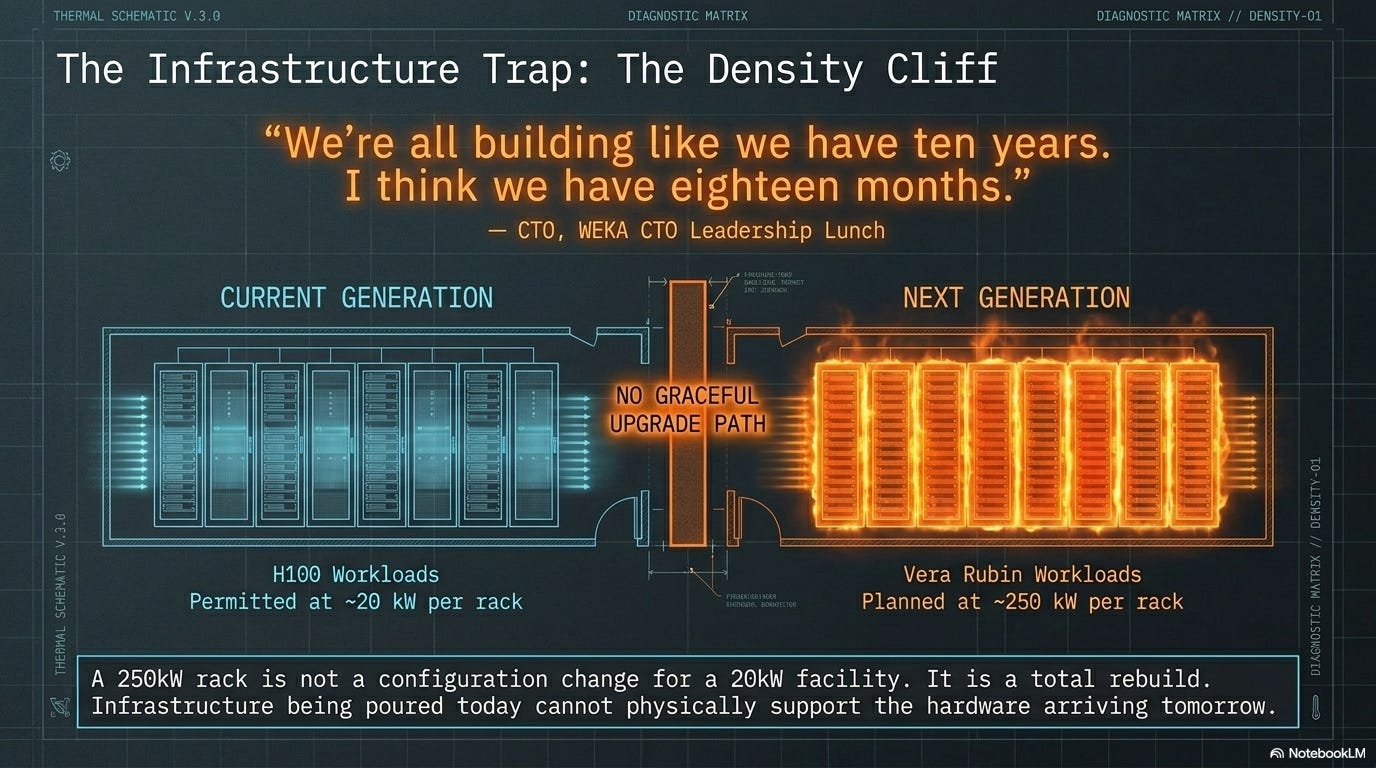
A CTO leaned over and offered the observation that has since become a useful frame for the entire conference: “We’re all building like we have ten years. I think we have eighteen months.”
He was not talking about AI capability timelines or model development cycles. He was talking about data center infrastructure. Today’s facilities are being designed and permitted for H100-generation workloads — at approximately 20 kilowatts per rack. Vera Rubin racks, already in deployment planning at major hyperscalers, run at 250 kilowatts per rack. By the time today’s facilities go live, the workloads they were designed for will have been superseded by a generation of hardware they cannot support.
The facilities being permitted and poured today will be technically obsolete before their ribbon-cutting ceremonies.
YOUR AI BILL IS TOO HIGH — AND YOUR MODEL IS TOO DUMB
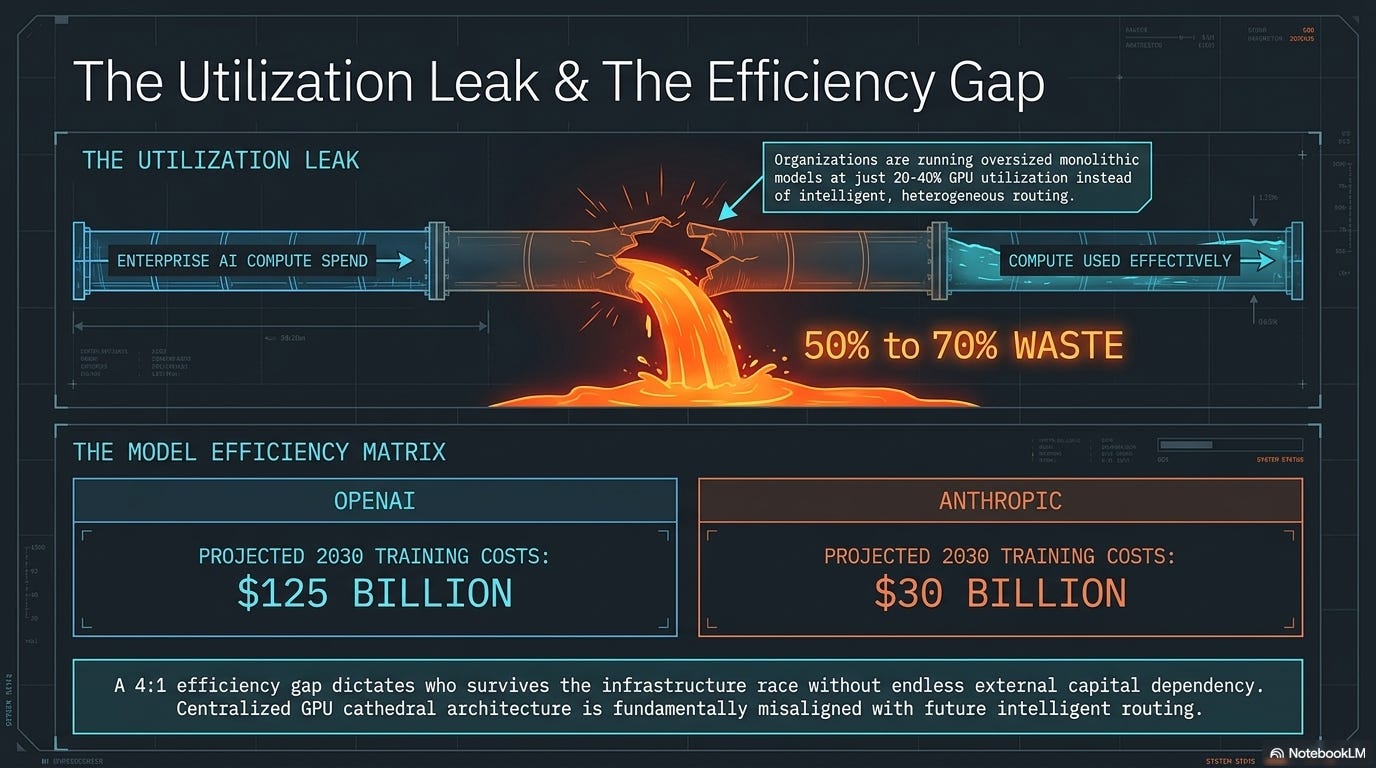
Jared Quincy Davis from Mithril ran a roundtable session that was, by multiple accounts, the most practically useful forty minutes at the conference. His thesis: 50 to 70% of enterprise AI compute spending is waste. Organizations are running oversized models at 20 to 40% GPU utilization on tasks that smaller, purpose-built systems could handle at a fraction of the cost.
The implication for infrastructure investment is direct. If the trajectory of enterprise AI is toward smarter heterogeneous workloads with intelligent routing — not toward bigger monolithic GPU farms — then the centralized cathedral model of data center construction is the wrong architecture. The density revolution reinforces this: infrastructure built for 20-kilowatt racks has no graceful upgrade path to 250-kilowatt requirements. It is not a configuration change. It is a rebuild.
This connects to the wider capital allocation question. OpenAI projects $125 billion in annual training costs by 2030. Anthropic’s current figure is approximately $30 billion. A four-to-one efficiency gap, if it persists, is not a detail. It determines which company can sustain the infrastructure race without external capital dependency.
THE PITCH DECK THEATER AND THE SLIDE NOBODY MADE
The Pitch Deck showcase ran ten startup presentations in a single hour: Impala, NiCE, BrandPal, Type 1 Compute, Visualize AI, AMD, StackOne, Regal, and Optimaze. Each pitch was crisp and technically credible. Each referenced a total addressable market north of $50 billion.
Not one included a slide addressing what happens when the foundation model provider they depend on decides to natively integrate their exact use case — a capability already visible in the Claude Code feature flags exposed in the March npm leak, and already in execution with Anthropic’s cutoff of third-party tool OpenClaw the week before the conference.
After reviewing more than 3,000 pitch decks across a career, the missing slide is the same in every cycle. The missing slide is always the platform-risk slide.
THE PARALLEL THAT KEEPS COMING BACK
The AI industry in April 2026 is in precisely the position the telecommunications industry occupied in 1999. The technology is demonstrably real. The infrastructure buildout is underway and physically verifiable. The demand projections are, by any reasonable analysis, directionally correct.
And almost nobody in the room can coherently explain how the value created by all of this gets captured by the people currently spending the money.
Railroads changed the world. Railroad investors lost everything. Fiber optic cables now carry virtually all global internet traffic. The companies that laid most of that cable went bankrupt. AI data centers will change the future. The serious question — the one the hallways were asking that the stages were not — is whether the investors writing the checks today will be present to see that future, or whether, as in every infrastructure cycle before this one, the value will ultimately be captured by smaller, faster, more adaptable operators who did not try to build permanent structures in a period of maximum uncertainty.
The railroads changed the world. Railroad investors lost everything. The question is not whether AI data centers will matter. It is whether today’s investors will still be standing when they do.
Sources: HumanX 2026 conference sessions, April 6–9, 2026, Moscone Center, San Francisco. Sessions: Stefan Weitz opening keynote; Mike Krieger “The Next Human-AI Era”; Jared Quincy Davis roundtable “Why Your AI Bill Is Too High (And Your Model Is Too Dumb)”; WEKA CTO Leadership Lunch; PwC Scaling Smart reception; AI Collective investor session; LiveKit Voice AI Happy Hour; After Dark, San Francisco City Hall.
Absolutely love this, Jiri! The behind-the-scenes insights from HumanX are what really spark the fire for innovation. Can't wait to see how we can push the boundaries even further. Let’s keep challenging the status quo and share those untold stories