
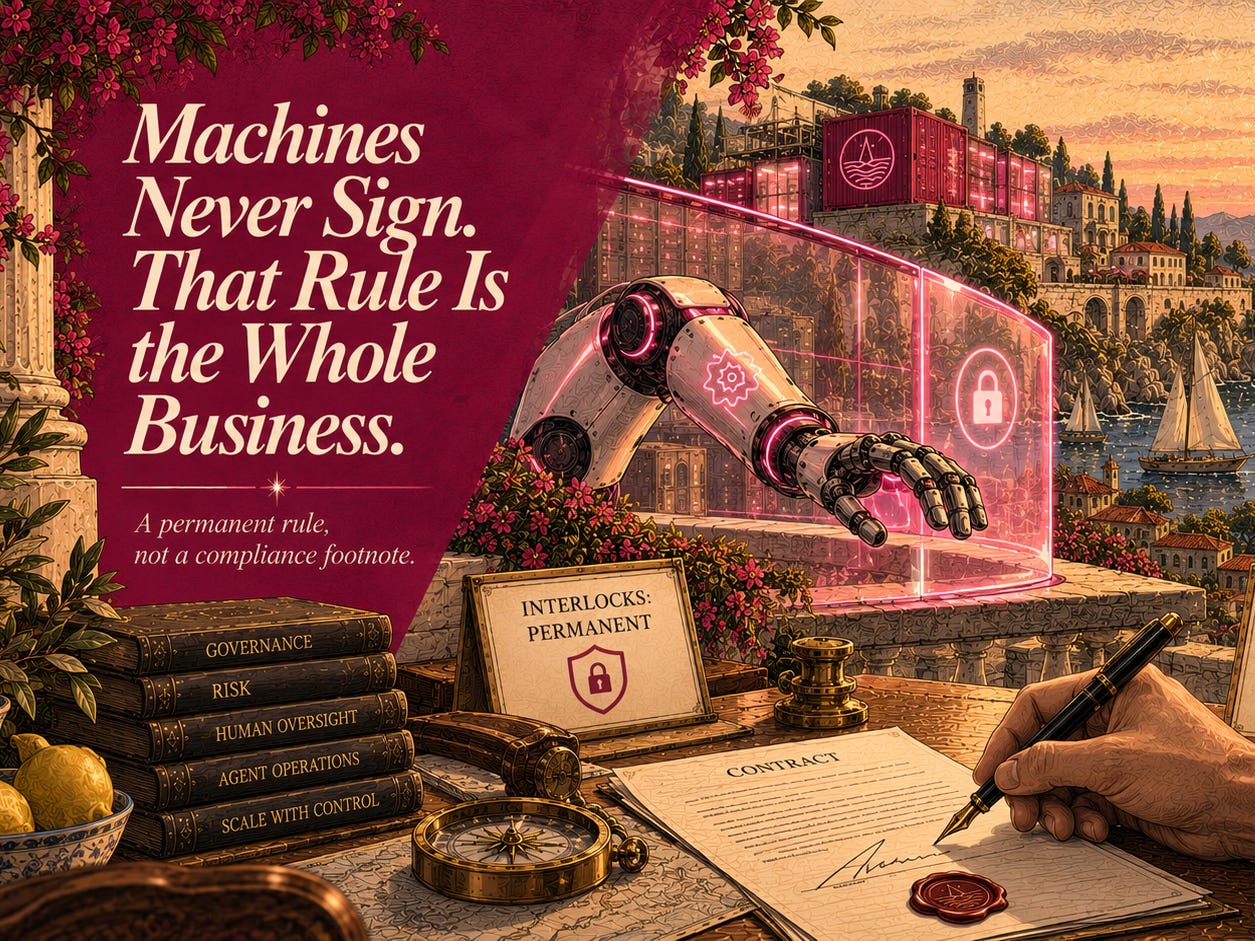
The interesting thing about a permanent rule is what it rules out. “Machines never sign” sounds like a compliance footnote. It’s actually the entire architecture of how this business scales without the trust problem that kills most attempts at running infrastructure with a skeleton crew.
Here’s why that rule can’t be a setting, something a future version toggles off once the agents prove themselves. The moment a machine can sign, move money, or send something outside the company without a human in the loop, you’ve converted a productivity tool into a liability nobody signed up for, and you’ve done it exactly at the moment the fleet has earned the most trust and the least scrutiny. That’s the failure mode this rule exists to prevent, permanently, not provisionally.
Four humans hold the functions that stay human no matter how far the agent fleet advances: money movement, signatures, client relationships, physical witness. Everything else, the reconciliation, the provisioning, the pricing math, the paperwork, is built to be handled by agents that have earned their way up a graded ladder, one gate at a time, with rejection rates and security reviews standing between one level and the next.
That’s not a limitation on how far automation can go in this business. It’s the reason automation can go as far as it has without the whole thing collapsing the first time an agent makes a confident, well-formatted, completely wrong decision with real money attached.
Subscribe for the next piece, or download the market report for the full commissioning-ladder detail.