

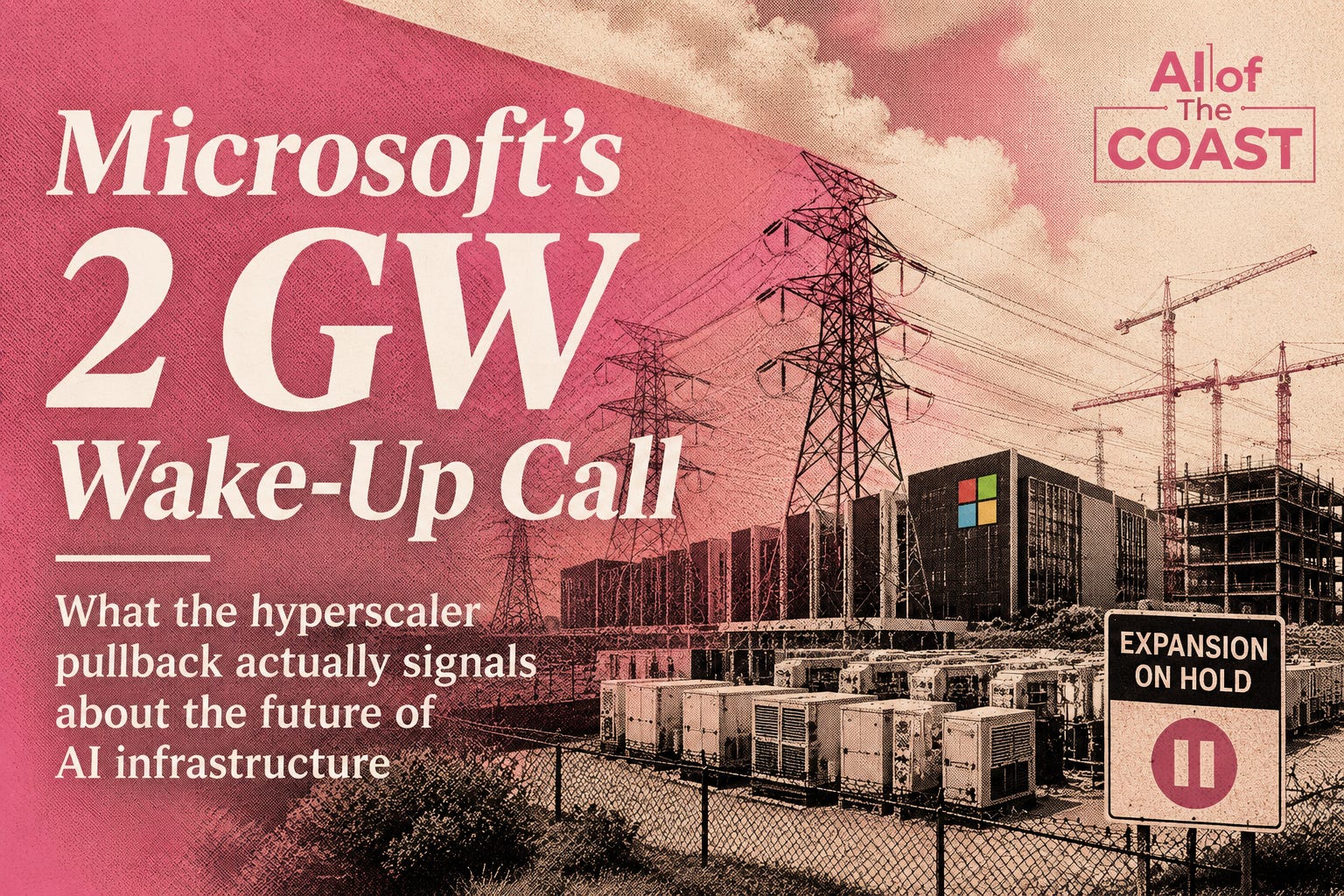
Between late 2024 and March 2025, Microsoft canceled or deferred data center capacity agreements totaling more than 2 gigawatts of planned electricity consumption across the US and Europe. TD Cowen’s analysts discovered this through channel checks and reported it in a series of notes that sent Microsoft’s share price down and sparked widespread debate about AI overcapacity.
Most of the coverage got the story wrong. They framed it as evidence that AI demand was softer than expected — that Microsoft had overbuilt and was pulling back. That framing is superficially plausible but misses the actual signal entirely.
What Actually Happened
Microsoft’s data center cancellations were not primarily about demand being lower than expected. They were about architectural mismatch. The majority of the canceled capacity was associated with training workloads for OpenAI — specifically, facilities that had been planned or commenced before Microsoft’s relationship with OpenAI evolved and before Stargate, OpenAI’s joint venture with SoftBank, was announced with a $100-500 billion commitment to build its own infrastructure.
When OpenAI reduced its dependency on Microsoft Azure for training workloads, Microsoft was left holding capacity commitments for infrastructure that had been designed for a specific purpose — large-scale model training — that no longer needed that capacity. The cancellations were not a demand signal. They were an alignment signal: the demand existed, but it was going to a different piece of infrastructure.
The key distinction: Microsoft didn’t cancel because AI demand fell. It canceled because the specific workloads the canceled capacity was designed for — OpenAI training runs — moved to a different infrastructure provider. Global AI compute demand continued to grow throughout this period. The hyperscale architecture’s rigidity is what created the mismatch.
The Overcapacity Narrative Is Wrong, But the Structural Concern Is Right
Here is where the analysis gets genuinely complicated. Microsoft CEO Satya Nadella acknowledged in early 2025 that “there will be an overbuild” of AI infrastructure. CFO Amy Hood described Microsoft as working from a “capacity-constrained place” with shortages of both power and space. These two statements seem contradictory — overbuild and constraint simultaneously — but they make sense if you understand that different types of capacity are constrained in different ways.
The capacity that is being overbuilt is general-purpose cloud infrastructure optimized for the 2022-2024 workload mix. The capacity that is constrained is high-density AI inference infrastructure optimized for the 2025-2027 workload mix. You can have a massive oversupply of the former and a critical undersupply of the latter simultaneously — and that is approximately the situation the market is in.
“The hyperscale model’s rigidity is not just an engineering problem. It is a capital allocation problem. When you build a cathedral for one liturgy, the sunk cost prevents you from redesigning it for the next one.”
The $80 billion Microsoft committed for 2025 data center spending is real. The demand for AI compute is real. But a significant portion of that capital is going into infrastructure that will be structurally misaligned with the highest-growth segments of AI workload demand by the time it is operational. That is the actual risk — not that AI demand is softer than expected, but that the capital is flowing into the wrong architecture at enormous scale.
What the Pullback Reveals About Infrastructure Flexibility
The 2 GW cancellation reveals something important about the hyperscale model’s fragility: it cannot gracefully absorb demand changes.
When workloads shift — as they inevitably do in a technology transition this rapid — hyperscale operators are left with capacity commitments that cannot be repurposed without significant cost.
The cancel provisions, the lease break clauses, the wasted site preparation — these are the hidden costs of architectural inflexibility.
A modular deployment has a fundamentally different risk profile. If the workload for which a modular facility was designed changes, the modular units can be repurposed or redeployed with significantly less sunk cost.
This is not a marginal advantage. In a technology environment where workload requirements are shifting every 12-18 months, the ability to adapt without stranding capital is a structural competitive advantage.
The Microsoft pullback is the clearest evidence yet that the hyperscale model’s rigidity is not just an engineering constraint but a financial one.
Two gigawatts of canceled capacity represents billions of dollars in projects that were committed, designed, and in some cases begun before the demand signal changed.
The operators who avoid that scenario — by maintaining flexibility at the infrastructure layer — will compound capital more effectively over the AI infrastructure build cycle.
The market read this as a demand signal. It was actually a flexibility signal. And the implication is exactly the opposite of what the bearish coverage suggested: the demand is there, and growing.
The architecture that can actually capture it — modular, flexible, energy-first — is the one that needs to be built.