


The electrical grid was designed in an era of predictable consumption — factories that drew power in stable, foreseeable rhythms, neighborhoods whose demand peaked at 6pm and subsided by midnight, industrial loads that could be modeled on spreadsheets by engineers drinking bad coffee in 1960s utility offices. The grid is a consensus machine. It balances supply and demand across thousands of nodes simultaneously by relying on the accumulated statistical regularity of human behavior.
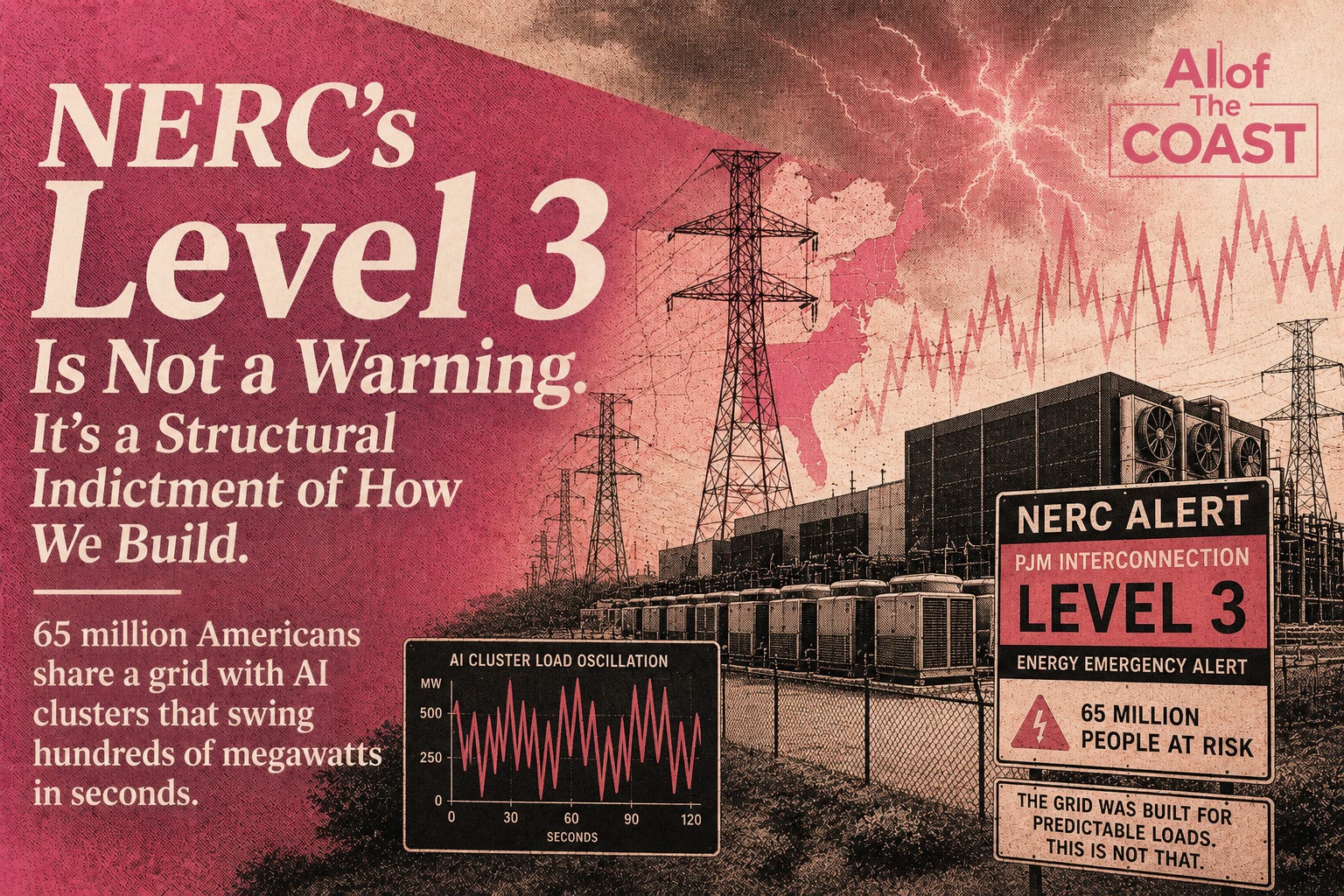
AI training clusters are the opposite of this. They are chaos injected directly into the consensus machine. A frontier model training run can swing from near-zero to hundreds of megawatts in seconds when a job launches, then collapse back just as suddenly when a checkpoint is reached. The grid’s balancing mechanisms, built for the rhythms of steel mills and suburban dishwashers, have no analog for this.
NERC issued a Level 3 — their highest — for the PJM Interconnection. 65 million Americans. The charge is not that data centers use too much power. It is that they use it in ways the grid’s architecture was never built to survive.
NERC issued a Level 2 last year. The industry issued some reports, convened some panels, and kept building larger clusters in more concentrated geographic locations in the same handful of corridors that have been drawing data center investment since the 1990s. The Level 3 is the watchdog’s way of saying: the conversation phase is over. Summer is coming to the Mid-Atlantic. The first serious heat wave will coincide with data center load spikes and residential cooling demand simultaneously. Sixty-five million people share a grid with the machines.
The centralized model’s grid problem is not an engineering problem that can be engineered away within the centralized model. It is a concentration problem. When you put 500 megawatts of demand in a single location and it oscillates, the shock radiates outward through the grid at the speed of physics. The larger the concentration, the larger the shock. The more concentrated the buildout, the more severe the instability. This is not a fixable bug in the hyperscale architecture. It is a structural feature.
The Modular Answer
Distributed modular compute changes the grid physics. A 5MW DDCU deployment oscillating at the edge of a grid node creates a local fluctuation the node can absorb. Ten thousand such deployments distributed across the national grid create statistical regularity — the kind of aggregate load behavior the grid was designed to balance. The centralized model creates single points of grid shock. The modular distributed model creates distributed load that looks, from the grid’s perspective, more like the predictable human behavior it was built to manage. The architecture that doesn’t produce NERC Level 3 alerts is the architecture that doesn’t concentrate hundreds of megawatts in a single swinging load.
Level 3 is a big step. I wonder if the RTOs will make equally big steps and what that will look like. We know what it will look like in ERCOT, and, to some extent, in PJM. What do you think about the others?
The concentration framing is the most underappreciated part of this piece. Most of the policy debate treats this as a capacity problem — "build more generation, build more transmission" — but your point that the oscillation pattern of AI workloads is the real culprit reframes it entirely. More supply doesn't fix a synchronization problem.
One thing I'd push on: is distributed modular compute realistically incentivized under current market structures? Hyperscalers consolidate in PJM corridors partly because of talent density, fiber infrastructure, and interconnect agreements that took decades to build. The grid physics argument for distribution is compelling — but what's the forcing function that actually gets operators to build at the edge instead of in the same five counties in Virginia? Regulation, insurance pricing, or something else?