

In the iconography of the AI economy, the sacred objects are always the same — the model, the GPU, the training run, the benchmark score — while the substrate that makes any of it possible remains invisible until it fails catastrophically, at which point it becomes a congressional hearing topic and everyone acts surprised. The industry has a talent for amnesia about its own foundations.
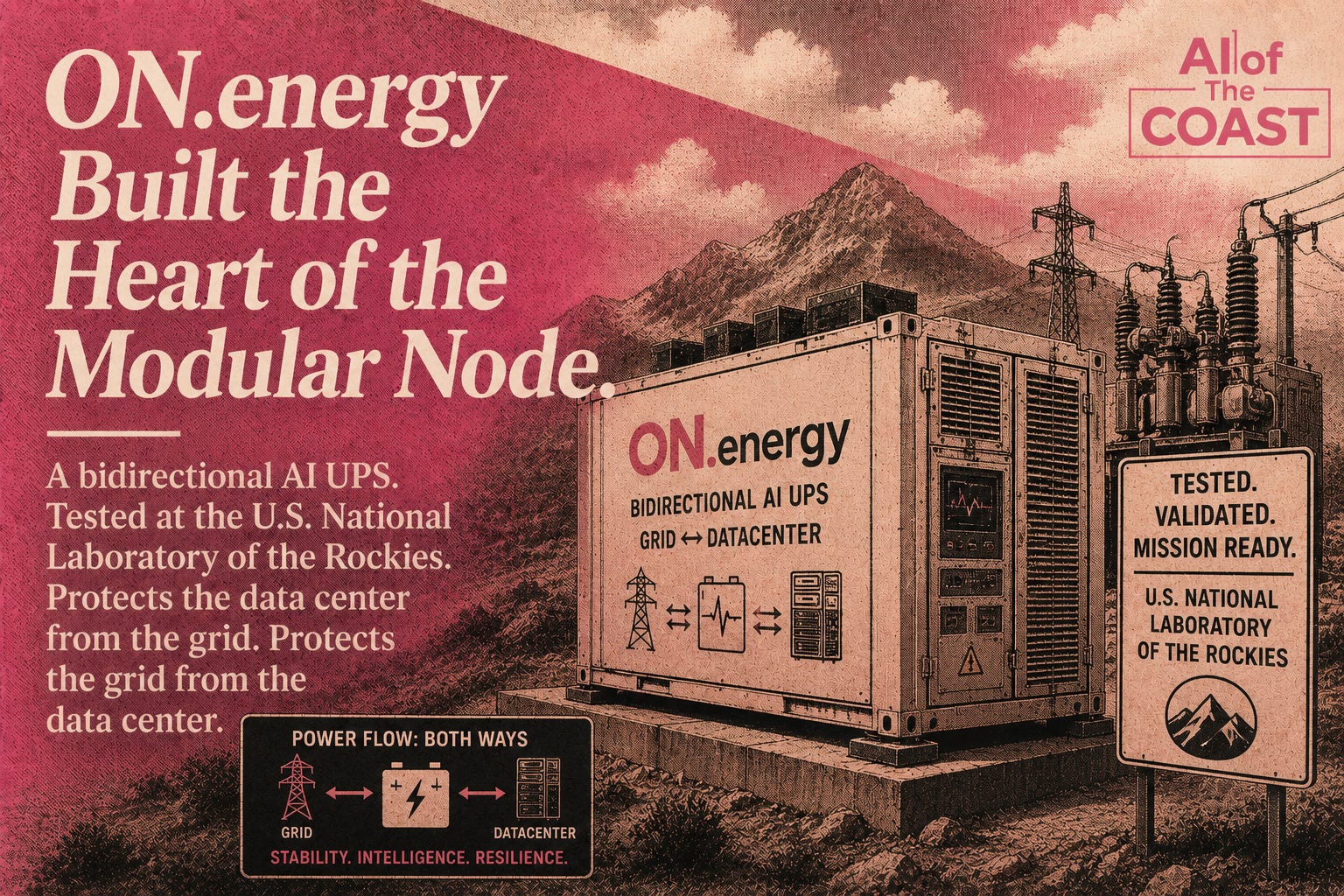
ON.energy built something that should not be invisible. Their bidirectional AI UPS — a power conditioning system that sits between a data center and its grid connection — passed every stress test at the U.S. National Laboratory of the Rockies. The system protects the data center from grid instability. It also, and this is the directionally important part, protects the grid from the data center’s own oscillating demand. Bidirectional. The buffer between two chaotic systems that are currently sharing a wire and not getting along.
NERC issued a Level 3 grid alert for the same problem this technology solves — in the same week it passed its national lab tests. Timing is not coincidence. It is the market screaming at builders who are listening.
The industry’s instinct is to dismiss this as table-stakes infrastructure — a UPS is a UPS, we’ve had those for decades. That instinct is wrong and getting more expensive to maintain. The legacy UPS was a one-directional emergency backup: when the grid goes dark, the battery bridges the gap. The AI UPS is a continuous active intelligence layer: monitoring both sides, absorbing shocks in both directions, converting the chaos of frontier training workloads into signals the grid can survive. Different category. Different stakes.
I have funded infrastructure-adjacent companies through three market cycles. The picks-and-shovels play is always invisible during the gold rush and structurally unavoidable during the normalization. Grid buffers and bidirectional power conditioning are this cycle’s unglamorous essential. The companies building them are not receiving $3 billion seed rounds. They will matter more than many that are.
The Modular Answer
ON.energy’s AI UPS is not just a grid stability tool. It is the embedded intelligence layer that makes autonomous modular compute deployments viable at the edge. A DDCU deployed at an industrial site, a logistics hub, or a rural carrier facility cannot rely on the grid tolerance that a Virginia data center corridor campus takes for granted. It needs active power intelligence embedded in the unit — managing its own relationship with the local grid, absorbing local instabilities, presenting a stable demand profile to the utility. The bidirectional AI UPS is the nervous system of the autonomous modular node. ON.energy may not know they’re building the infrastructure layer for a distributed compute future. But they are.