


I predicted a market correction. It hasn't fully arrived. So how do I grade a prediction whose payoff is still pending? Honestly: by showing you that every precondition I named is now in place, and letting you judge the timing for yourself.
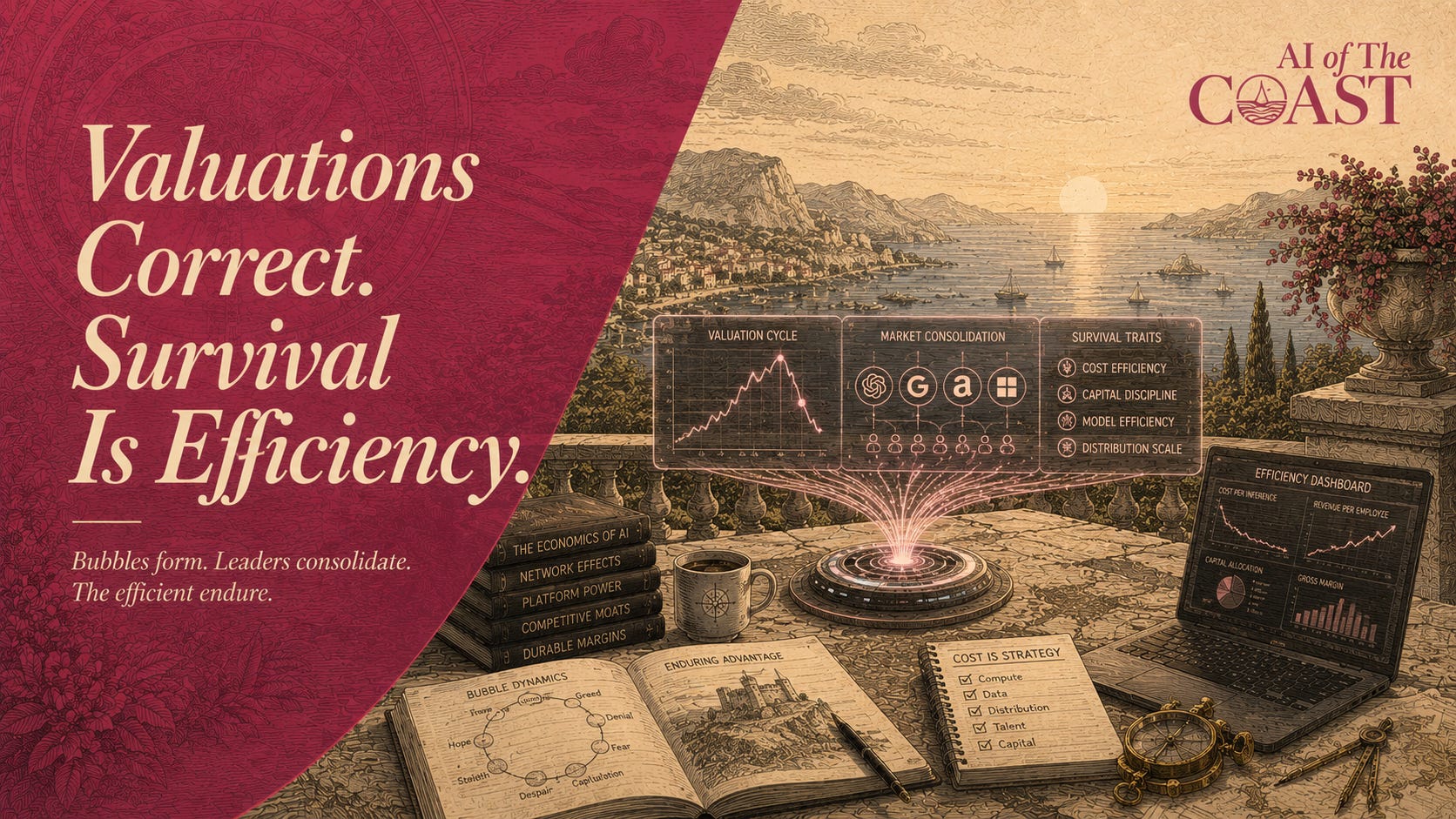
Prediction ten: runaway valuations could trigger a market correction; high-burn startups get forced to consolidate or fold; a handful of players dominate foundational models as an oligopoly; lean, cost-efficient, specialized vendors survive and thrive through any correction. My favorite spin-off was the 'AI Application Powerhouse' — an app-store-style meta-layer aggregating AI tools.
The oligopoly: confirmed and entrenched
The foundation-model oligopoly I predicted is now simply the structure of the industry. OpenAI, Anthropic, Google at the frontier; a tight cluster of hyperscalers controlling the compute they run on.
Anthropic crossed $30B annualized revenue by April 2026; OpenAI around $24B. The capital required to play at the frontier — OpenAI's reported $1.4 trillion in multi-year compute commitments — is itself the moat that keeps the oligopoly closed.
Exactly as predicted: a handful of players who can afford the massive models dominate and shape pricing.
The correction: every precondition present, trigger still pending
Here's the careful part. I predicted a correction was possible. As of May 2026, the bubble debate has gone fully mainstream — and the specific mechanism analysts now fixate on is the one I'd have flagged: circular financing.
Look at the web that Bloomberg, INSEAD, and GMO are all now diagramming: Nvidia invests up to $100B in OpenAI, which spends it largely on Nvidia chips. Microsoft owns ~27% of OpenAI and is its primary cloud provider. OpenAI took a stake in AMD while AMD takes OpenAI orders. Nvidia holds part of CoreWeave and guarantees CoreWeave's unsold capacity. GMO calls it 'reminiscent of the circular financing of the internet bubble.' Even Sam Altman has said 'someone is going to lose a phenomenal amount of money.'
$1.4T — OpenAI's reported multi-year compute commitment
~$13B — OpenAI 2025 revenue against that commitment
95% — of enterprises reporting zero measurable return on genAI investment (MIT Media Lab)
$5T+ — Nvidia valuation peak, October 2025
And the demand-side warning is just as loud: an MIT Media Lab report found that despite $30-40 billion in enterprise genAI investment, 95% of organizations reported zero measurable return. That's the gap between deployment and value that breaks investment theses. I'm not calling the exact week of a correction — anyone who does is guessing. But every structural precondition I named in January 2025 is now visibly in place, and the mainstream financial press is naming them too.

Cost-efficiency as survival: validated by DeepSeek
My claim that cost-efficiency would be the survival trait got its proof point in DeepSeek — frontier-ish performance at a fraction of the cost, which repriced the entire conversation about what a model 'should' cost to train and run. The lean, efficiency-focused players didn't just survive; they forced the giants to defend their economics. As I keep saying: when oil becomes a commodity, Exxon still makes money — but not at 21x revenue multiples. The model layer is commoditizing, and the premium is the thing at risk, not the market.
The 'AI Application Powerhouse': partially built
My app-store-meta-layer concept partially materialized — aggregators and platforms bundling AI tools emerged, and the 'one-stop AI platform' is a recognized category. But no single dominant 'AI app store' claimed the aggregator crown the way I floated. The meta-layer is fragmented, not consolidated. Partial credit on the spin-off, full credit on the structural prediction.
The next 12 months: the trigger, or the grind
My forecast for May 2027: either a visible correction hits — most likely triggered by one high-burn AI company failing to refinance and forcing a repricing through the circular-financing loops — or the market grinds higher on the argument that, unlike 1999, these firms have real revenue and real cash flow (Morgan Stanley notes corporate cash flow is triple its 1999 level).
I lean toward a sharp, sector-specific repricing rather than a broad collapse, concentrated in the app-layer companies with no profitability and the infrastructure plays with stranded assets.
Watch the refinancing calendar, not the stock charts. The AI startups with enormous burn must refinance within the next couple of years, and lenders will finally demand revenue proof.
The moment one can't, the circular loops around Nvidia, OpenAI, and CoreWeave start to unwind — and unwinding is faster than building. That's the trigger I'd watch through 2027.
Grade: hit on structure, pending on timing. I told you the conditions for a correction in January 2025. The conditions are all here now. The only thing missing is the match.
Sources: original forecast (Jan 6 2025); Bloomberg AI circular-deals analysis (Mar 2026); INSEAD 'Are We in an AI Bubble?' (Feb 2026); GMO via Medium analysis (Mar 2026); MIT Media Lab enterprise-genAI return study; DeepSeek cost reporting; Anthropic/OpenAI revenue figures 2026; Morgan Stanley cash-flow comparison.