


This prediction has a bonus feature: the way it failed in one place proved the part I got right in another.
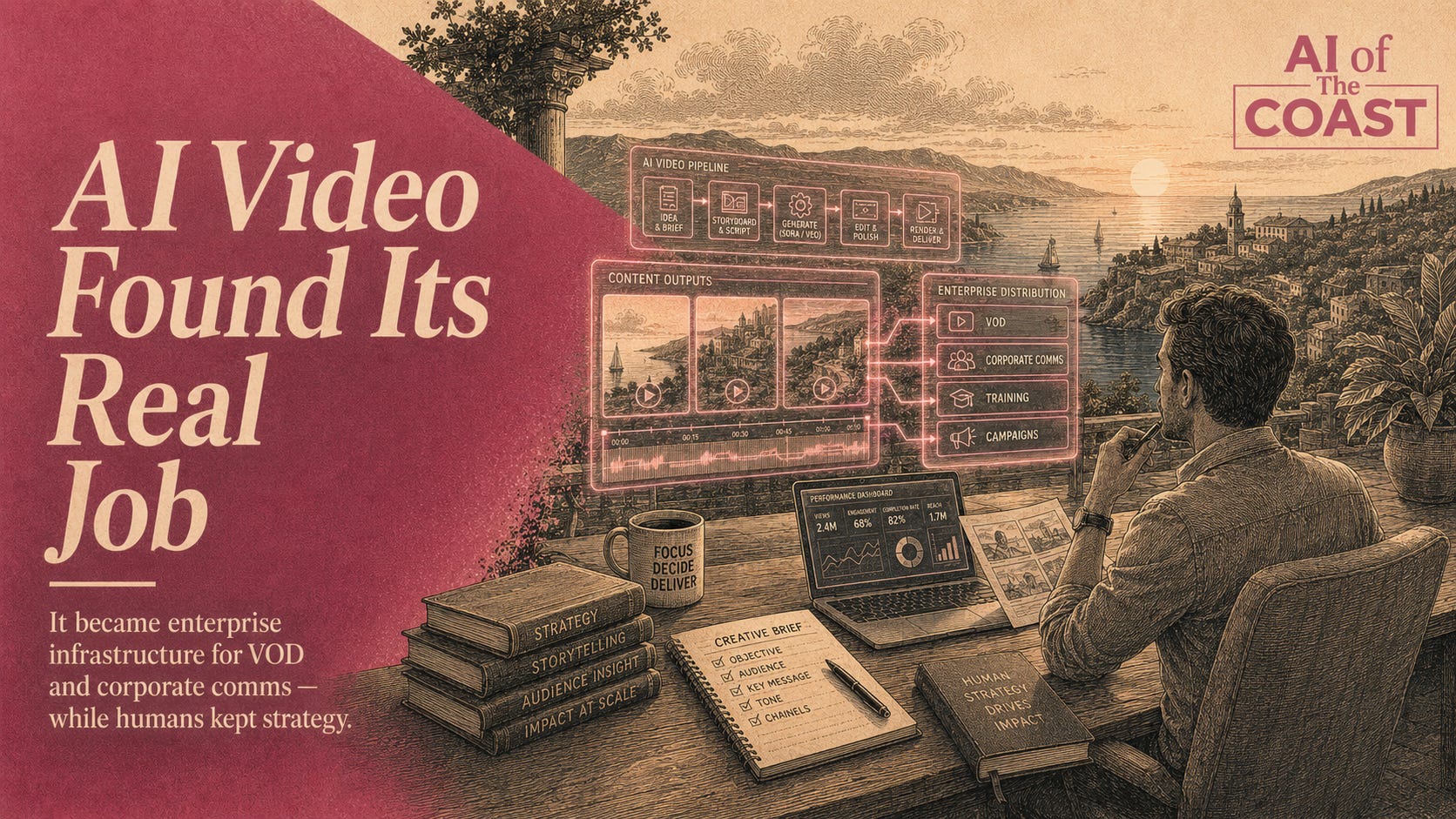
Prediction eleven: VOD services harness AI for scriptwriting and animated character design; enterprises adopt AI agents for timely commercial and consumer-facing media; human creators retain creative oversight and strategic messaging.
My favorite spin-off was the 'Personalized Echo Chamber' — AI-driven, human-approved 'internal TV stations' for corporations and 'aligned broadcast networks' for political entities, with explicit warnings about misinformation and reinforcement.
AI video became enterprise infrastructure — fast
By early 2026, AI video generation crossed from novelty to production tool.
Google's Veo 3 generating 4K clips up to 60 seconds with native audio. Sora 2 holding character and scene continuity across shots.
Runway, Kling, Synthesia, HeyGen — the latter shipping synthetic presenters in 175+ languages with native lip-sync. Studios are cutting production costs 70-90%. The dominant use cases are exactly the ones I named: corporate training, onboarding, product demos, marketing, internal communications.
Enterprises adopting AI for commercial and consumer-facing media — that was the prediction, and it's now the default workflow.
Crucially, the market positioned itself precisely along my 'humans keep strategy' line. The 2026 consensus on AI video tools is that they produce a usable first draft, and humans handle brand alignment, emotional resonance, and final approval.
The tools got reframed from 'type a prompt, get a finished video' (the 2024 fantasy) toward editability — storyboard, remix, recut, human-in-the-loop.
That's my January 2025 framing almost verbatim: AI handles the grunt work, humans ensure brand alignment and strategic messaging.
The Sora consumer collapse: my caveat, written in blood
Here's the part that delights the forecaster in me. OpenAI's Sora launched as a consumer app and exploded — over 1 million downloads in under five days in late 2025.
Then it cratered.
Downloads fell 32% month-on-month in December 2025, another 45% in January 2026. Cumulative in-app purchase revenue from launch to shutdown: about $2.1 million total, against operating costs estimated near $1 million per day.
OpenAI confirmed the consumer app shuts down April 26, 2026. The Disney partnership collapsed over unsustainable economics. Deepfakes and guardrail-bypassing ran rampant.
Why did the consumer toy fail while enterprise video thrived?
Because the consumer app removed exactly the thing I said had to stay: human strategic oversight.
Unsupervised, prompt-anything video generation produced slop, abuse, and IP nightmares.
The enterprise tools that kept humans on brand alignment and approval — Veo on Vertex AI, Synthesia avatars for corporate content — became durable businesses.
My prediction wasn't just that enterprises would adopt AI video. It was that the human-approval layer was load-bearing. Sora's consumer failure is the cleanest possible proof of that caveat.
70-90% — production cost reduction from AI video tools in 2026
175+ — languages with native lip-sync (HeyGen)
~$2.1M — total Sora consumer in-app revenue vs ~$1M/day cost
Apr 26 2026 — Sora consumer app shutdown date
The Personalized Echo Chamber: arriving, with the dangers I flagged
My 'Personalized Echo Chamber' concept — organizations running AI-powered internal broadcast networks, with explicit misinformation risk — is materializing as hyper-personalized video at scale and AI-generated corporate/political content.
The provenance and disclosure infrastructure I implied was necessary is now being mandated: most platforms and jurisdictions require AI-content disclosure, and standards like SynthID and C2PA are being deployed. I called both the capability and the need for transparency safeguards. Both arrived.
The next 12 months: the buyer splits three ways
My forecast for May 2027: AI video consolidates around the buyer, not the model — consumer creators in the Gemini/YouTube ecosystem, agencies and tool-builders on programmatic APIs, and enterprise marketing teams on stable, integrated, indemnified platforms like Veo on Vertex.
The 'best model' framing dies; the 'right tool for your buyer and your risk tolerance' framing wins. Benchmark wars between Sora, Veo, and the rest will keep missing the point: these are three different products for three different buyers.
Watch provenance become a purchasing requirement, not a nicety. As deepfake liability and IP exposure mount, enterprises will only buy AI video from vendors who indemnify them and embed verifiable provenance.
The 'human-approved, traceable' layer I described in January 2025 becomes a procurement checkbox. The vendors who treated it as optional get filtered out.
Grade: hit, with a bonus. The adoption call landed, and the one consumer failure of the year — Sora's collapse — was a controlled experiment that proved my human-oversight caveat. Sometimes the market runs your A/B test for you.
Sources: original forecast (Jan 6 2025); Veo 3 / Sora 2 capability reporting (2026); Constellation Research and digitalapplied on Sora consumer shutdown (Mar-Apr 2026); HeyGen/Synthesia enterprise avatar adoption; SynthID/C2PA provenance standards; AI-content disclosure mandates 2026.
Sora’s consumer flop and enterprise AI video’s quiet takeover are the same story: the model didn’t fail, the go-to-market aimed it at the wrong buyer.