


In January 2025 I closed the forecast predicting healthcare attracts significant AI investment with broad diagnostic and personalized-care adoption, while volatile crypto markets see renewed interest in AI-enhanced blockchain for authenticity and trust. Healthcare delivered loudly; the blockchain-trust angle delivered quietly, reframed around AI provenance.
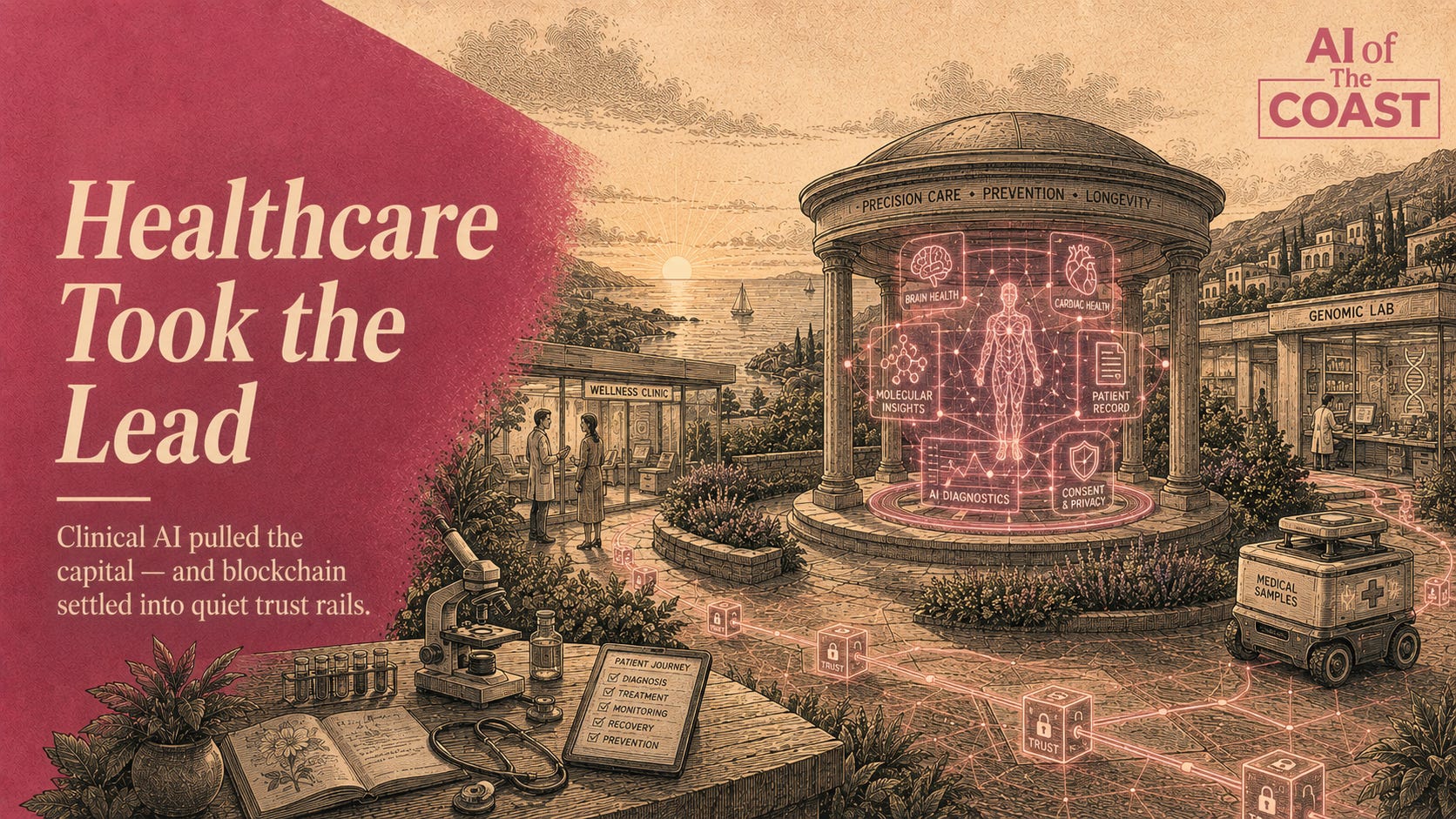
My thirteenth prediction was the 'beyond the hype' grab-bag — healthcare plus the crypto/blockchain trust angle. Closing the forecast, I want to grade it the way I'd grade a portfolio: by which bets paid and which merely held.
Prediction thirteen: healthcare attracts significant AI investment and broad adoption in diagnostics and personalized care; crypto markets stay volatile but AI-enhanced blockchain — for authenticity and trust — sees renewed interest. My favorite spin-offs were a pediatric/parenting 'one-stop' AI assistant and blockchain-AI synergy for verifying outputs like synthetic-media authenticity.
Healthcare: the loud, clear win
Healthcare AI in 2026 is exactly the surge I predicted, and then some. Around 80% of hospitals now use AI in at least one clinical or operational function. The FDA had cleared roughly 1,250-1,300 AI/ML-enabled medical devices by mid-2025, radiology dominant — AI is now the default 'second reader' in diagnostic imaging. The diagnostics, imaging, genomics, and personalized-medicine adoption I named is real and measured.
The regulatory tailwind exceeded my expectations. The US didn't just invest in healthcare AI — it cleared the runway. The FDA's January 6, 2026 guidance relaxed clinical-decision-support device requirements, letting many generative diagnostic tools reach clinics without full premarket sign-off. New federal models — CMS ACCESS, FDA TEMPO Pilot — let selected manufacturers deploy without premarket authorization while covered. The FDA even deployed agentic AI in its own workflows as of December 2025. I predicted significant healthcare investment and adoption. I underestimated how aggressively US policy would accelerate it — which ties directly back to my prediction-2 miss about the US going build-fast rather than precautionary.
~80% — of hospitals using AI in at least one clinical/operational function
~1,250-1,300 — FDA-cleared AI/ML medical devices by 2025
26 — CPT codes for clinical AI as of January 2026
Dec 2025 — FDA deploys agentic AI in its own workflows
My pediatric/parenting 'one-stop AI assistant' spin-off didn't emerge as a single dominant product, but the category — AI-driven personalized health guidance with clinician oversight, ambient AI as 'the shell around the visit' — is exactly where consumer and clinical health tech converged. Right category, no single breakout name. Partial credit on the spin-off, full credit on the structural call.
The blockchain-trust angle: quieter, and reframed as provenance
Here's the nuanced grade. I predicted AI-enhanced blockchain would find renewed interest specifically for authenticity and trust — verifying outputs, fighting synthetic-media fraud. The literal 'blockchain' framing got quieter in 2025-2026 as crypto did its usual volatility dance. But the underlying need I identified — cryptographic verification of authenticity in an AI-saturated world — became one of the most important problems in tech, just under different branding.
Content provenance and authenticity verification — SynthID, C2PA, and the disclosure mandates now rolling out across jurisdictions — are precisely the 'AI-enhanced trust and authenticity' use case I flagged, addressing exactly the synthetic-media-verification problem I named. Separately, the agent-to-agent payment rails (prediction 3) are where crypto's machine-commerce thesis actually found traction. So the trust-and-authenticity need I predicted is real and growing; it just expressed itself as provenance standards and machine-payment protocols more than as headline 'blockchain' products. I had the need right and the label slightly dated.
The next 12 months: healthcare agentic care and provenance-by-default
My forecast for May 2027: healthcare AI crosses from documentation and diagnostics into agentic care — autonomous AI agents drafting personalized interventions and care adjustments for physician review, not just flagging data. The FDA's own agentic deployment and the ACCESS/TEMPO frameworks are the leading indicators. The bottleneck shifts from 'can AI do it' to reimbursement and liability — who pays, and who's responsible when an agent's care suggestion is wrong. Watch the CPT codes and Medicare benefit-category fights; that's where healthcare AI's 2027 economics get decided.
On the trust side: provenance becomes default infrastructure. As AI-generated content saturates everything, verifiable authenticity stops being optional and becomes a baseline requirement — embedded in cameras, platforms, and enterprise content pipelines. The 'AI-enhanced trust' need I named in January 2025 matures into invisible plumbing, the way HTTPS did. Whether the verification layer runs on a blockchain or a simpler cryptographic standard matters less than that it exists everywhere.
Closing the scorecard
Thirteen predictions, seventeen months, one honest reckoning. The headline: I was substantially right on the structural calls — narrow-AI-not-AGI, agent swarms, the one-person unicorn, humanoids as niche labor, the safe-zone autonomous map, energy as the binding constraint, the oligopoly-and-correction setup, AI video adoption, the 90% automation, and the healthcare surge. Where I missed, I missed on mechanism (China's open-source vector, the test-time-compute shift) and on second-order human cost (the disappearing entry-level rung), not on direction.
The forecaster's lesson I'm taking into the next thirteen predictions: getting the direction right is the easy 70%. The hard 30% — and the part that separates a useful forecast from a lucky one — is the mechanism and the second-order consequence. That's where I'll push harder next time. Same beach. Same coast. Sharper pencil.
____________________________________________
Sources: original forecast (Jan 6 2025); FDA AI-device clearance data and Jan 6 2026 clinical-decision-support guidance; CMS ACCESS / FDA TEMPO frameworks; MobiHealthNews and Chief Healthcare Executive 2026 predictions; Bipartisan Policy Center on AI CPT codes; SynthID/C2PA provenance standards; agent-to-agent payment protocols.