
This one I’ll take cleanly. No asterisk.
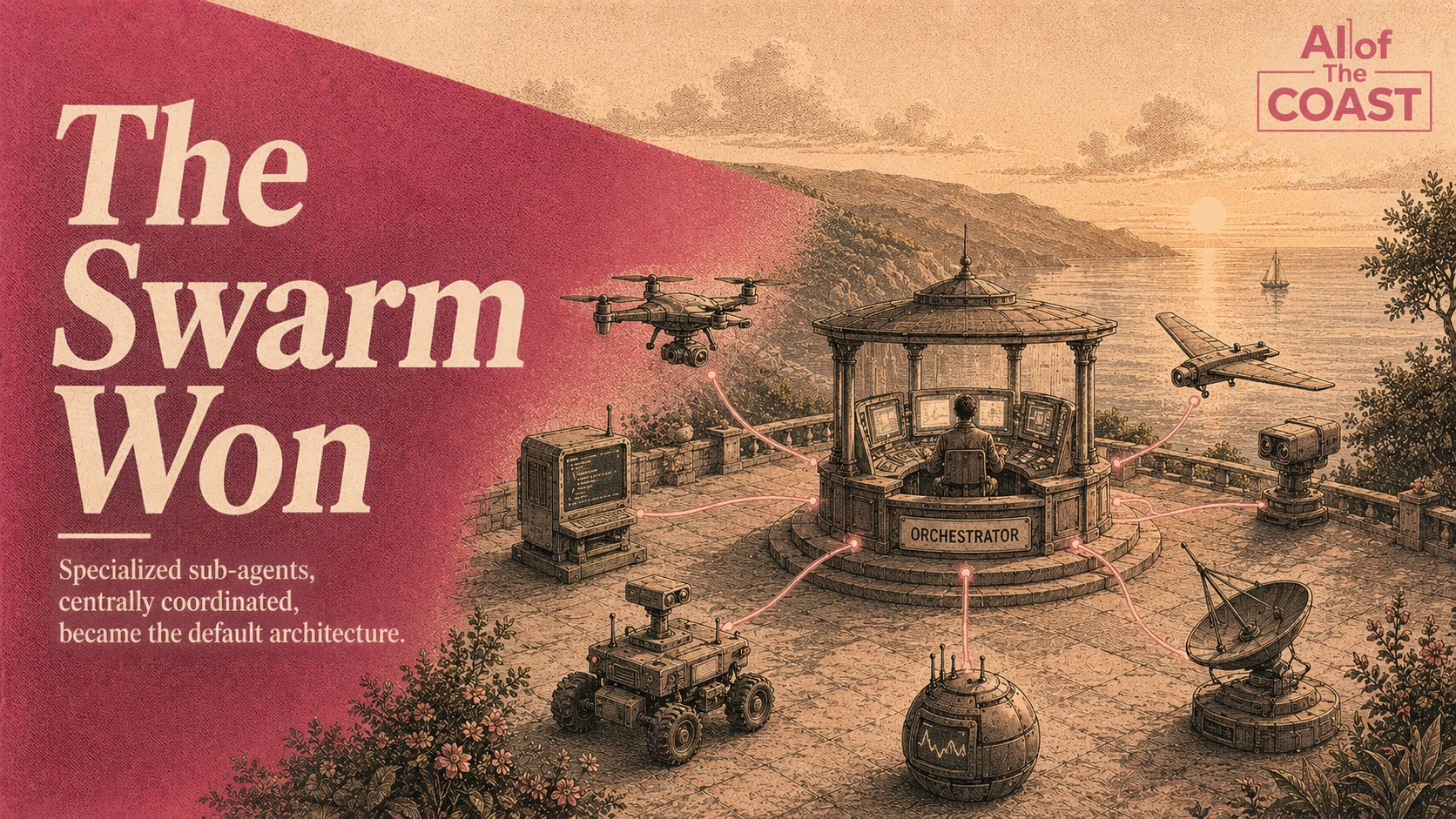
Prediction three said the single ‘super agent’ that seamlessly does everything stays out of reach. Instead, multiple specialized agents — swarms — operate under a central orchestrator, each handling a narrow domain with high efficiency. I predicted dynamic coordination, a marketplace of plug-and-play agents, and interoperability standards as the crucial enabler. My favorite spin-off was the ‘Central Swarm Transaction System’ — a high-velocity marketplace where agents transact with each other.
Read any 2026 AI architecture doc and you’re reading my January 2025 prediction back to me.
The single super-agent never showed
OpenAI, Anthropic, Google — none of them shipped the mythical do-everything agent. What they shipped was orchestration. Claude’s agent framework. Multi-agent systems where a coordinator delegates to specialized sub-agents. The ‘manager agent dispatches to worker agents’ pattern is now so standard it’s boring. Exactly as predicted: building one agent to flawlessly handle everything proved too complex; specialized agents leveraging domain-specific tooling won.
The reliability data backs the architecture choice. Fully autonomous single agents fail roughly 70% of real multi-step tasks. Structured, orchestrated workflows with specialized components consistently outperform. The industry didn’t choose swarms because it’s elegant. It chose swarms because monolithic autonomy doesn’t work yet.

The marketplace is forming — slower than the hype, faster than the skeptics
My ‘Central Swarm Transaction System’ — agents transacting with agents at machine speed — is half-built. The agent-to-agent payment rails I wrote about are real: protocols for machine-to-machine commerce, micropayment layers, agent-to-agent communication standards. Y Combinator’s Winter 2026 batch was 41.5% agent-infrastructure companies. The plumbing for the swarm marketplace is being laid right now.
But — and this is the honest part — it’s plumbing, not yet a thriving economy. The ‘self-sustaining AI services ecosystem where agents compete, collaborate, and transact’ that I described is still mostly humans wiring agents together, not agents autonomously hiring each other. The vision was right. The timeline was optimistic. The economy is being built; it isn’t running.
What being early actually costs
Here’s the uncomfortable founder lesson. I was right about the architecture in January 2025, eighteen months before it became consensus. Did that make me money? Only if I built or invested on the conviction. Being right and being early are the same thing wearing different clothes, and the market pays you for the second one only if you can survive long enough to be called the first one.
The companies that committed to multi-agent orchestration in early 2025 — when it still sounded speculative — are the ones with the 2026 lead. The ones that waited for consensus are paying acquisition prices for what conviction would have given them cheap.
The next 12 months: orchestration eats the application layer
My forecast for May 2027: ‘orchestration’ stops being a feature and becomes the product. The winning AI companies won’t sell you a model or an agent. They’ll sell you the coordinator — the layer that decides which specialized agent handles which slice of your workflow, routes the work, catches the failures, and bills you for the outcome.
Watch interoperability standards become the real battleground. Whoever owns the protocol that lets agents from different vendors transact becomes the TCP/IP of the agent economy. That’s a winner-take-most position, and the fight for it is just starting.
And watch the failure rate stay the moat. As long as autonomous agents fail 70% of unsupervised tasks, the orchestration layer’s most valuable function isn’t coordination — it’s knowing when to stop, escalate, and put a human in the loop. The orchestrators that get the human-handoff right will beat the ones that promise full autonomy and ship chaos.
I called the architecture in January 2025. The whole industry caught up in 2026. The lesson isn’t that I’m a genius. It’s that the obvious structural answer is often visible eighteen months before everyone agrees to see it — and that gap is the only edge that matters.
Sources: original forecast (Jan 6 2025); industry multi-agent orchestration patterns 2025-26; agent task-reliability data (Gartner, buildmvpfast analysis 2026); YC W26 batch composition (41.5% agent infrastructure); agent-to-agent payment protocol development 2025-26.
Jiri Fiala is CEO and co-founder of DCXPS, building Tier 3 modular AI data centers and the Chapek.io bare-metal GPU cloud platform.
