
Of all thirteen predictions, this is the one where I want to read you my own January 2025 words and then just show you the news.
What I wrote: consciousness and self-awareness on par with fictional robots stays out of reach. Progress centers on form factors and specialized intelligence. Niche applications — manufacturing, healthcare, surgical assistance — see traction; household companions remain far off. And the workforce impact is augmentation: robots handle repetitive or hazardous tasks alongside humans, not instead of them.
Now the news.
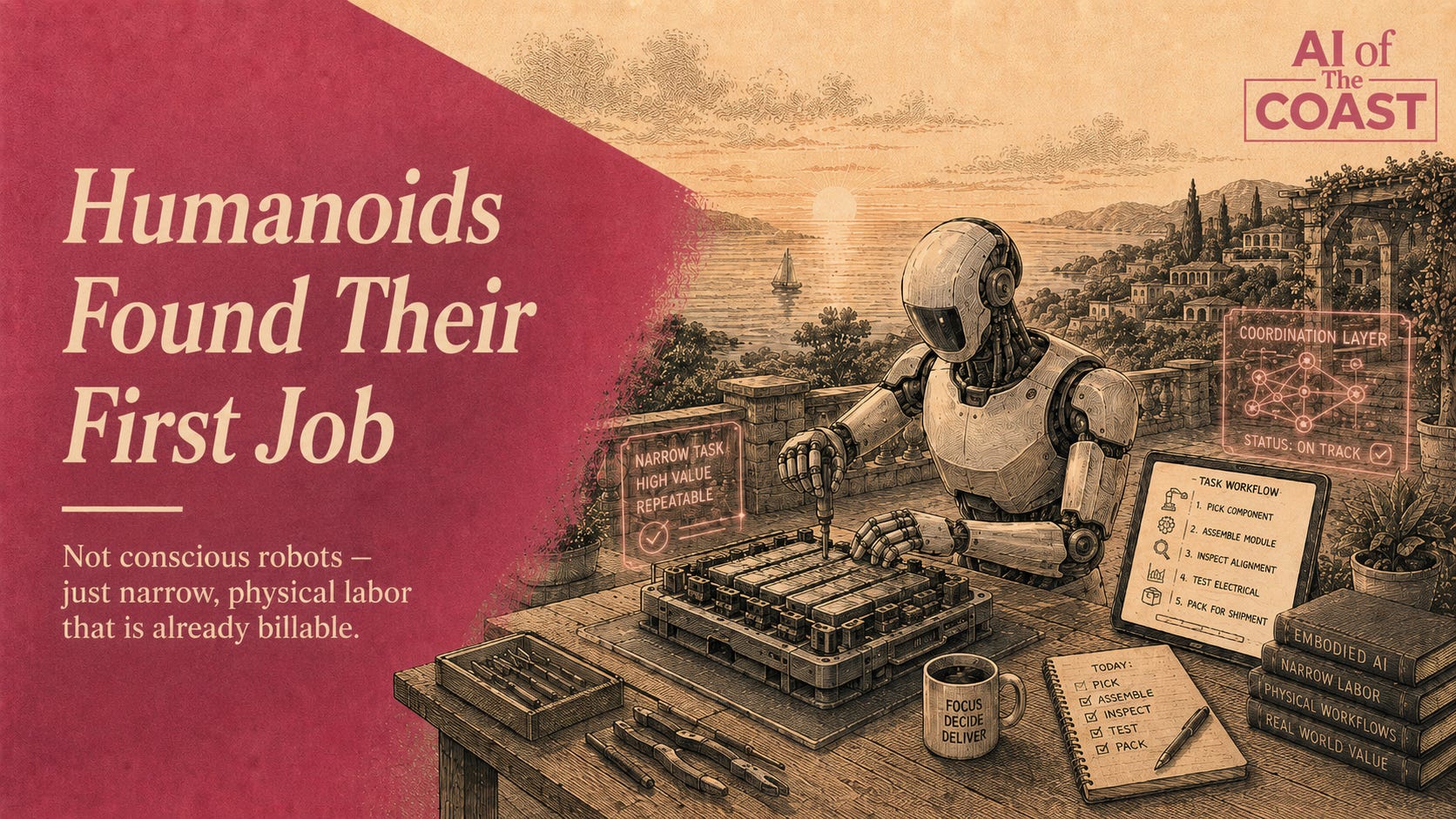
Form factors got real. Cognition stayed narrow.
Figure AI’s Figure 02 spent eleven months on BMW’s Spartanburg line — 1,250 operating hours, 30,000+ vehicles supported, 90,000+ sheet-metal parts handled. It came back scratched and grimy, and that data trained Figure 03. In January 2026, Figure deployed 40 Figure 03 units commercially at Spartanburg, billing BMW roughly $25 per robot-operating-hour. Tesla discontinued the Model S and Model X and converted Fremont lines to build Optimus, targeting production start in summer 2026. Unitree shipped 5,500+ units in 2025 and is targeting up to 20,000 in 2026, with a G1 on Amazon for around $17,990.
Notice what’s in none of those sentences: consciousness. Self-awareness. General intelligence. Every single deployment is a narrow, supervised, industrial form-factor play. Musk himself admitted on the Q4 2025 earnings call that the Optimus units inside Tesla factories exist to generate training data, not to perform productive labor. He called it R&D. That is the single most honest sentence anyone in humanoid robotics said all year, and it confirms my January 2025 call to the decimal.

Augmentation, not replacement — exactly as called
The deployment pattern is precisely the ‘human-robot collaboration’ I described. Agility’s Digit moving totes at Amazon and GXO. Apptronik’s Apollo tested by Mercedes. Boston Dynamics’ Atlas piloting at Hyundai. Every one of these is a robot taking over the repetitive, hazardous, or ergonomically brutal task while humans handle judgment, exceptions, and oversight. Nobody got replaced. The work got reshaped. That was the prediction.
Where I planted a flag worth revisiting: the autonomous power plant
My ‘favorite’ spin-off in this prediction was the Autonomous Power Plant with AI Data Centers — a self-contained complex where humanoid robots tend specialized crops for biogas conversion, power generates on-site, and AI workloads run on that isolated energy. I called it a frontier where robotics, renewable energy, and AI converge under one roof, run with minimal human intervention.
Eighteen months later, that concept is the spine of half of what I write about — the modular, energy-sovereign, robotically-tended compute facility. The grid can’t keep up (PJM capacity prices ran up over 1,000% for the 2026-2027 delivery year). The case for compute that brings its own power and tends itself with robots got stronger every month of 2025. I didn’t predict it would become my central thesis. It did.
The next 12 months: the China volume bet versus the Western quality bet
My forecast for May 2027: humanoids cross from ‘hundreds to low thousands doing productive work globally’ into the low tens of thousands — still niche, still industrial, still supervised. No household humanoid does anything genuinely useful at scale by mid-2027. The 1X NEO home pre-orders ship, underwhelm, and teach the market that the living room is harder than the factory.
The real 2026-2027 story is the bifurcation I’d now bet on: China wins on volume and price (Unitree’s 20,000-unit target, 90% of global unit volume), the West wins on industrial quality and integration (Figure’s $25/hour billable units).
The question that decides the decade is whether Chinese volume-and-iteration beats Western quality-and-integration — the same question that decided EVs, drones, and solar. I know which way that historically breaks.
And watch the economics, not the demos. A robot that bills $25/hour and runs more than one shift pays for itself against a $20-30K purchase price fast. The backflip videos are marketing. The invoice to BMW is the business. I told you in January 2025 to watch the form factor and the niche. Watch the invoice now.
Sources: original forecast (Jan 6 2025); Figure AI BMW Spartanburg deployment (Jan 2026); Tesla Q4 2025 / Q1 2026 earnings; Unitree shipment and pricing data (2026); Agility/Apptronik/Boston Dynamics deployments; PJM capacity auction (2026-27 delivery year).