
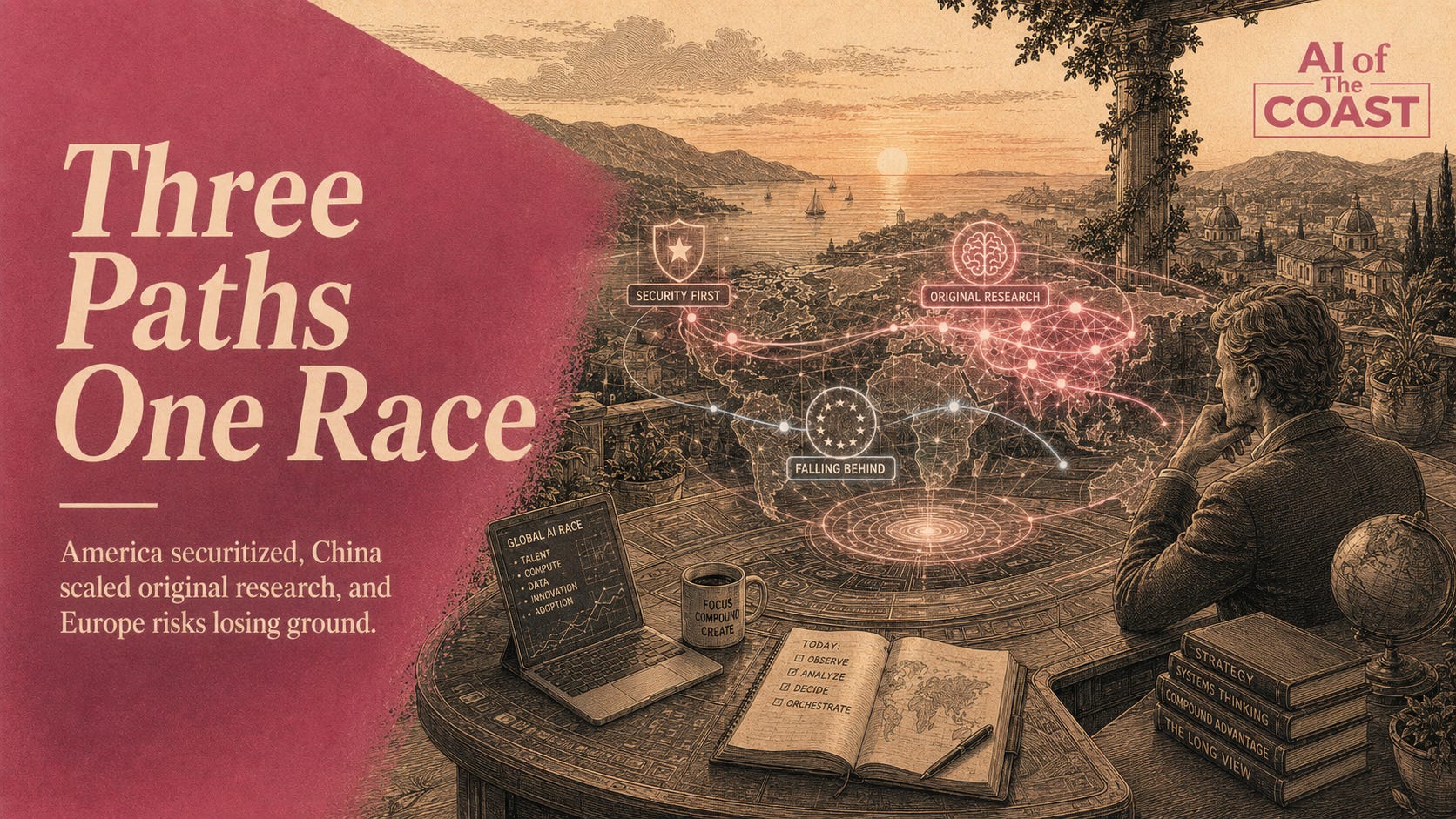
Three claims, three different grades. Let me grade them in public.
Prediction six: the US leverages AI for national security; China shifts from copying-and-monetizing to genuine original research; Europe’s regulatory inertia risks losing ground. My favorite spin-off was ‘Iron Curtain Copy Cats’ — the idea that nations erect digital iron curtains while entrepreneurs smuggle and adapt AI models across borders, spurring localized innovation and fragmented parallel ecosystems.
Europe: A+. Painfully so.
I said Europe leads on ethics and regulation but its fragmented landscape deters experimentation and risks lost ground. Eighteen months later this is the consensus diagnosis of European tech policy. The EU AI Act arrived; European AI champions did not arrive at the same scale as American or Chinese ones. The continent that wrote the rulebook is buying most of its frontier models from elsewhere. I wish I’d been wrong about this one. I wasn’t.
The US: A. Security-first held.
The US national-security framing was correct and intensified. Federal AI policy reoriented around security primacy, the chip-export contest with China became the central geopolitical fact of the industry, and the build-fast doctrine (see prediction 2) is explicitly justified in national-competitiveness terms. The US treated AI leadership as a security imperative, exactly as predicted.
China: right direction, wrong mechanism — and bigger than I imagined
Here’s the interesting miss. I predicted China would shift from ‘copy and monetize’ to ‘authentic original research and breakthroughs.’ The direction was dead right — China stopped being a fast-follower. But I pictured that originality showing up as proprietary national champions racing the US lab-to-lab.
Instead, China’s originality expressed itself through open source, and that turned out to be a far more powerful vector than I imagined. DeepSeek’s efficiency shock. Alibaba’s Qwen crossing 700M+ downloads. MIT Technology Review documenting that Chinese open-source models surpassed US models in total downloads. A ‘ghost model’ that turned out to be Xiaomi — a phone company — beating expectations. China didn’t just do original research. It commoditized the model layer and gave it away, which is a more disruptive strategic move than any single proprietary breakthrough would have been.
My ‘Iron Curtain Copy Cats’ concept anticipated cross-border model smuggling and adaptation. The reality was almost the inverse and more elegant: China didn’t need anyone to smuggle its models. It published them under permissive licenses, and the world adapted them voluntarily. The iron curtain went up on chips and capital; the models flowed freely outward by design. I had the fragmentation right and the direction of model flow backwards.
What this teaches about predicting geopolitics
The lesson for any forecaster: you can call the actor and the direction correctly and still miss the mechanism, and the mechanism is where the strategic surprise lives. ‘China innovates’ was easy. ‘China weaponizes open source to commoditize its rivals’ moat’ was the actual 2025-2026 story, and I didn’t see the open-source angle clearly enough in January 2025.
The next 12 months: the open-weight bloc becomes a third power
My forecast for May 2027: the open-weight ecosystem — overwhelmingly Chinese-led — becomes a recognized third pole of AI power alongside US closed labs and EU regulation. Enterprises and entire nations standardize on open Chinese weights for cost and sovereignty reasons, the way they once standardized on Android. The strategic consequence: the US closed-lab moat erodes from below, not from a competing closed lab but from free, good-enough open alternatives.
Watch the US response. The build-fast doctrine collides with the reality that ‘fast’ may not beat ‘free.’ Expect a real debate inside the US about whether to compete with Chinese open source by open-sourcing more aggressively — a debate that would have sounded absurd in January 2025 and will sound inevitable by 2027.
And watch Europe try to turn its regulatory weight into a third kind of leverage — ‘trusted AI’ as a product category. It’s the only card the continent holds. Whether anyone pays a premium for it is the open question. I called Europe’s predicament in January 2025. The next year tells us whether predicament becomes strategy or just decline.
___
Sources: original forecast (Jan 6 2025); MIT Technology Review on Chinese open-source models (Feb 2026); Japan Times on the Xiaomi ‘ghost model’ (Mar 2026); DeepSeek efficiency reporting; US-China chip-export contest 2025-26; EU AI Act competitiveness debate.
Sources: original forecast (Jan 6 2025); EY 2025 wealth-management AI survey; MIT findings on white-collar task automation; entry-level/junior labor-market analysis 2025-26; the author’s own prediction 12 (90% of certain job tasks automatable).