
Pull up Waymo's 2026 expansion map and then reread my January 2025 prediction. They're the same document.
Prediction seven: fully driverless cars — zero human oversight — remain confined to 'safe zone' regions, often with mild climates and favorable road conditions. Human drivers remain indispensable elsewhere. Early adoption limited by geography, regulatory hurdles, and the hard problem of mixed human-and-robot traffic. My favorite spin-off: closed autonomous systems — dedicated tracks, hanging railways — scaling faster than open-road autonomy because they strip out the edge cases.
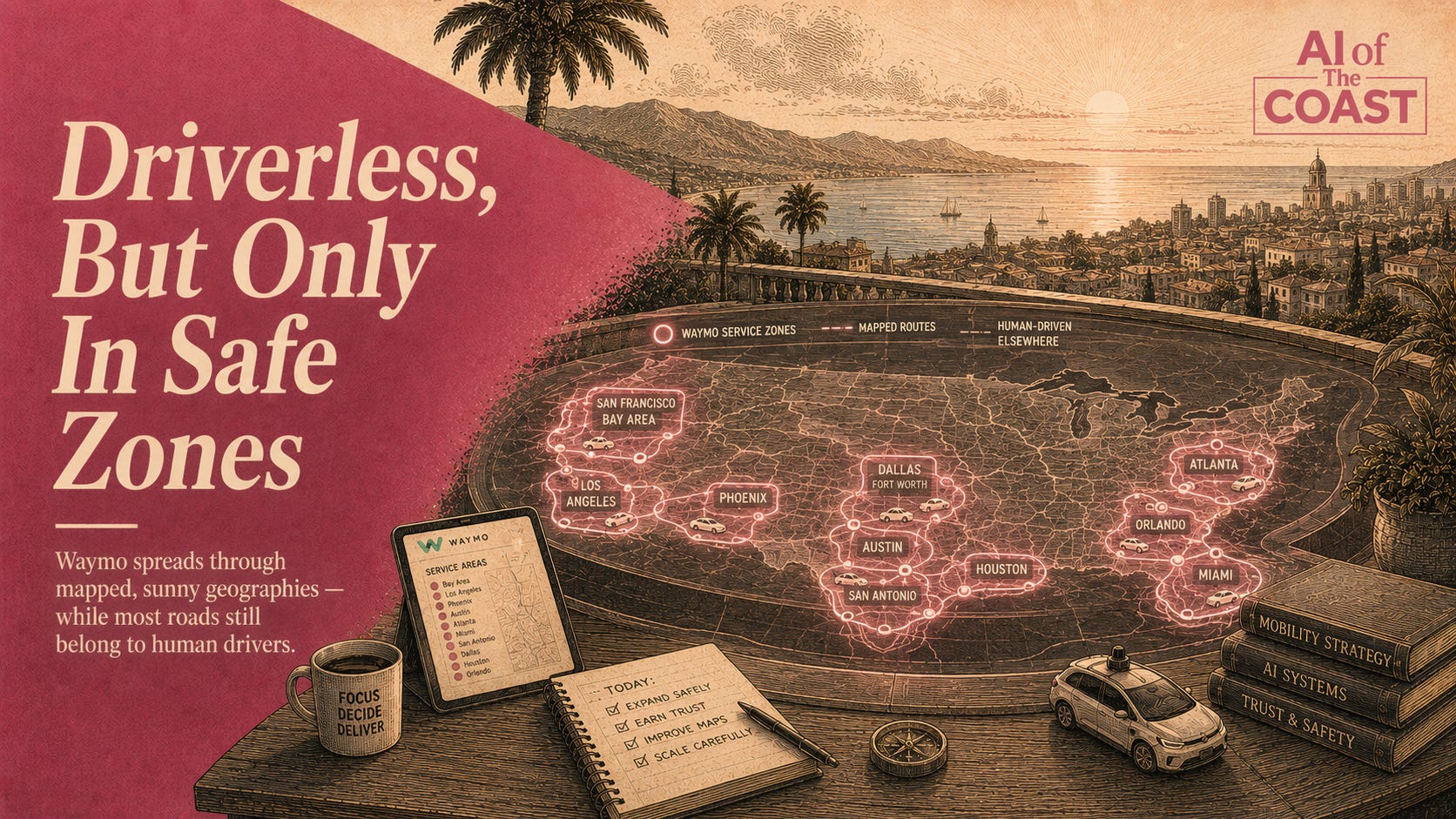
Where did Waymo actually scale in 2025-2026? Phoenix. San Francisco. Los Angeles. Austin. Atlanta. Then the 2026 expansion: Dallas, Houston, San Antonio, Miami, Orlando — and planned moves into Las Vegas, Nashville, San Diego. Read that list. Sunbelt. Mild climates. Favorable, mappable road conditions. Exactly the 'safe zones' I named. Waymo only began offering freeway routes in late 2025, in its established sunny markets, gradually. The geofence is the business model.
And the regulatory friction I flagged? Washington D.C. still required a human behind the wheel as of the 2026 expansion announcements — Waymo has to lobby to change the permitting before it can go driverless there. China suspended new autonomous-driving permits nationwide after a Baidu Apollo Go fleet froze en masse in Wuhan, trapping passengers for up to two hours. Regulatory hurdles, exactly as predicted, slowing the rollout of fully autonomous fleets.
~10 US metros with Waymo driverless service by 2026 — all favorable climates. 400K+ Waymo weekly paid trips across its markets. 100M+ fully driverless miles in Waymo's safety data. 0 cold-climate, snow-belt cities with full driverless service.
Mixed traffic stayed hard — as called
My prediction that integrating human drivers and pedestrians with driverless cars 'remains a key challenge' held. Waymo recalled over 1,200 vehicles to fix software causing low-speed collisions with gates and chains. A Waymo burned in the Los Angeles protests — a reminder that robots on public streets live in a messy human world. The technology works beautifully inside the geofence and gets humbled the moment conditions drift outside it. That boundary — works in the safe zone, struggles outside — is the entire 2026 autonomous-vehicle story, and it's the boundary I drew in January 2025.
The closed-track bet: still early, still right in principle
My 'favorite' was closed autonomous systems — dedicated tracks and right-of-way that eliminate the edge cases. This didn't produce a flashy 2025-2026 headline, so I'll mark it honestly as 'unresolved but vindicated in principle.' The logic I laid out — that controlled environments with no random pedestrians or unpredictable human drivers dramatically reduce the autonomy problem — is exactly why Waymo's geofenced, well-mapped operational design domains work and open-road full autonomy still doesn't. The safe zone is a soft version of the closed track. I was right about the principle; the literal hanging railways remain a niche.
The next 12 months: the geofence expands, the fantasy doesn't
My forecast for May 2027: Waymo crosses into 15+ metros and begins meaningful freeway operations, but every new market still fits the safe-zone template — favorable climate, mappable geometry, cooperative regulators. No Waymo robotaxi provides commercial driverless service in a serious snow city by mid-2027. The 'go anywhere, any conditions' driverless car remains a demo, not a product.
Watch the private-ownership fantasy get a reality check. Startups keep promising consumer-owned full-autonomy vehicles. The same constraint I named in January 2025 bites: a privately owned autonomous car comes with the same geofence — 'drive here, not there; sunshine, not storms.' Consumers won't pay premium money for a car that only fully drives itself in five zip codes on clear days. The robotaxi fleet model wins precisely because it can stay inside the safe zone; private ownership can't.
And watch China. The permit suspension is temporary, but it reveals the real bottleneck — not the technology, the trust. A single mass-freeze incident set the whole Chinese industry back. That fragility is structural, and it's why I keep saying the safe zone isn't a phase autonomous vehicles graduate out of. It's the shape of the business for years.
I drew the geofence in January 2025. Waymo spent 2026 driving inside it. Grade: surgical.
Sources: original forecast (Jan 6 2025); Waymo 2026 expansion announcements (CNBC, TechCrunch, The Robot Report, Nov-Dec 2025); Waymo safety data (100M+ driverless miles); Fortune on China's robotaxi permit suspension and Baidu Wuhan incident (May 2026); Waymo recall reporting
.