

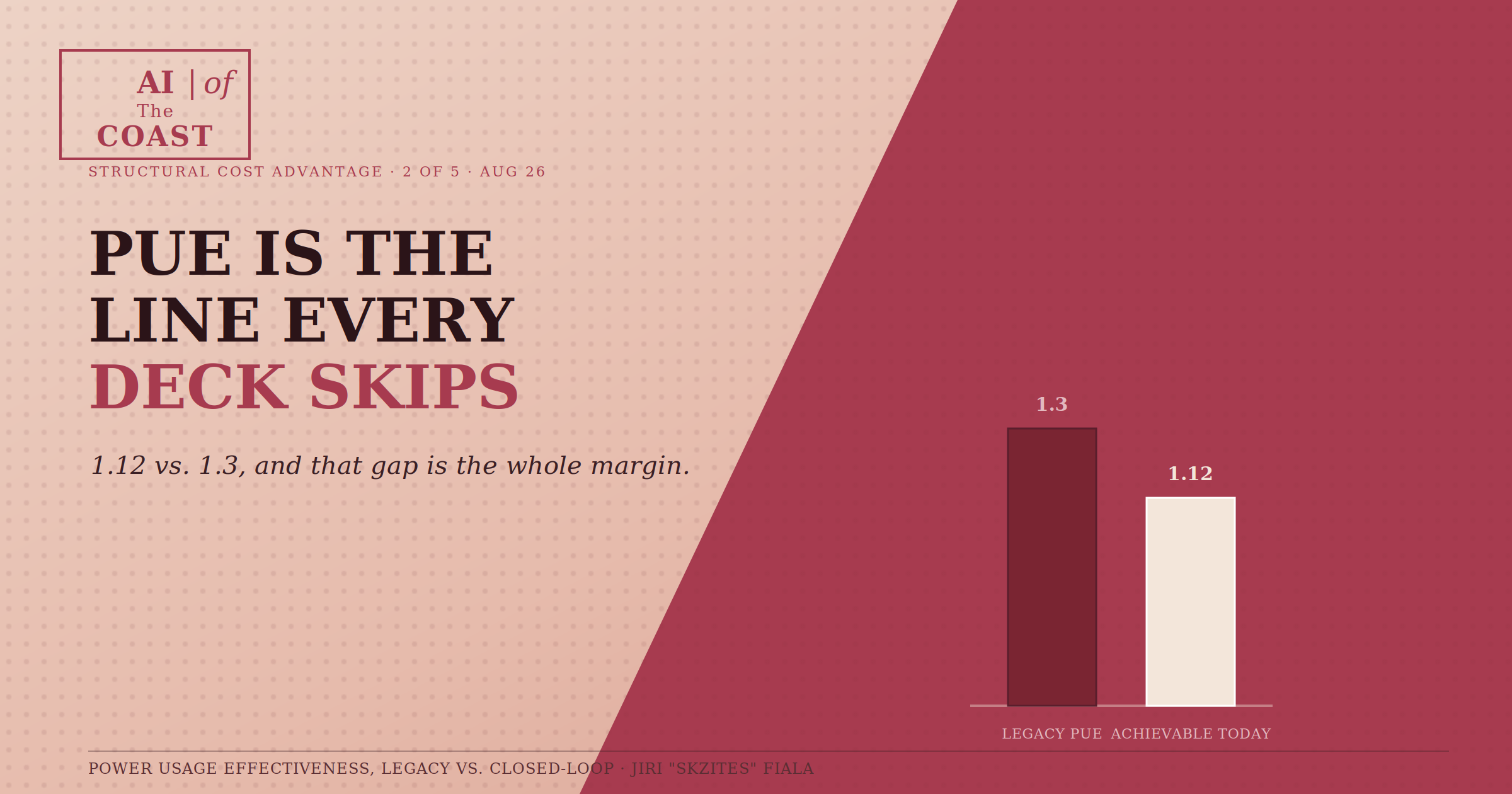
PUE, power usage effectiveness, is the ratio of total facility power to the power actually reaching the compute. A PUE of 1.3 means 30% of everything you’re paying for goes to cooling, distribution, and overhead before a single GPU cycle happens. A PUE of 1.12 means that number drops to 12%.
That 18-point gap sounds like an engineering footnote. It isn’t. On a facility running hundreds of GPUs continuously, that gap compounds across every hour of every year the facility operates, and it shows up nowhere on a GPU spec sheet, nowhere in a financing summary, and almost never in the two-page teaser that gets passed around before a deal reaches diligence.
Most legacy data center infrastructure was designed for PUE assumptions closer to 1.3, sometimes worse, because it was built for a world where power was cheap and compute density was low. Neither of those assumptions holds anymore. Compute density has gone up an order of magnitude, and power is now the binding constraint on this entire category, which means every point of PUE inefficiency isn’t a rounding error, it’s a direct tax on the one resource everyone in this market is fighting over.
Closed-loop liquid cooling can push PUE to 1.12 or better with equipment available today, the technology isn’t the bottleneck. What’s missing is a diligence habit that treats cooling architecture as a line item instead of an afterthought, because power efficiency stopped being a nice-to-have the moment power became the scarcest input in the entire value chain.
If your diligence process has a line for GPU generation and no line for PUE, you’re measuring the part of the deal that’s easy to see and skipping the part that actually determines the margin.
Subscribe for the next piece, or download the market report for the full unit-economics comparison.