

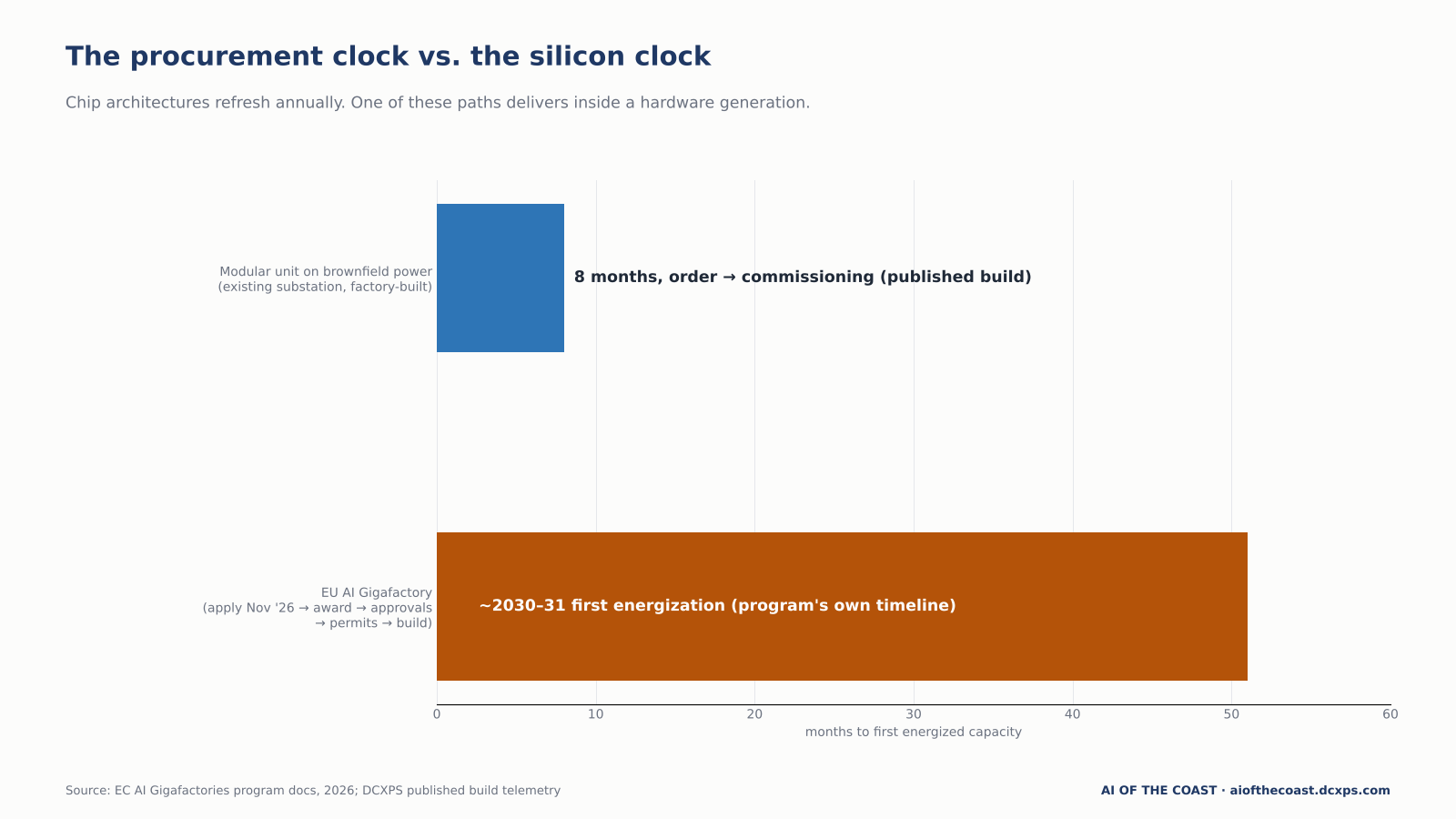
On November 12, the application window closes for Europe’s AI Gigafactories program — seven planned temples of sovereign compute, €10 billion of public money expected to unlock €20 billion more. Award decisions are expected in early 2027. Then, per the program’s own documentation, something remarkable happens: an estimated 18 to 24 additional months of approvals after pre-notification.
Do the arithmetic Brussels declines to do in public. Applications close November 2026. Awards early 2027. Approvals land somewhere in late 2028. Then you break ground — into the same five-year transformer queues and multi-year grid connections everyone else is standing in, except with European permitting on top, which runs three to seven years for industrial-scale connections. The first gigafactory plausibly energizes in 2030 or 2031.
NVIDIA’s architecture cadence is now annual. Between the day a gigafactory’s spec sheet is approved and the day its halls power on, the silicon it was designed around will be three to five generations obsolete.
I’m Czech. I build AI infrastructure in Europe, for Europeans, under European law — so when I say the sovereignty diagnosis is correct, I mean it with my own balance sheet. Europe running its intelligence on rented American compute is a strategic dependency with a kill switch on the wrong continent. The European Court of Auditors’ Mihails Kozlovs put it precisely: “in the AI race, there is a risk that the winner takes it all.”
The diagnosis is right. The instrument is a cathedral. And cathedrals are for worship — tents are for war.
The procurement clock versus the silicon clock
Let me be fair to the program first, because the lazy version of this critique is just Brussels-bashing, and the lazy version misses what’s genuinely new.
Nineteen nations signed on — Germany coordinating with over €1 billion committed, grants up to €25 million per project open to European companies. AMD, NVIDIA, and Qualcomm signed letters of intent to supply chips, which matters: allocation is the scarcest commodity in this industry, and a political bloc pre-negotiating it is real leverage. The six-layer sovereign stack the program sketches (from orchestration through sovereign foundation models down to sector AI services) is a more coherent industrial architecture than anything the EU produced in the previous decade of AI strategy. The ECA’s own 2024 audit called that earlier era “neither clearly defined, nor well coordinated.” The new program is at least clearly defined.
But coherence on paper collides with two clocks that don’t negotiate.
The first is the one I covered Tuesday: physics. Transformers, interconnection, construction — the global stack of lead times applies in Bavaria exactly as in Virginia, with longer permitting. Fifty gigawatts of American vapor should be Europe’s cautionary tale, and the gigafactory program is structurally more exposed to it, because consortium-scale projects are the hardest kind to site, power, and permit.
The second clock is financial scale, and here the comparison is brutal. The whole €30 billion program (public and private, seven factories, 19 nations, multi-year) is less than one quarter of Micron’s revenue this September. It’s about 4% of what Amazon, Microsoft, Alphabet, and Meta alone will deploy on AI infrastructure this year. Goldman has global AI investment crossing $1 trillion in 2026, of which $581 billion is American. Europe is bringing a commendable procurement document to a capital expenditure war.
The uncomfortable conclusion isn’t that Europe should spend more public money. It’s that public money was never going to be the mechanism. Nobody subsidized the American buildout — it’s vendor finance, ring-fenced project capital, and operators racing each other to energize. Sovereignty built on grants moves at the speed of grant committees. Sovereignty built on operating margin moves at the speed of demand.
What “born sovereign” means
There’s a second path, and since I’m walking it, treat this section as a founder’s argument, not neutral analysis.
The alternative to procuring seven cathedrals is operating many tents: smaller, modular, factory-manufactured units deployed on Europe’s own stranded and brownfield power: retired plant sites, industrial substations, grid nodes with spare capacity that exist in every member state in quantity. Units that energize in months, not electoral cycles. EU-built, EU-owned, EU-operated, under EU law from the first weld — which is what I mean by born sovereign, as opposed to sovereignty retrofitted onto a procurement.
The numbers I can publish from our own build: a modular intelligence factory with 392 GPUs and roughly 450 kW of IT load, under contract on a former power-plant site in Central Europe, about eight months from order to commissioning, design PUE ≤1.12 on closed-loop liquid cooling. One such unit is a rounding error next to a gigafactory. Two hundred of them, distributed across the grid where the power already sits, are a different kind of animal entirely: capacity that arrives on the silicon clock, refreshes module-by-module instead of hall-by-hall, fails in 1 MW increments instead of campus-sized ones, and never asks a single county to host a gigawatt.
Distributed beats monumental on every axis the last two months of news exposed: time-to-energize, grid consent, blast radius, refresh economics. The sovereignty argument usually gets framed as where the data sits. The operator’s version is harsher: sovereignty is who can commission, run, and refresh capacity without asking permission from another jurisdiction’s supply chain or another company’s roadmap. A gigafactory grant doesn’t buy that. An operating discipline does.
And the two paths aren’t enemies, which is the part I’d genuinely like someone in Brussels to hear. The gigafactories’ pre-negotiated chip allocations and sovereign-stack software layers would be dramatically more useful anchored by distributed capacity that’s already live and earning while the cathedrals are permitted. Let the seven big sites be the training anchors of the 2030s if they must. But let the tents carry the decade in between — because the decade in between is where the race is decided.
The part nobody wants to say out loud
Maya Sherman’s line in the program coverage (”No country is fully sovereign in AI”) is correct and cuts both ways. The chips are American-designed, Taiwanese-fabbed, Korean-memoried. Full-stack autarky is fantasy for everyone, the United States included.
But that’s an argument for choosing your dependencies deliberately, not for having them chosen for you. There’s a hierarchy of sovereignty, and it runs: own the demand, own the sites, own the operations, own the energy, and then worry about owning the silicon. Europe keeps attacking the stack from the hardest end (trying to will sovereign chips and sovereign foundation models into existence by consortium) while leaving the tractable layers to whoever shows up. Sites, power, and operations are tractable today, with European capital, European law, and European grid assets. That layer is winnable this decade. The silicon layer is a 2035 project no matter whose flag is on the fab, and the model layer, honestly, is being commoditized by open weights faster than any grant can track.
Win the layers physics lets you win now. Rent the rest on your own terms, from positions of operating strength, the way every energy-importing industrial nation has managed strategic dependency for a century. That’s not defeatism. That’s how the Czech Republic, with no oil, kept its refineries.
Where this lands
My forecast, on the record: the gigafactory awards in early 2027 will be celebrated, the approvals will consume most of two years, at least two of the seven will die in siting or power before pouring concrete, and the first operational gigafactory will energize into a hardware generation it wasn’t designed for. Meanwhile, the real European sovereign capacity of the late 2020s will be assembled unit by unit, by operators nobody invited to the announcement photos — on brownfields, behind existing substations, at a structural cost advantage, generating revenue while the consortia generate documentation.
And in 2031, some commissioner will stand in front of the first finished cathedral and declare European AI sovereignty achieved, and they’ll be wrong in the most instructive way possible: it will have been achieved years earlier, quietly, in tents.
The window closes November 12.
The grid is already open.
I run DCXPS — a Czech-founded operator building modular intelligence factories on European brownfield power. The 392-GPU unit figures are our published build telemetry; the “tents” I’m arguing for are literally my product, so read this as testimony from inside the race, not a view from the stands.