


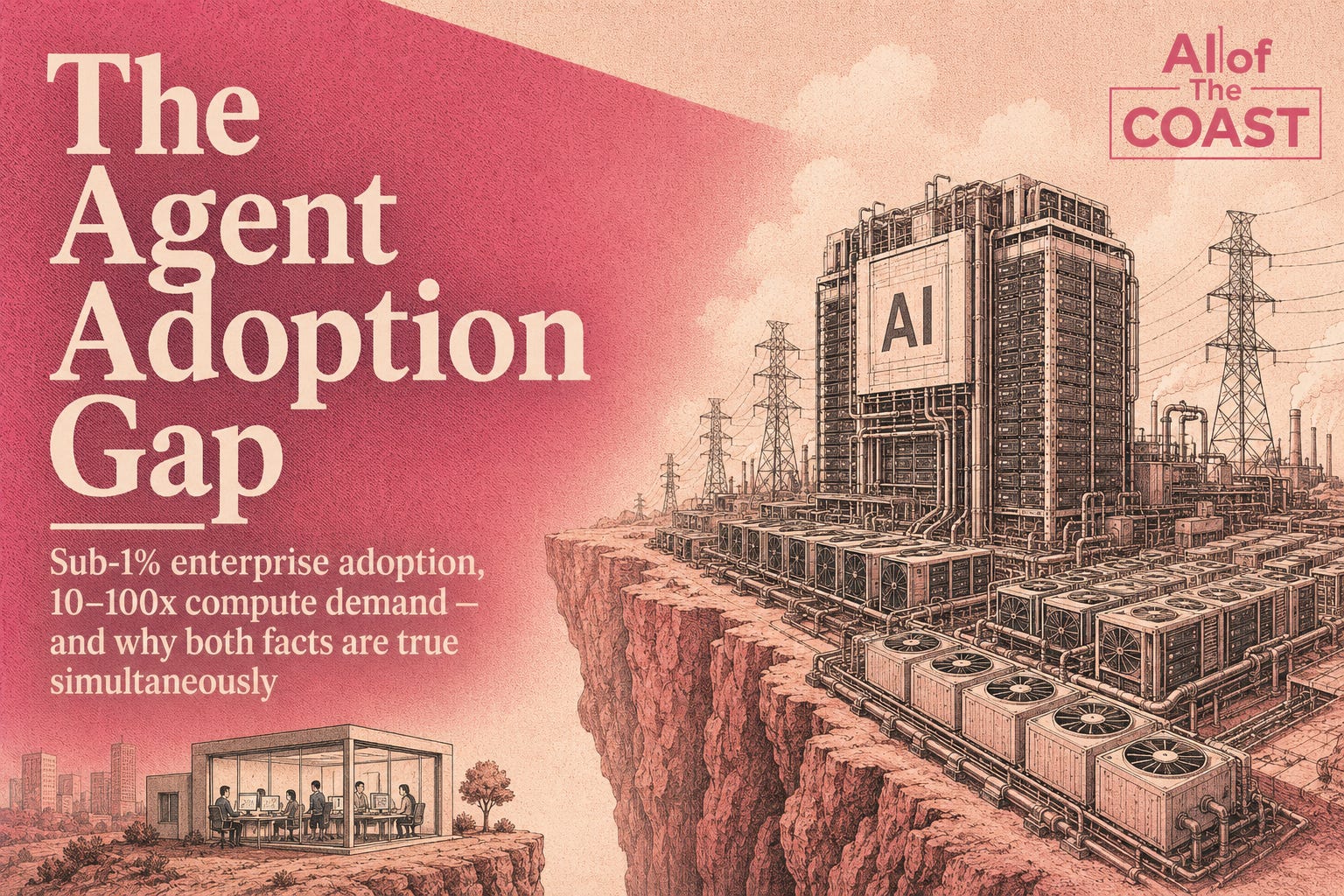
In February 2026, Anthropic reported that Claude had reached $25 billion in annualized revenue — up from roughly $100 million in early 2024. In the same month, OpenAI reported revenues exceeding $25 billion annualized. The AI application layer is generating real money at real scale. The growth rates are extraordinary.
And yet — and this is the fact that most AI infrastructure analysis ignores — less than one percent of enterprises globally have meaningfully integrated AI agents into their core business operations. Not AI tools. Not AI assistants. Not employees using ChatGPT occasionally. Agents: autonomous AI systems that perform multi-step tasks, access live data systems, take actions in external systems, and operate without human intervention on each individual decision.
Why the 1% Number Matters More Than the Revenue Numbers
The distinction matters because of the compute differential. A copilot — an AI assistant that helps a human complete a task, like drafting emails or summarizing documents — is relatively compute-light. A single inference call generates a response and the compute is done. The typical enterprise copilot deployment adds perhaps 50-200 API calls per user per day to an organization’s compute footprint.
An agent is categorically different. A genuine AI agent — one that can autonomously research a topic, write code, test that code, identify errors, look up documentation, revise its approach, and deliver a working solution — may make hundreds to thousands of API calls to complete a single multi-step task. It runs planning loops. It uses tools. It checks its own output. The compute requirement per task is not 2x the copilot’s requirement. It is 10-100x, depending on task complexity.
<1%
Enterprises with meaningful AI agent integration
10-100×
More compute agents need vs. copilots
$30B
Anthropic ARR Feb 2026 (up from ~$100M in early 2024)
$25B+
OpenAI annualized revenue Feb 2026
The Math of Full Adoption
There are approximately 330 million knowledge workers globally. If 10% of them — 33 million people — are using AI copilots today, they are generating something on the order of 3-7 billion API calls per day collectively. That is already a meaningful compute load, and it explains a significant portion of the AI infrastructure buildout.
Now model what happens when agent adoption reaches 10% of knowledge workers — 33 million people using agents that make 1,000 API calls per task and complete 5-10 tasks per day. That is 165 billion to 330 billion API calls per day. Roughly 50-100x the current compute load. And 10% adoption of agents is still in the early adopter category. Full mainstream adoption at 50-60% would imply compute loads 250-500x what exists today.
“We are not in an AI bubble. We are in the pre-adoption phase of a technology whose full compute requirements, when realized, will dwarf everything currently built or planned.”
This is why I say the infrastructure buildout is not speculative — it is structurally necessary. The debate is not whether the compute will be needed. The debate is on what timeline, in what configuration, and with what architectural requirements. The people who say the hyperscale buildout is “overbuild” are confusing the current adoption curve with the eventual adoption ceiling.
The Compute Requirements of a World With Agents
A world where AI agents are genuinely pervasive — where every knowledge worker has personal agents, where every enterprise process has autonomous AI assistance, where every application has an agentic layer — is a world that requires infrastructure orders of magnitude larger than what is being built right now.
The IEA’s projection of 1,000 TWh in data center electricity consumption by end of 2026 already sounds enormous. It will look trivial by 2030 if agent adoption reaches even 20% of knowledge workers. This is not speculative modeling. It is arithmetic applied to the compute differential between current copilot deployments and genuine agent deployments.
The infrastructure imperative is not about serving the AI market as it exists today. It is about building for the market as it will exist when adoption reaches the S-curve inflection point. That inflection point is not here yet — the sub-1% enterprise adoption figure makes that clear. But the infrastructure to serve it when it arrives takes years to build. The window to build infrastructure that will capture the adoption wave is now, not after the wave has already started.
This is precisely the dynamic that played out in telecommunications in the 1990s. The buildout that seemed excessive for 1999’s internet traffic was exactly right for 2005’s internet traffic. The problem was not the infrastructure investment — it was the timing and the balance sheet structure of the companies that made it. The infrastructure was needed. The capital structure wasn’t right.
Strong framing on the compute differential. Maybe double-check those opening figures, because they read low by an order of magnitude — Anthropic was ~$30B annualized by April (not $1.4B) and OpenAI ~$25B (not $4B). Worth fixing because it strengthens you: the bulk of Anthropic's is Claude Code, an agentic product, so your thesis is already in the numbers.