

Somewhere between 2028 and 2030, a data center will operate for 90 consecutive days without a human being present on-site. The AI systems managing the facility will make 90% of all operational decisions without human involvement. The robotic maintenance fleet will swap hardware, clean sensors, inspect cooling systems, and adjust power routing without human instruction.
This is not a prediction. It is a design specification.
The transition it represents is more profound than the transition from mainframes to personal computers, more profound than the transition from owned servers to cloud infrastructure. It is the transition from infrastructure we operate to infrastructure that operates.
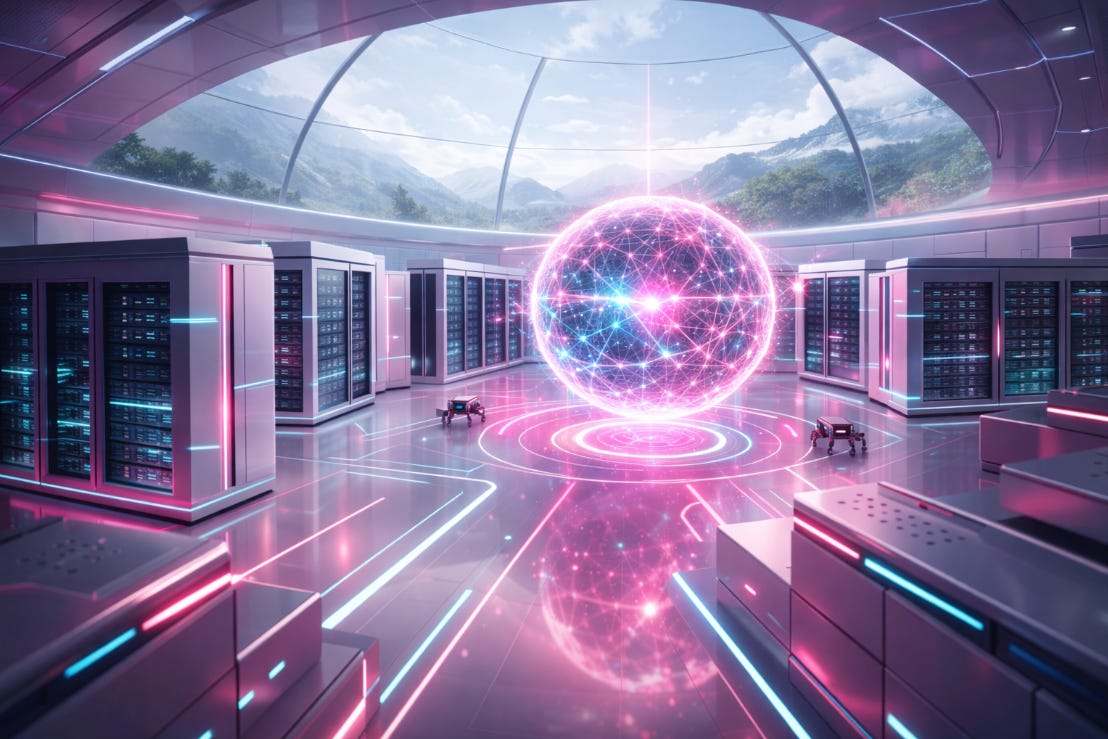
The Four-Tier Decision Framework: How Machines Learn to Run Themselves
The autonomy of a Dark Data Center Unit doesn’t arrive complete. It evolves through a decision framework that progressively expands the machine’s authority as confidence levels increase.
Tier 1: Fully Autonomous. Confidence above 95%. Action executed immediately. No human notification. Examples: routine cooling adjustments, firmware updates, thermal monitoring responses, fan speed optimization. These decisions happen thousands of times per day in any operating data center. Currently, they require human involvement — a monitoring system alerts, a human assesses, a human acts. In the DDCU architecture, they are handled by AI agents with no human in the loop.
Tier 2: Supervised Autonomous. Confidence 85–95%. Action executed with notification. Human override window. Examples: non-critical hardware swaps, power rebalancing between compute nodes, cooling mode transitions. The system acts, informs, and accepts correction. Humans see what happened and can reverse it, but intervention is not required for execution.
Tier 3: Human Approval. Confidence 75–85%. System proposes solution, awaits human decision. Examples: major component failures, network reconfiguration events, significant thermal anomalies. The human is a decision-maker but not a diagnostician — the system has already identified the problem and proposed the solution.
Tier 4: Human Only. Below 75% confidence, or strategically significant. Examples: strategic capacity allocation, customer SLA renegotiations, infrastructure expansion decisions. Humans set objectives. Machines execute.
The target: 90% of all decisions at Tier 1 or 2. Fewer than 10 human escalations per orchestrator per day. A single human managing 15–20 autonomous compute nodes — 15 to 20 megawatts of frontier AI infrastructure.
This is not theoretical. Every sensor reading from every generation-one MADC facility is training data for the autonomy systems of generation three. Every failure mode encountered in human-operated facilities is a lesson the AI learns before it needs to apply it without supervision.
The Robotics Stack: From Fixed Sensors to Humanoids
The autonomy layer requires physical implementation. Software decisions are meaningless without mechanical execution.
Class 1: Fixed robotic systems. Embedded sensors, cable management systems, automated coolant flow monitors. Already deployed in sophisticated data centers. These systems run continuously, invisibly, generating the data that makes everything else possible.
Class 2: Mobile robotic systems. Rail-mounted and wheeled inspection platforms. Thermal scanning. Vibration analysis. Automated patrol routes that cover every unit on a schedule. One mobile platform can inspect dozens of racks per hour — faster, more consistently, and with better sensor resolution than human inspectors.
Class 3: Robotic arms. The hardware manipulation layer. Drive swaps. PSU replacement. Server insertion and extraction. Filter changes. In immersion-cooled configurations, overhead gantry systems extract servers from dielectric fluid tanks without draining — using quick-disconnect couplings that allow hardware replacement in under five minutes. Versus 30–60 minutes for traditional rack-based maintenance.
Class 4: Submersible systems. The most exotic element, specific to two-phase immersion cooling. ROV-class drones approximately 30cm × 20cm × 15cm navigate within dielectric fluid for real-time thermal and visual inspection. These systems inspect solder joints, connector integrity, and thermal distribution without any fluid drainage or server removal. The global immersion cooling market reached $2.64 billion in 2025 and is projected to $16.55 billion by 2034 — the technology is production-ready.
And then the humanoids.
The Humanoid Robot Is Not Optional at Scale
General-purpose humanoid robots become viable at Generation 4 — the 10 MW DDCU architecture arriving around 2030–2032. Not because the hardware doesn’t exist earlier (Boston Dynamics, Figure AI, 1X Technologies, Tesla Optimus are all shipping or near-shipping bipedal platforms), but because the operational context doesn’t justify the cost until sites reach sufficient scale.
At 10 MW per DDCU and 10–20 DDCUs per site, you have 100–200 MW of compute infrastructure at a single location. That’s a facility worth managing with humanoid systems.
The humanoid’s value proposition in a DDCU context is specific: it can perform precision compute maintenance (replacing a failed NVMe drive) and agricultural labor (harvesting tomatoes in an adjacent aquaponic greenhouse) using the same physical platform. The same robot that responds to a thermal alarm at 2 AM is tending the farm at 6 AM.
This is not science fiction. Figure AI has demonstrated object manipulation and task execution in warehouse environments. Tesla’s Optimus program is explicitly targeting general manufacturing tasks. The convergence of frontier AI models for spatial reasoning with increasingly capable bipedal hardware is producing platforms that will be operational in commercial settings by 2027–2028.
For DDCU operations, the target humanoid specification is roughly: 1.7m height, 65 kg, bipedal locomotion with autonomous pathfinding, precision manipulation for components as small as SFP+ transceivers, computer vision sufficient for fault detection and agricultural assessment, and a 6–8 hour operational cycle before recharge.
At Generation 4 scale (10–20 units per site), the deployment of 10–20 humanoid robots per site creates a staff ratio of approximately 1 human per 25 MW of compute capacity. Compare to the current hyperscale standard of 0.5–1.0 humans per MW. That is a 25–50x reduction in human labor intensity.
The Self-Sustaining Loop: When the Machine Feeds Itself
The DDCU architecture’s deepest innovation is not the autonomy or the robotics. It is the energy loop that makes the entire system self-sustaining.
GPU compute at scale generates enormous quantities of waste heat. A 1 MW compute cluster running at 90% utilization rejects approximately 0.9 MW of heat continuously. This heat leaves the immersion cooling system at 40–55°C — warm enough to be uncomfortable in a room, hot enough to be genuinely useful for greenhouse agriculture.
At Generation 3 (1 MW DDCUs), each cluster generates 2–5 MW of recoverable thermal energy — enough to heat 5,000–10,000 square meters of greenhouse space year-round. This is not a marginal benefit. In Northern European climates, greenhouse heating accounts for 40–60% of total production costs. Waste heat from compute eliminates that cost entirely while simultaneously creating a carbon sink (plants fixing atmospheric CO2) adjacent to a carbon source (natural gas CHP combustion).
At Generation 4 (10 MW DDCUs), each cluster generates 15–25 MW of recoverable waste heat. Heated greenhouses. Aquaponic fish farms. Fruit orchards under polytunnels. Mushroom cultivation chambers. Each mature cluster produces enough food for 2,000–5,000 people annually.
The GPU’s waste heat becomes the farm’s heating system. The farm’s organic waste becomes the digester’s feedstock. The digester’s methane becomes the CHP’s fuel. The CHP’s electricity powers the GPU. The loop is closed.
This is not poetry. The thermodynamic accounting is real. The agricultural economics are real. Every element of the loop has been demonstrated in industrial settings. The DDCU architecture assembles them into a single autonomous system because the alternative — managing each element separately — leaves enormous value on the table.
The Orchestrator: The Last Human Job in the Data Center
Every element of the DDCU architecture converges on a single remaining human role: the orchestrator. Not the operator. Not the technician. The orchestrator.
An orchestrator manages 15–20 autonomous compute nodes. Their function is strategic, not operational. They set objectives. They review Tier 3 and 4 escalations. They make decisions that require human judgment — customer SLA negotiations, strategic capacity allocation, relationships with energy suppliers, expansion planning.
Everything else is machine territory.
By 2034, DCXPS projects 343 orchestrators managing 10 GW of compute capacity — roughly 29 MW per human. Compare to the traditional hyperscale model: 200+ humans per 100 MW, or 0.5 MW per human. The productivity differential is approximately 58x.
The orchestrator is not a diminished human role. It is an amplified human role. One person, with AI tools and robotic execution, has the reach of a traditional data center operations team. The work that remains for humans — the judgment, the relationships, the strategic thinking — is the work that was always most valuable and most consistently crowded out by operational noise.
The machines do the labor. The humans do the thinking.
That sentence will sound threatening to some people. It should sound liberating.
The most compelling part of this roadmap isn't just the 'dark' autonomy—it’s the thermodynamic integration. We’ve spent a decade treating waste heat as a liability to be mitigated; seeing it rebranded as the primary input for a localized food system turns the data center from a 'resource drain' into a civic anchor. If the GPU-to-Greenhouse loop holds up at scale, we’re looking at a future where compute power literally feeds the local population. That’s a powerful counter-narrative to the 'AI as a carbon-glutton' trope