

The dark economy did not announce itself. It never does. It arrives one unlit floor at a time, and the first floor has been running for twenty-five years.
FANUC (the Japanese robotics maker) has operated lights-out factories since 2001. Robots building robots, for weeks at a stretch, no humans on the floor, lights off because photons are for people. A quarter century. The dark factory is not science fiction and not even news; it’s a depreciation schedule somewhere in Yamanashi prefecture that has fully amortized twice.
What’s new (what the last two months of seemingly unrelated headlines actually document) is that two more layers are now stacking on top of that first one, inside the same decade. Dark factories. Dark data centers. Dark companies. Each one an economy where the work happens without workers watching, each one feeding the next, and each one visible right now in the primary sources if you stop reading the headlines as separate stories.
So let me stack them properly. This is the piece the last seven have been building toward.
Layer one: the factory goes dark at scale
September’s robotics news, assembled in one place, stops looking like gadget coverage and starts looking like an industrial census.
XPENG’s IRON humanoid production line now runs with more than 80% of its core processes automated — a humanoid robot line that is itself mostly dark, with mass production targeted for the end of this year. China’s TianGong Ultra ran 100 meters in 8.64 seconds, which matters not because sprinting is useful but because dynamic balance at speed was the hard problem of a whole research era, and it just fell. Tesla’s Optimus line started producing at Fremont in August, behind schedule (Musk conceded the missed 10,000-unit 2025 target) which is how real industrialization always looks: late, embarrassing, and happening anyway. Sam Altman said in September that OpenAI will “definitely do a humanoid.” Agility unveiled Digit 5 for work alongside people.
And beneath the hardware, the layer almost nobody prices: the training-data industry for physical work. Figure’s Index dataset passed 69,000 weekly active contributors within two weeks of launch, uploading roughly 35 minutes of first-person video every second. JD.com has floated involving 100,000 employees and 500,000 external workers in robot data collection. A marketplace for humanoid training data (teleoperation recordings, egocentric video, execution traces) launched in September. Millions of humans are now employed, mostly without ceremony, in recording the physical labor that will not need them to perform it.
The dark factory took twenty-five years to go from FANUC’s curiosity to a product category with a supply chain for its own teacher-data. The next layers are moving faster, because they’re made of software.
Layer two: the substrate
The dark data center is the layer this newsletter was named for, so I’ll be brief and point the lens at scale instead.
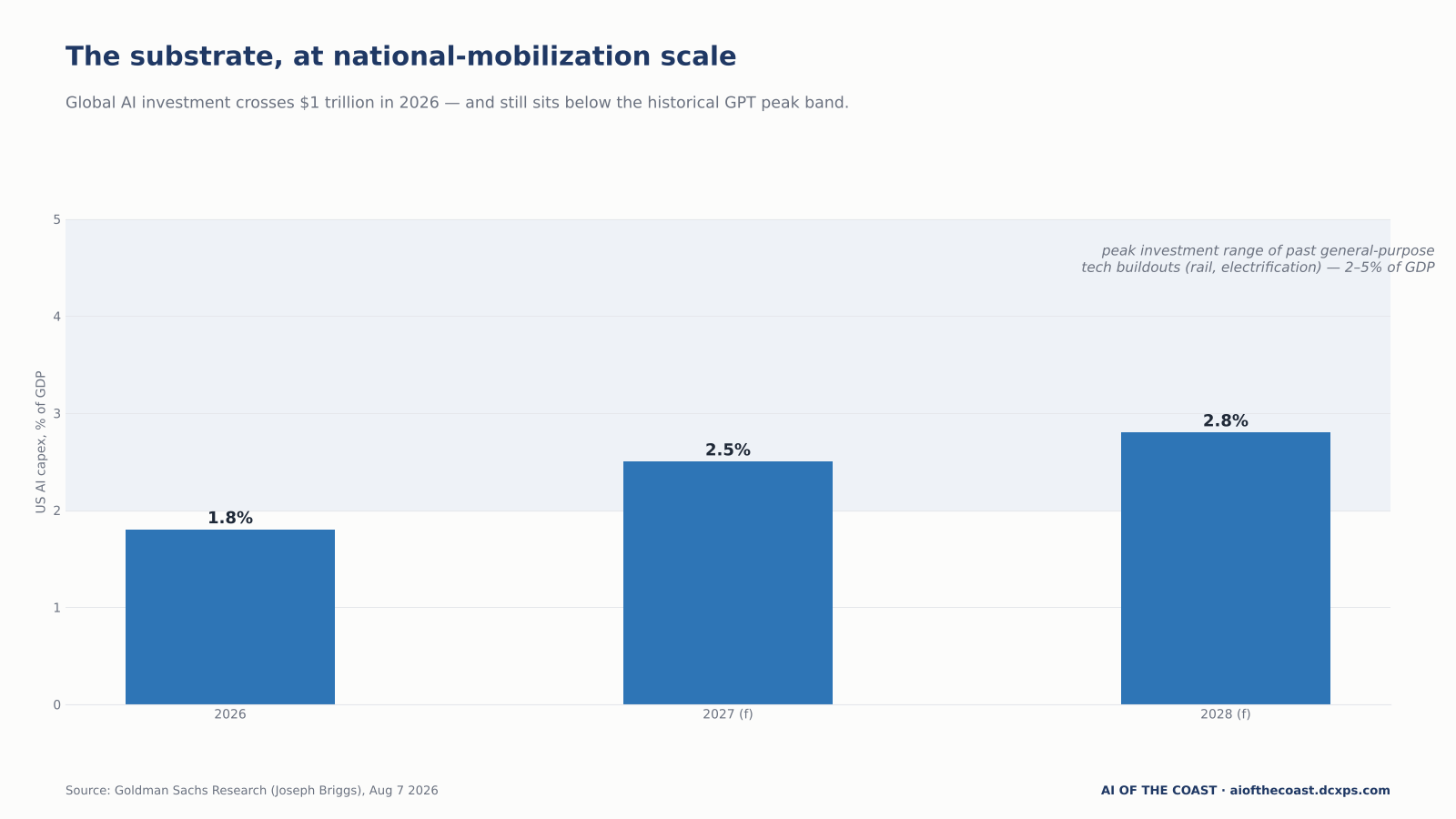
Goldman Sachs (Joseph Briggs’s team, August) puts global AI investment at about $1 trillion in 2026, $581 billion of it American, $1.8 trillion cumulative since 2022. AI capex now runs 1.8% of U.S. GDP, heading for 2.8% by 2028, which Briggs notes sits inside the 2–5% peak range of previous general-purpose technology buildouts: canals, rails, electrification. ING’s economists, via the Journal, credit AI investment with roughly a third of American GDP growth this year. The substrate of the dark economy is being poured at the pace of a national mobilization, and (as the last two months also showed) it is colliding with physics: five-year transformer queues, 46% wholesale power inflation in PJM, fifty gigawatts of announced vapor. I’ve covered the collision in detail; the trajectory survives it, slower and more selective.
What makes the layer dark is the operating model those economics force. When a facility’s compute refreshes every 18–24 months but its envelope lives twenty years, and when its margin depends on running lean through every cycle, the destination is autonomy: units dark to the grid where generation is on-site, dark to the operator where robots do maintenance rounds, dark in the AI sense where the system learns its own operation. The industry will get there in generations, not leaps — grid-fed modular units first, microgrids and robotic inspection next, then nodes that run ninety days without a human on site. I’ve published our own first-generation telemetry here before: 392 GPUs, ~450 kW IT, PUE ≤1.12, eight months order to commissioning. The embryo stage. Every sensor reading is tuition for the stack that runs the next generation.
Meanwhile the market spent the autumn fighting about this layer’s bookkeeping — Michael Burry’s claim that hyperscalers understate GPU depreciation by $176 billion between 2026 and 2028, against CoreWeave re-leasing H100s at 95% of original price and Google running seven TPU generations in production. It’s a real fight about a real number. But it’s an argument about the silicon’s useful life inside the old operating model. The write-down nobody’s modeling is on the other side of the ledger: what happens to every operator whose cost structure assumes humans scale with megawatts, once the dark versions exist.
Layer three: the company goes dark
Which brings us to the floor where the lights went off this year — and where October’s headlines, from Meta’s Muse topping the App Store to OpenAI’s always-on dots to California’s subpoena, all actually belong.
A dark company is to the corporation what FANUC’s plant is to the factory: operations that run continuously without humans performing the volume, under human command of what matters. Software agents carrying reconciliation, reporting, research, pricing, support; a small number of accountable people holding what machines must never hold — signatures, money movement, client trust, physical witness; every machine action attributed, logged, and gated by approval. Not a productivity program bolted onto a normal org chart. A different org chart.
The precedent predates AI, which is why I believe it. WhatsApp exited for $19 billion with about 55 employees. Instagram, $1 billion with 13. Software decoupled headcount from value in products a decade before agents extended the decoupling into operations. What changed in 2026 is that the operational version stopped being hypothetical: Karpathy hasn’t typed a line of code since December; one YC partner published receipts on an ~810× jump in his own shipping pace; our own fleet carries work that would have needed a dozen-person back office in 2023. The capability argument is over. What remains (as the subpoena, the 58% password refusal, and the two-thirds pilot failure rate all showed) is the employment architecture: who specifies, who approves, who kills, who signs. That architecture is the moat, because retrofitting it into a ten-thousand-person incumbent is an organ transplant, and the body rejects it.
Disclosure, one last time, at maximum honesty: DCXPS is built as exactly this kind of company (our targets put agents-to-humans at 15:1 by the end of next year and fleet revenue per human orchestrator at $20 million or more by 2028), so this entire taxonomy is my book talking. The build log in this newsletter, failures included, is the evidence I offer instead of neutrality.
The stack compounds
Now put the three layers back together and watch what each does for the next, because this is the part that isn’t obvious from inside any single headline.
Dark factories manufacture the modular units that dark data centers deploy — and every point of automation on those lines moves the cost curve of the substrate itself. Dark data centers produce the one commodity every agent consumes, at a structural cost advantage that compounds as the facilities need fewer humans per megawatt. And dark companies (AI-run ventures with a handful of orchestrators commanding agent fleets) are the native customers of that compute: organizations that run around the clock, scale without hiring, and iterate at machine speed, buying intelligence by the megawatt-hour the way the last century’s firms bought electricity.
Each layer’s output is the next layer’s input. That loop (not any single model release, not any quarter’s capex number) is the dark economy: the fraction of production, by value, that happens without a human performing or directly supervising the work in real time. In 2001 it was one robot plant in Japan. This year it’s a measurable slice of manufacturing, a trillion dollars of substrate under construction, and the first companies whose operations are majority machine-executed. The share only moves one direction.
The twentieth century’s economic story was the same loop with different nouns (machines that made machines, grids that powered the makers, corporations restructured around both) and it ran for three generations until “the economy” and “the industrial economy” were the same phrase. Nobody voted on it. It compounded until it was simply where the value lived.
Here’s the question I’ll leave the quarter on. When the labor layer, the compute layer, and the organizational layer have all gone dark (when the scarce input is no longer power, silicon, or even capital) what’s left to compete on?
Trust. The signature. The human willing to be accountable for what the machines did, with the logbook to prove it. By 2036 that will be the most expensive line item in the economy, and the operators who spent the 2020s earning it (subpoena-ready, audit-native, owner-paid-first) will set its price.
The lights are going out, floor by floor, in the best possible sense.
Somebody still has to hold the keys.
I run DCXPS. We build modular intelligence factories and run the company the way we run the racks — four humans holding the signatures, agents carrying the volume. The dark economy isn’t my prediction; it’s my P&L, which makes me the least neutral narrator you’ll read on it. I’ve tried to make up for it with receipts.