


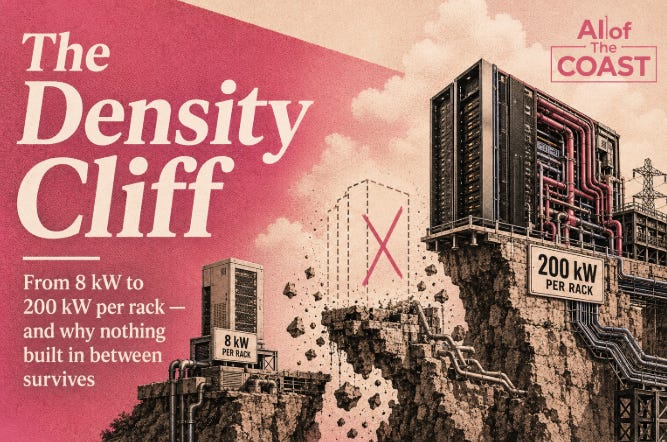
There is a number that almost nobody outside the data center engineering community is paying attention to, and it might be the most important number in AI infrastructure right now. Not the $400 billion in capex. Not the 100 GW of projected US capacity. The number is kilowatts per rack — and it is moving faster than any other metric in the infrastructure landscape.
In 2021, the average data center rack drew about 8 kilowatts of power. By 2024 that had risen to 17 kW. By early 2026, AI-specific racks were already exceeding 50 kW. Nvidia’s current Blackwell architecture is pushing toward 120 kW per rack. The next generation, anticipated for 2027-2028, is targeting 200 kW and above. That is a 25x increase in power density over seven years.
Why This Is an Architectural Discontinuity, Not an Upgrade
Consider what has to change when you go from 17 kW to 120 kW per rack. The power delivery infrastructure — cables, busbars, PDUs — must be redesigned from the floor up. At 120 kW, a standard rack draws roughly 500 amps at 240 volts. The cabling alone for a 1,000-rack AI cluster at that density represents a fundamentally different electrical engineering problem than a conventional data center.
The cooling systems change entirely. Standard computer room air handlers, which move large volumes of cool air through hot aisles, become physically inadequate above 30 kW per rack. At 50 kW, you need rear-door heat exchangers at minimum. At 120 kW, you need direct liquid cooling — coolant pipes routed directly to the heat-generating components. At 200 kW and above, the leading approach is immersion cooling, where the entire server assembly is submerged in a non-conductive dielectric fluid.
Immersion cooling requires a flooring system capable of supporting the weight of immersion tanks full of dielectric fluid — significantly heavier than standard server racks. It requires plumbing for the fluid circulation. It requires different sealing systems for the building envelope. A conventional raised-floor data center cannot simply be “converted” to immersion cooling. You would need to essentially rebuild the facility interior.
8 kW
Average rack 2021 — air cooling, standard facility
30 kW
Air cooling limit — above this, problems begin
120 kW
Nvidia Blackwell — requires liquid cooling
200 kW+
Next-gen target — immersion or direct-to-chip only
The Stranded Capital Problem
Here is where this becomes an investment thesis rather than just an engineering observation. The hyperscale data center buildout currently underway represents the largest capital investment in the history of computing. Microsoft is spending $80 billion in 2025 alone. Amazon, Google, Meta, and others are each committing tens of billions annually. A significant portion of that capital is being deployed into facilities that are being designed and built today, at 2024-2025 density assumptions, for facilities that will not be operational until 2027-2030.
By the time those facilities open, the workloads they will need to serve will require 120-200 kW per rack, not 20-30 kW. The facilities will be operational but structurally under-equipped for the frontier AI workloads. This is not a small mismatch. A facility designed for 25 kW average density will have roughly one-fifth the effective AI compute capacity per square foot of a facility designed for 120 kW density. That is the difference between serving 1,000 frontier AI racks and 200 frontier AI racks in the same building footprint.
“The density gap doesn’t just affect efficiency. It determines whether a facility can physically serve the workload at all. Air cooling a 120 kW rack doesn’t make it run slower. It makes it fail.”
The Modular Advantage at High Density
A modular data center has a fundamental advantage in a high-density world: it can be designed specifically for the density requirements of the hardware being deployed, rather than averaged across a multi-decade facility lifecycle. When a hyperscale operator builds a campus that will serve 50,000 racks over 20 years, they have to make assumptions about average density that will inevitably be wrong.
A modular deployment for a specific AI workload starts with the GPU specification and works backward to the facility design. What does a cluster of 10,000 Blackwell GPUs actually need? Specific power delivery. Specific cooling architecture. Specific network topology. The modular facility is designed to those specifications, deployed, and operated. When the next GPU generation arrives with different specifications, new modular units can be deployed alongside or in replacement, without stranding the existing infrastructure.
This is the engineering logic that the market is independently converging on. At Data Center World 2026, multiple vendors were presenting integrated rack-level solutions — power, cooling, and compute in a single deployable module — designed explicitly for the density requirements of current and next-generation AI hardware. The modular model is not a workaround for organizations that cannot afford hyperscale. It is the architecturally correct answer to a density problem that hyperscale cannot solve without effectively rebuilding itself.
The 200 kW Horizon
The 200 kW per rack figure is not science fiction. It is what Nvidia and its OEM partners are currently engineering toward. At 200 kW, a single rack of AI accelerators draws enough power to supply roughly 150-200 average US homes. A modestly sized AI data center with 500 such racks would require 100 MW of dedicated power — equivalent to a medium-sized gas-fired power plant running at full output.
This is why the most forward-looking AI infrastructure operators are no longer looking at grid interconnection as their primary power strategy. They are building dedicated power generation — natural gas turbines, small modular reactors, fuel cells — co-located with the compute. Because at 200 kW per rack and thousands of racks, you cannot simply ask the local utility for another 100 MW. The grid was not designed for that kind of point load. The transformer lead times alone would delay your deployment by three years.
The density cliff is the physical forcing function that makes modular, energy-first infrastructure not just attractive but necessary. Hyperscale was designed for a world of 8-17 kW racks. That world is ending. The next world requires a completely different architectural approach.