

Microsoft committed $80 billion to data center expansion in fiscal year 2025. Google committed $75 billion. Amazon pledged $100 billion. Meta announced $65 billion. That’s $320 billion in a single year, from four companies, building facilities that will require 60+ months to complete, in a regulatory and grid environment that makes 60 months look optimistic.
This is not a success story. This is a structural trap being mistaken for a strategy.
The AI Arms Race Built on Quicksand
The hyperscale buildout began in earnest in 2022 when ChatGPT demonstrated that AI services had consumer demand.
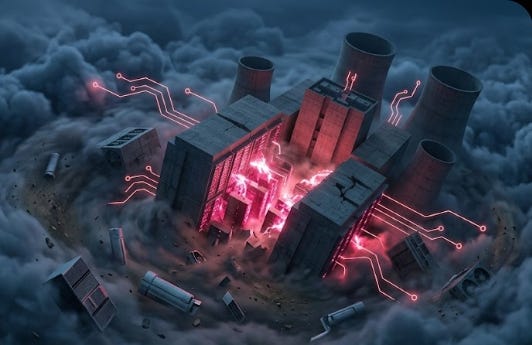
What followed was the largest coordinated capital deployment in the history of technology infrastructure — faster than the telegraph network, faster than electrification, faster than the fiber optic buildout of the 1990s.
The scale is genuinely staggering. As of mid-2025, more than 1,000 data centers were under construction or permitted in the U.S. alone, with combined capacity of 75 GW — comparable to the peak daily demand of New York City. The global AI infrastructure market requires an estimated $6.7 trillion in investment through 2030, and roughly $24.6 trillion by 2034.
Every major technology company, every sovereign wealth fund, every infrastructure REIT, and a remarkable number of people who had never thought about cooling towers before 2022 poured capital into the same bet: that large, centralized, grid-connected data centers were the correct substrate for AI.
They were betting on a technology that had already started making their bet obsolete.
The Five Structural Failures of Hyperscale
Let me be specific, because this matters. Hyperscale AI data centers are not slightly suboptimal. They are structurally wrong for the workload they’re designed to serve. Here’s why.
1. The Grid Has Already Failed Them
ERCOT — the Texas grid operator — faces 137 GW of pending interconnection requests. The entire installed generating capacity of Texas is roughly 150 GW. U.S. electric utilities collectively face $174 billion in capital expenditure demands. AI data centers project natural gas consumption growth of 3x by 2030.
The arithmetic is simple and brutal: demand is growing at 23% annually while grid capacity grows at 2–3%. This is not a temporary bottleneck. It is a structural failure of the centralized power model when confronted with exponentially growing, geographically concentrated demand.
Every hyperscale campus being built today is competing for the same oversubscribed grid connections. Ashburn, Virginia — ground zero of American data center density — has effectively run out of available power. Silicon Valley, Northern Virginia, Phoenix, Dallas — every major data center hub faces identical constraints.
The companies building here aren’t ignorant of this. They’re hoping their projects complete before the queue closes entirely. It’s infrastructure roulette at $50-billion-per-spin.
2. Construction Time vs. Hardware Lifecycle
A traditional hyperscale data center takes 48–72 months from groundbreaking to revenue-generating operations. That’s four to six years. During those four to six years, GPU performance will roughly double — twice. The cooling infrastructure designed for NVIDIA H100 racks consuming 700W per GPU will be inadequate for successor architectures pushing 1,000–1,500W per GPU. The power distribution designed for today’s rack densities will require expensive retrofitting for tomorrow’s.
Microsoft and Google both reported in 2024 that significant portions of their new facilities required retrofit work before operations began — because hardware specifications had shifted during the construction window. This isn’t a project management failure. It’s a fundamental mismatch between 48-month construction cycles and 18-month technology cycles.
3. Capital Lockup Destroys Return Economics
Traditional data center capital is locked for approximately 60 months before the first dollar of revenue. You approve the budget, begin site selection and permitting, break ground, build, install power infrastructure, install cooling infrastructure, rack hardware, run commissioning — and at the end of 60 months, if everything went perfectly (it didn’t), you begin generating revenue.
The cost of capital alone on a $5 billion facility over 60 months at 7% interest is roughly $1.75 billion before a single GPU renders a single token. This is not a trivial inefficiency. It is a structural drag that shapes every financing decision, every customer contract, every operational tradeoff.
Compare this to an architecture where capital begins generating revenue at month four or five of a ten-month deployment cycle. The difference isn’t incremental. It is the difference between a real estate company and a technology company.
4. The Human Dependency Problem
A 100 MW hyperscale data center employs somewhere between 50 and 200 people in direct operations — network engineers, hardware technicians, security staff, facilities managers, cooling specialists. The staff-to-compute ratio is roughly 0.5–1.0 humans per MW.
This is expensive. It is also a constraint. Sites must be located near labor markets. Facilities must provide facilities for those workers. Benefits, turnover, training costs — the human element adds 15–25% to operational expenses beyond the hardware.
More subtly: human presence introduces a site selection constraint. Data centers locate near cities, near universities, near the workers who maintain them. This means they concentrate in geographies that are also grid-constrained, expensive, and heavily regulated.
5. The Hardware Refresh Catastrophe
When a hyperscale data center’s compute becomes obsolete — in 4–5 years, not 20 — the facility does not gracefully transition. It requires a comprehensive retrofit. Power distribution systems designed for one generation’s voltage requirements must be redesigned for the next. Cooling infrastructure built for air-cooled racks must be rebuilt for liquid-cooled racks. Floor loading, cable management, network architecture — everything is coupled to the hardware generation it was built for.
The cost of a major compute refresh in a traditional hyperscale facility runs 60–70% of the original construction cost. You don’t upgrade a hyperscale data center. You demolish it in place and rebuild inside the same shell.
The Capacity Mirage: 75 GW Under Construction, Already Behind
Here’s the number that should stop every infrastructure executive in their tracks: as of mid-2025, 75 GW of data center capacity is under construction in the U.S. alone. This is an enormous number. It is also already insufficient.
Goldman Sachs estimated in early 2025 that by 2030, AI workloads alone will require an additional 200–300 GW of compute capacity globally. The 75 GW under construction represents roughly 25–37% of that near-term need — before accounting for inference scaling, edge deployment, sovereign AI programs, or the workloads that don’t exist yet because the models to create them haven’t been trained.
The industry is building at maximum speed. It is building the wrong thing at maximum speed.
A $320 billion construction program is not a solution to the infrastructure crisis. It is the crisis, wearing a hard hat.
What Comes After the Gigawatt
The hyperscale era is not ending because it failed. It’s ending because it succeeded completely — and that success revealed every structural limitation simultaneously.
The grid can’t support it. The permitting timelines can’t support it. The hardware refresh economics can’t support it. The capital efficiency can’t support it. The concentration risk can’t support it. Every growth driver of the AI era — exponential workload growth, geographic expansion, hardware generational churn — amplifies the weaknesses of the centralized model.
The question isn’t whether the hyperscale model continues to exist. It will. Microsoft and Google will still operate enormous campus data centers in 2040. But they will no longer be the dominant form of AI infrastructure. The dominant form will be something structurally opposite: distributed, autonomous, grid-independent, modular, and self-sustaining.
The gigawatt delusion is the belief that more of the same thing solves a structural problem. It doesn’t. History is littered with industries that mistook scale for strategy. The railroads. The telecom companies of the 1990s. The cable television operators of the 2000s.
The infrastructure of the future doesn’t look like Ashburn, Virginia with more capacity. It looks like something that doesn’t need Ashburn at all.