

The railroads changed the world. Railroad investors lost everything. Fiber optic cables carry the internet. Telecom investors lost their shirts. AI data centers will change the future. The question is whether today’s architecture will still be standing when they do.
I want to describe something that doesn’t fully exist yet but will exist because the physics and economics are already pointing directly at it. Not a data center. Something that has outgrown the category
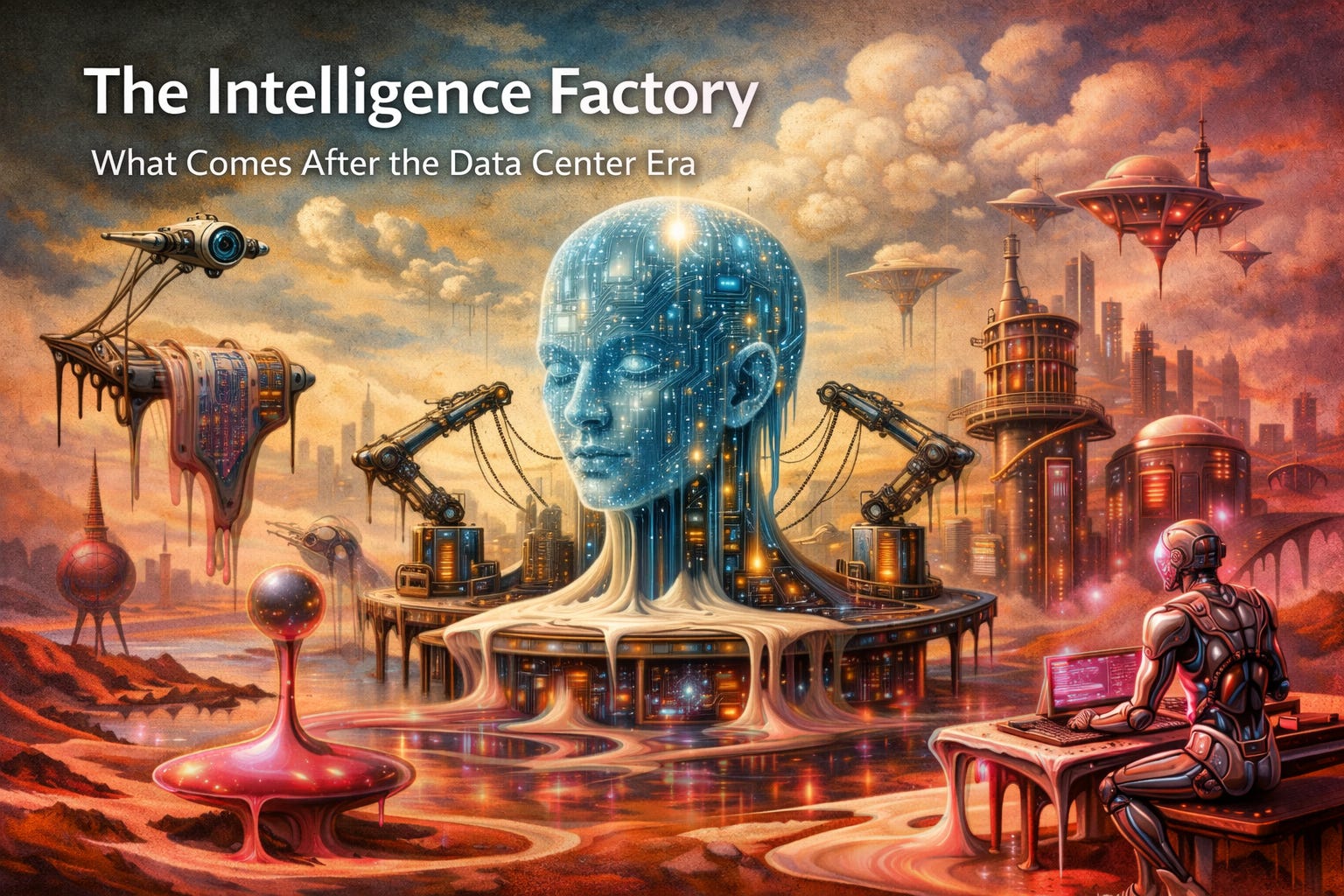
The Five Generations in Summary: What We’re Progressing Toward
Generation 1 (2026–2027): The MADC. 1 MW modular units at brownfield sites with existing grid. Human technicians on-site. Revenue from month five. The embryo.
Generation 2 (2027–2028): The MADC+. On-site CHP power generation. First-generation robotics. 85%+ grid independence. The cluster begins to breathe on its own.
Generation 3 (2028–2030): The DDCU Gen 1. Zero grid dependency. Zero permanent human presence. Full robotic maintenance. The term “Dark” becomes real: dark to the grid, dark to the operator, dark in the AI sense — self-optimizing, emergent. The agricultural loop begins: waste heat from immersion cooling powers adjacent greenhouse structures.
Generation 4 (2030–2032): The 10 MW DDCU. Scale leap from 1 MW to 10 MW per unit. Humanoid robots performing both compute maintenance and agricultural labor. Integrated farms producing food for 2,000–5,000 people per cluster annually. EBITDA margins expanding toward 93%.
Generation 5 (2032–2034+): The Robotic DC City. Multiple DDCU clusters converging into 100–200 MW campuses managed by fleets of 200–500 humanoid robots. Human population: 5–10 orchestrators. Dark Factories manufacturing next-generation DDCUs on-site. AI designing the hardware that the next AI will run on.
The data center is a cocoon. What emerges from it is something else entirely.
Why Big Data Centers Will Fail — The Structural Argument
Let me be direct, because this matters and the conventional wisdom is wrong.
Traditional hyperscale data centers will not fail because they’re operated incompetently. They’ll fail because they’re architecturally unsuited to the problem.
The grid cannot scale to serve them. The U.S. grid grows at 2–3% annually. AI compute demand grows at 23% annually. These lines cross around 2028–2030 in most projections. By then, new hyperscale interconnection will require regulatory interventions and energy contracts of the kind that currently require 7+ years to negotiate. The facilities being announced today — already committed to 48–72 month construction cycles — will emerge into a grid environment that has materially worsened since their groundbreaking.
The hardware they’re designed for will be obsolete before they open. NVIDIA’s Vera Rubin architecture, announced in 2025 for shipping in 2026, operates at rack densities and cooling requirements that require significant infrastructure modification from facilities designed for the Hopper architecture in 2022–2023. Every hyperscale data center in the 2025 construction pipeline will require expensive retrofitting to serve 2028-class hardware. This is not an edge case. It is the normal operating rhythm of GPU development intersecting with a 5-year construction cycle.
The capital efficiency is terminal at scale. When Microsoft commits $80 billion with a 5-year return horizon, the compound financing costs alone consume a material fraction of the return. When a DDCU generates revenue from month five, the same capital compound at a dramatically different rate.
Hyperscale data centers will continue to exist. For certain workloads — consumer inference at population scale, certain national security applications, ultra-low-latency applications requiring metropolitan proximity — hyperscale concentration provides advantages that distributed modular systems cannot replicate. But the marginal unit of AI infrastructure investment — the next dollar deployed in the infrastructure sector — will increasingly find better returns in DDCU architectures than in new hyperscale campus construction.
The Robotic DC City: What It Actually Means to Live Next to One
A Robotic DC City in 2034 covers 50–200 hectares. It contains 10–20 DDCU Gen 2 units (10 MW each), giving it 100–200 MW of frontier-class AI compute. Its central energy compound delivers 200+ MW from biogas, natural gas, wind, and solar. Its humanoid robot population is 200–500. Its human population is 5–10 orchestrators. Its agricultural output feeds 10,000–25,000 people annually.
It generates AI compute at frontier scale. It generates its own electricity. It grows food for surrounding communities. It deploys humanoid robots to maintain both the compute infrastructure and the agricultural systems. It hosts hundreds of Dark Startups that exist entirely within its compute fabric. It exports surplus energy to the local grid.
The economic output of a single Robotic DC City rivals a small municipality. The social footprint is fundamentally different: it requires almost no human labor for operations, while generating agricultural output, energy export revenue, compute revenue, and startup equity value simultaneously.
This is not dystopian. The criticism that autonomous systems eliminate human work misses what they actually produce: the conditions under which uniquely human work becomes possible at scale. The machines do the labor. The humans set the objectives. That inversion — not the machines themselves — is the civilization-scale shift.
The Dark Factory: Infrastructure That Builds Itself
Generation 5 introduces the element that completes the loop: the Dark Factory, manufacturing next-generation DDCUs within the DC City itself.
AI systems running on the current generation’s compute design optimized compute nodes for the next generation. Robotic systems fabricate, wire, and test. Each generation of DDCU is designed by AI running on the previous generation. Target production rate: 100+ units per month at 40–60% cost reduction versus first-generation manufacturing.
The significance of this is not primarily economic, though the economics are compelling. It is architectural. An infrastructure that manufactures its own successors has achieved a form of self-replication. The limiting factor is no longer supply chain, manufacturing capacity, or capital deployment speed. The limiting factor is energy and land — the raw materials of the physical world.
At 2040 scale: 5,000+ DDCUs across 300+ sites globally. 50 GW total compute capacity. $150 billion annual revenue. 1,500+ AI-native portfolio companies. 10 million people fed. $200 billion Ventures AUM. $40 billion invested in intelligence research.
The Falsifiable Claims: What Has to Be True for This to Work
I don’t traffic in visions without falsification triggers. Here’s what has to happen for this trajectory to be real.
By end 2026: First MADC cluster operational. Revenue within 6 months. Falsification: no operational unit.
By 2027: 20+ MADCs across EU. First on-site CHP. Falsification: no grid-independent capability.
By 2028: First DDCU operates 90 days with zero humans on-site. Falsification: no autonomous operation exceeding 30 days.
By 2029: First waste-heat greenhouse produces food commercially. Falsification: no agricultural output.
By 2030: 800 MW deployed, top-3 AI infrastructure globally. Falsification: fewer than 300 MW operational.
By 2031: First humanoid robots performing dual compute and farm maintenance. Falsification: no humanoid integration.
By 2034: 10 GW, $44 billion revenue, $19.8 billion Ventures AUM, DC Cities operational. Falsification: fewer than 5 GW operational.
These are not aspirations. They are the predictions whose failure would require the thesis to be revised or abandoned.
The railroads changed the world. The question is never whether the technology transforms civilization. The question is whether the architecture underlying it survives the transformation it enables.
What Actually Changes
The transition from hyperscale data centers to DDCUs is not just an infrastructure story. It is a story about what becomes possible when the constraints that have shaped AI development since 2022 are removed.
The grid constraint is removed. Compute can deploy where power is abundant, not where permits allow. The geography of AI intelligence expands from a handful of data center corridors in Northern Virginia, Phoenix, and Dublin to wherever a truck can reach and biogas or wind or natural gas can be extracted.
The hardware refresh constraint is removed. When the compute module swaps and the energy compound persists, there is no demolition-and-rebuild cycle. Each GPU generation slots into existing infrastructure. The 18-month hardware cycle and the 5-year facility cycle are no longer in conflict.
The capital efficiency constraint is removed. Month-five revenue versus month-sixty revenue compounds dramatically over a 15-year infrastructure build.
The human labor constraint is removed — not by eliminating humans, but by amplifying each human’s productive scope by orders of magnitude.
What you get, at the far end of this trajectory, is compute as ambient infrastructure. Not a building you go to. Not a service you buy from a provider whose data center you’ll never see. Compute as a distributed, self-sustaining, autonomously-managed resource that is as ubiquitous as the internet — and as invisible.
The data center era ends not with a bankruptcy or a crisis. It ends the way every technological era ends: gradually at first, then all at once, with the winners being the ones who stopped building cathedrals and started building something that could breathe.
The Intelligence Factory is not a data center.
The Intelligence Factory is what a data center becomes when it stops needing us to survive.