

Two numbers are currently coexisting in the American economy that have no business coexisting.
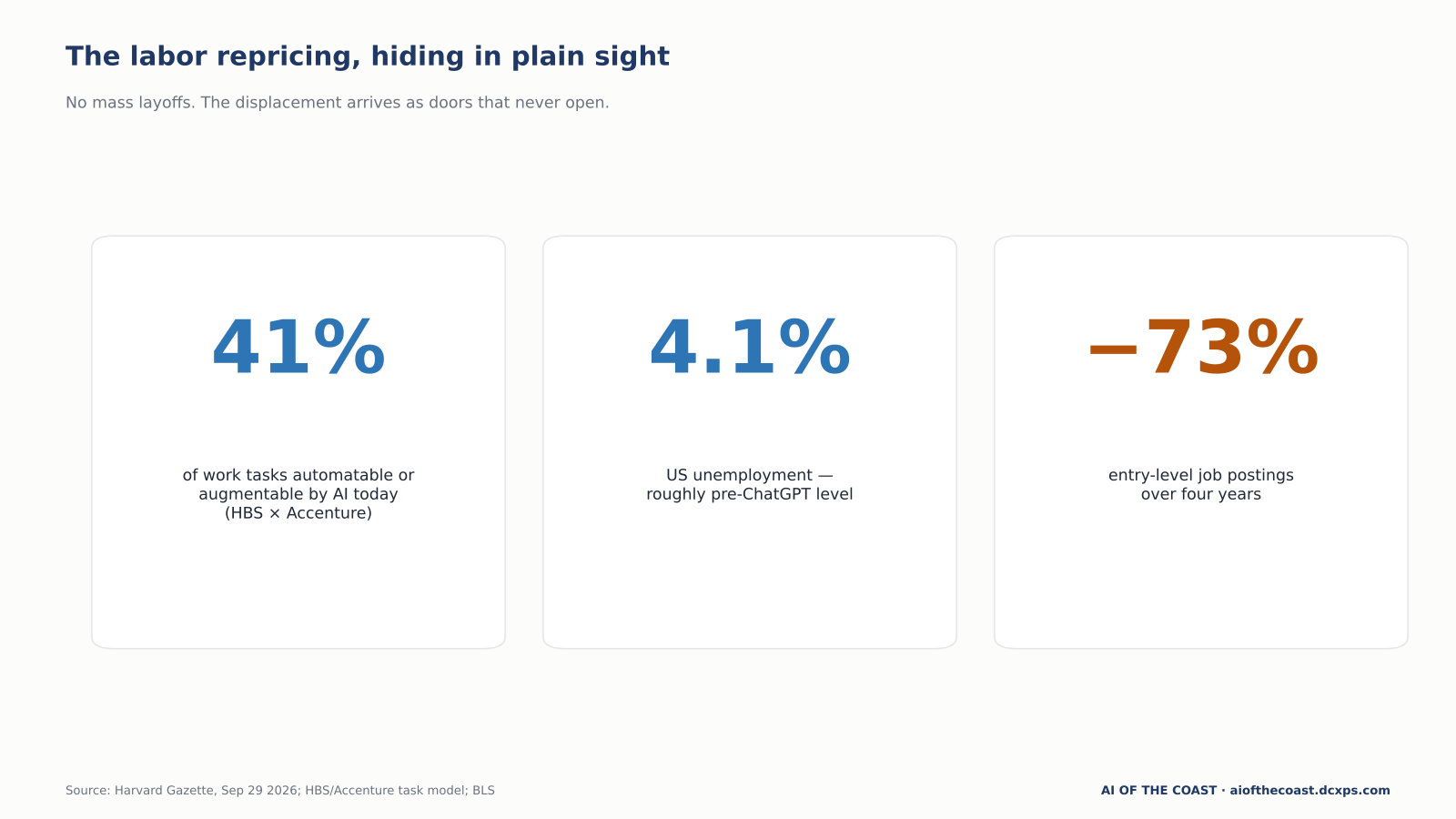
Forty-one percent of work tasks can be automated or augmented by AI today — that’s Joseph Fuller at Harvard Business School, modeling with Accenture Research, published this fall. And unemployment is sitting at roughly 4.1%, about where it was before ChatGPT existed.
Half the spreadsheet says the work is automatable now. The other half says nobody’s losing their job over it. In July I wrote about AI quietly gutting the junior job market, and the most common pushback I got was some version of: where are the mass layoffs, then? Harvard’s economists spent September asking the same question, and their answer (buried under academic politeness) is the most important labor-market insight of the year.
The layoffs aren’t missing because the technology fell short.
They’re missing because the organizations did.
The absorption problem
Fuller’s companion finding is the tell: only about one-third of corporate AI experiments succeed. He blames weak training, poor data, and employees who don’t understand the tools. All true, and all symptoms of the same disease I keep writing about from the operator’s side: companies are trying to deploy a workforce without building an employer.
Think about what the 67% failure rate actually means mechanically. A model that can do 41% of tasks meets an organization with no specification for which tasks, no golden set to measure against, no approval queue, no owner, no kill criteria — and produces a pilot that embarrasses everyone quietly enough to be renewed next quarter. Multiply by a few thousand enterprises and you get exactly the macro picture we have: enormous stated capability, negligible structural displacement, and CFOs admitting in surveys (Fortune ran one in March) that AI-attributed layoffs are running roughly nine times last year’s pace and still a fraction of the doomsday predictions.
Raffaella Sadun, also at Harvard, adds the human layer: executives chase the shiny object, discover their employees’ firm-specific tacit knowledge is doing far more load-bearing work than the org chart admits, and stall. She calls the idea that AI removes the need for human capital investment “a terrible trap.” She’s right — and notice that her trap and Fuller’s failure rate are the same finding from opposite ends. The constraint on AI labor substitution in 2026 is not model capability. It is management architecture: the specification, measurement, and accountability machinery that turns capability into dependable output.
Which is why the displacement, where it’s real, is happening in the one place that machinery isn’t required.
The door closes before the desk empties
You don’t need governance architecture to not hire someone. And so the labor impact of AI is arriving not as layoffs but as a quietly withdrawn ladder: entry-level job postings are down by as much as 73% over four years, by counts cited in the Harvard coverage. Dario Amodei’s 2025 warning (AI could eliminate half of entry-level white-collar jobs within five years) was received as a prediction about firings. Watch the postings data instead: it’s materializing as positions that never open.
Here’s the operator’s confession, because I owe you one: my company runs on a rule that makes this dynamic explicit instead of accidental. Before we hire a human for any function, someone writes a failure memo — which agent was tried, at what level of our commissioning ladder, and why it failed. No memo, no requisition. The result is a company where agents carry the operational volume and the humans we do bring on hold judgment, relationships, and signatures.
I will not pretend this scales to the whole economy painlessly. A failure memo is honest inside one firm; across fifty million firms it’s a generation of graduates meeting a labor market whose bottom rung is being sawed off while the official statistics glow. The Klarna data point (an assistant doing the work of roughly 700 full-time agents) is three years old now. Karpathy says he hasn’t typed a line of code since December. Garry Tan published his own toolchain showing three production services and forty-plus features shipped in sixty days, part-time. Each story is an individual or a firm discovering what our failure memos keep documenting: for a growing class of well-specified work, the agent clears the bar.
The honest framing is that we are living through a labor repricing disguised as a non-event. Doug Elmendorf’s NBER work with Karen Dynan and Louise Sheiner models the scenario band, and their reference point is instructive: the China shock cost 1.5 to 2 million American jobs across 2000–2007 and rearranged the country’s politics for two decades. Their AI scenario implies roughly 3 million people out of work at any given time — about 2% of the labor force in permanent churn. Not a crash. A tax, paid continuously, by whoever happens to be standing on the wrong rung.
The contrarian read: the slow part is almost over
Now the part of the argument I’d want challenged, because it’s the one with my fingerprints on it.
Most commentary treats the 67% pilot-failure rate as evidence the AI labor story is overhyped. I read it as a dam, not a verdict. Capability is sitting at 41% of tasks and compounding on the model curve. What’s lagging is the management layer — and management layers, unlike physics, copy fast once a working template exists. The telephone needed fifty years of switchboard institutions; the spreadsheet needed about five years of accounting departments retooling. The agent-employment architecture (specification, golden sets, approval queues, kill bars, audit logs) is being standardized right now, partly by operators like us, partly by the legal system (October’s subpoena did more for agent governance budgets than every consulting deck of 2025), partly by vendors bolting it on.
Accenture’s survey shows 52% of top executives expecting AI to increase entry-level hiring. I’d love that to be true, and there’s a version of it that is: Fuller already helps firms redesign junior roles so new engineers also carry sales and product exposure — apprenticeships for judgment instead of repetition. But watch what the number actually measures: expectations, from the same executive class currently failing two-thirds of its pilots. The postings data measures behavior. When expectations and behavior diverge by 73 points, bet on behavior.
So the sequence I expect, stated falsifiably: the pilot failure rate halves within two years as employment architecture commoditizes; task substitution converts from pilots into baseline operations with no layoff headlines, through attrition, hiring freezes, and re-scoped roles; and entry-level work bifurcates — the repetition track continues shrinking toward zero while a new bottom rung appears with a different spec entirely.
The first job of the next decade
Because here’s what the failure memos also document, with equal stubbornness: the agents fail constantly. They fail on ambiguity, on unowned context, on anything the specification didn’t anticipate, on tasks where the real requirement was a relationship. Every one of those failures is a human job description being written in real time.
We call that human an orchestrator — someone who commands a fleet of agents, owns their golden sets, reads their digests, catches their drift, and signs for their output. It is not a junior role in the old sense; it’s closer to a line manager whose reports happen to be software. The skills are specification writing, evaluation design, exception judgment, and the unglamorous discipline of review. Nobody is teaching this. There is no major for it, no apprenticeship track, no certification, while every company serious about agents is quietly discovering it’s the scarcest hire on the planet.
That’s the policy conversation worth having, far more than the layoff watch. Elmendorf’s crew proposes wage insurance, retraining, shorter weeks — reasonable cushions, all designed for the China-shock shape of displacement. The sharper intervention is upstream: rebuild the bottom rung around supervision instead of repetition, the way industrial economies once rebuilt craft apprenticeships around machine operation. The twentieth century turned farmhands into machinists and machinists into engineers inside two generations.
The machines never stopped needing people. They changed what the first job was.
It’s changing again — in postings data, not pink slips, which is exactly why almost everyone is looking at the wrong chart. The layoffs that refuse to arrive are not reassurance.
They’re the quiet before the re-spec.
I run DCXPS, an AI-native infrastructure operator. The failure-memo rule and the orchestrator role described above are our own operating practice (our targets put agents-to-humans at 15:1 by the end of 2027) so on this topic I am both witness and interested party. The Harvard, NBER, Accenture, and Fortune figures are theirs.