
The best business in AI right now is not models. It’s not GPUs. It’s not even power.
It’s DRAM.
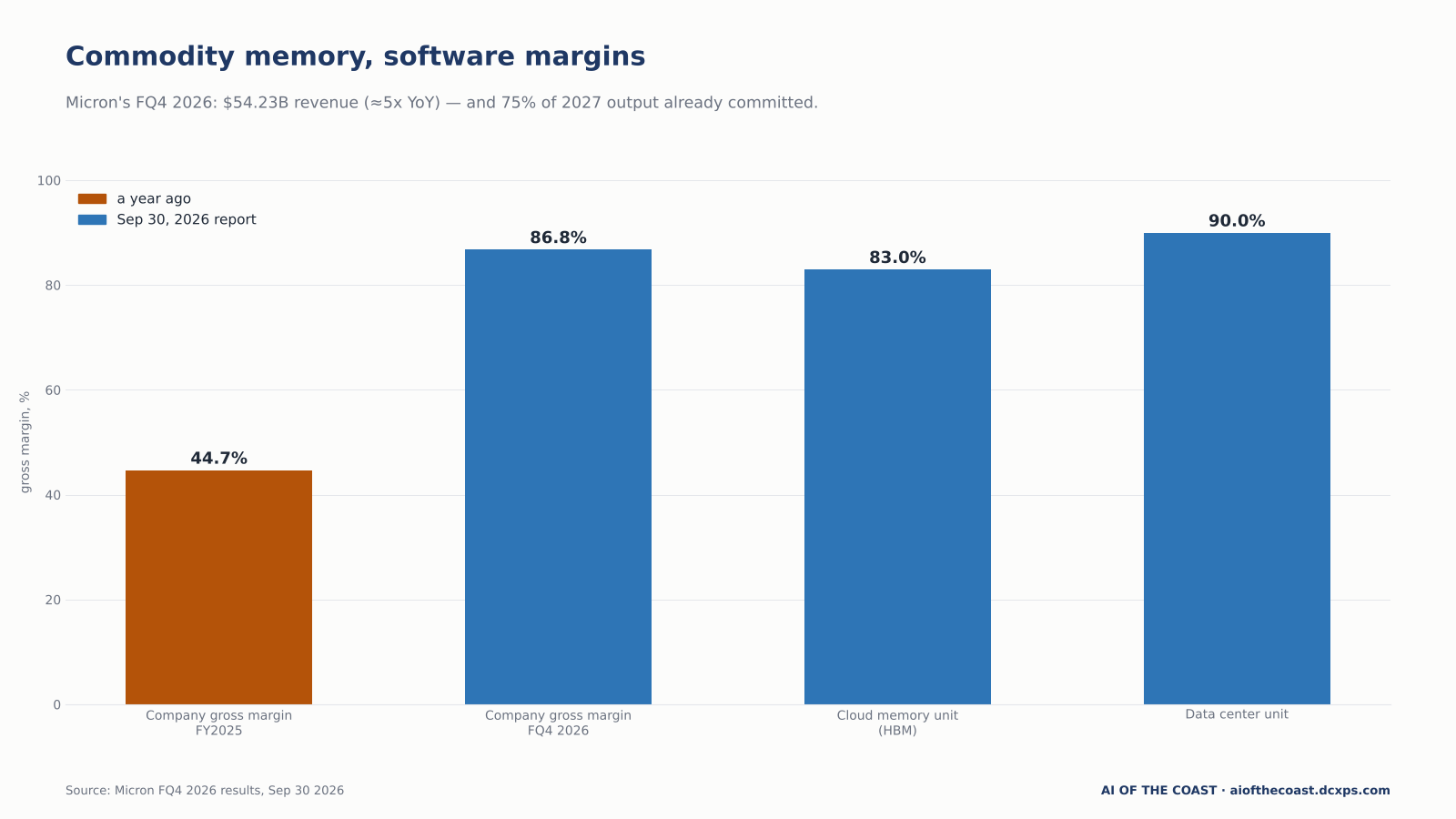
On September 30, Micron reported a quarter that should have ended every lazy “picks and shovels” metaphor in tech writing. Revenue of $54.23 billion for the quarter — nearly five times the prior year. Net income of $37.7 billion. Company-wide gross margin of 86.8%, up from 44.7% twelve months earlier. The core data center unit did $18 billion at a 90% gross margin. Ninety. A commodity memory maker is now running software margins on physical product, and guiding the next quarter to $61.5 billion.
Then CEO Sanjay Mehrotra said the sentence that reprices everything downstream: “We do not have line of sight to when supply and demand will return to balance.” About 75% of Micron’s entire 2027 output is already committed. Much of 2027 HBM is sold out at prices “much higher” than this year’s. Current sales conversations are about 2028.
They are selling memory two years forward, at prices unknown, to buyers who cannot say no.
Every founder I know spent 2024 and 2025 obsessing over GPU allocation. The market quietly moved the choke point one component over, and most of the industry hasn’t updated. The margin didn’t stay with the shovel. It moved to the steel.
The toll booth migrated
Mechanics first, because the numbers deserve to be seen in sequence.
An AI accelerator is, increasingly, a memory delivery vehicle. The compute die is a marvel, but what feeds it is high-bandwidth memory stacked around it, and HBM eats wafer capacity disproportionately: Samsung’s Kim Taewoo says HBM will take nearly 30% of industry DRAM wafer capacity in 2027, up from 20% this year. Every wafer that becomes HBM for an accelerator is a wafer that doesn’t become DRAM for servers, phones, or laptops. So the shortage leaks out of AI and into everything: Omdia has memory costs up roughly 5x and storage up 3x since early 2025. A Raspberry Pi that cost $35 now costs $67.50. Samsung added $100 to a phone because of a component that used to be a rounding error.
Now watch it hit the GPU cloud. Nebius (one of the most aggressive neoclouds in Europe) announced in mid-September its second price hike in roughly three months. From October 1: H100 up ~17% to $4.50 per GPU-hour, B300 up ~21% to $9.50. The sharpest line in the table: memory-backed instances, up about 41%. The May round had already lifted on-demand capacity 29% and spot capacity 51%. Microsoft told investors that roughly $25 billion of its capex (on a base of about $190 billion) is attributable to higher component prices alone. Silicon Data’s B200 rental index opened September at $5.62, up 27.6% year to date. SemiAnalysis tracked one-year H100 contracts rising from $1.70 to $2.35 per hour between October 2025 and March 2026.
Read those two paragraphs together and you get the inversion nobody priced: compute per FLOP keeps getting cheaper to manufacture, while compute per hour gets more expensive to rent. The spread is going somewhere. This quarter, it went to Boise, Idaho, at a 90% gross margin.
Why your mental model just expired
For two years, the standard infrastructure thesis ran: GPUs depreciate brutally, prices-per-hour only go down, ride the cost curve, pass savings to customers. Hyperscalers built pricing pages on it. Analysts built short theses on it. I built a company on a more uncomfortable version of it, which I’ll get to.
The memory shock breaks the clean version of that model, because the GPU-hour was never one price. It’s a stack of scarcities (silicon, memory, power, interconnection, and time) and the stack reprices on whichever layer is tightest. In 2023 the binding layer was GPU allocation. In 2024–25 it was increasingly power and interconnection. In late 2026 it’s memory, with power still rising underneath. The headline people quote, “GPU prices always fall,” was true of exactly one layer for exactly one window.
Here’s the operator’s version of the stack, from our own bill of materials. In the modular intelligence factories we build, the published split on a ~$45M flagship unit is roughly $7M of infrastructure (envelope, power, cooling, networking) against $38M of GPU compute. The silicon is 84% of the capital and churns on an 18–24 month performance cycle. The infrastructure is 16% of the capital and lives twenty years. When a cost shock arrives on the silicon side (memory included, since it ships inside the accelerators) it flows through 84% of your capex, and the only question is whether your pricing floats or you eat it.
Micron just told you the shock lasts through 2028 at minimum. Plan accordingly.The futures market is assembling itself
The futures market is assembling itself
Something else happened while everyone watched the earnings line: compute started trading like a commodity, in the full technical sense.
There are now published per-GPU-hour indexes from Silicon Data moving double digits a year. There’s a visible term structure: spot versus one-year contract versus the multi-year committed deals the hyperscalers sign. There’s a storage problem (you can’t warehouse a GPU-hour; unsold is gone, like electricity). There’s quality basis: the same H100-hour trades anywhere from $1.99 at a discount provider to nearly $7 at a hyperscaler, an 84–141% spread for an identical underlying, which is a market screaming for standardization. And now, courtesy of Micron, there’s a two-year forward sold out at undisclosed prices — the textbook birth condition of a futures market, because every party in that chain is desperate to hedge.
Electricity went through exactly this in the 1990s: from utility tariff, to bilateral contracts, to traded power markets with hubs, indexes, and derivatives. Oil did it in the 1980s. In both cases the winners of the transition were not the biggest producers. They were the operators who could deliver the physical — who owned dispatchable capacity at a structural cost advantage and could sell into whichever part of the curve paid best.
That is where this goes. Within a few years, I expect GPU compute to trade on term structure the way power trades today: spot for inference bursts, forwards for training campaigns, capacity obligations with penalties. The sellers who thrive won’t be the ones with the most megawatts on a slide. They’ll be the ones whose cost base is low enough, and whose commissioning is fast enough, to be the reliable physical leg of someone else’s hedge.
Disclosure, as always: I sell that physical leg. We quote B300 server capacity at $80.00 per hour and H200 NVL at $50.44 on our published list, and a structurally lower cost base is the entire company thesis — so when I tell you the margin is moving to whoever owns scarce physical capacity, I am talking my own book. The difference is I’m also building it, with my own balance sheet in the blast radius.
What to actually do about it
If you’re buying compute: stop evaluating on spot price. The number that matters is delivered cost over your workload’s life, and in a market where the input stack reprices 20–40% in a quarter, a fixed-price term contract from a solvent counterparty is worth more than a discount from a thin one. The cheapest hour on the page is rarely the cheapest hour you’ll actually consume — I wrote a whole piece on that in August and the memory shock doubled the argument.
If you’re building: separate your balance sheet the way the physics separates. Long-lived envelope, short-lived silicon. Design for the swap — the unit where the compute module refreshes while power, cooling, and chassis persist is the unit whose economics survive three silicon generations. A facility that must re-engineer power and floor loading every refresh cycle is not an asset. It’s a recurring construction project with a famous logo.
If you’re investing: the depreciation fight you keep hearing about (Burry’s $176 billion and the useful-life schedules) is Friday’s piece, and the memory shock cuts both ways in it. Rising replacement costs and re-leased H100s at 95% of original price argue silicon holds value longer. An 18-month performance cadence argues it doesn’t. Both sides are about to be tested with real balance sheets.
One more number before the close, because it’s the one I’d frame: Micron’s full fiscal year came in at $133.19 billion against $37.38 billion the year before. One company, one component, one year, 3.6x. When a single input to intelligence production grows like that while its customers keep ordering two years forward — that is not a bubble signal and not a health signal. It’s a bottleneck signal. Bottlenecks migrate. Power was first, memory is now, and the next one is already forming in the transformer queues and the substation backlog.
The lesson of every commodity supercycle is the same and nobody learns it: the money is made by whoever stands at the narrowest point of the pipe, and the narrow point moves. The skill isn’t picking today’s choke point. It’s building the operation that profits from the migration itself.
Micron found the narrow point and put a toll booth on it.
Where’s yours?
I run DCXPS. We build modular intelligence factories — the ~$45M unit economics and price card cited above are our published figures, and the structural-cost-advantage argument is my commercial position as much as my analysis. Priced in, I hope, by paragraph three.