
Paul Krugman calls the AI deal wheel a possible “canary in the coal mine.” Azeem Azhar calls it a “financial ouroboros” — the snake eating its own revenue. Jim Cramer spent the summer hearing dot-com echoes. The diagram they’re all pointing at is real, and it is genuinely funny to draw.
NVIDIA commits up to $100 billion to OpenAI, which commits to filling data centers with NVIDIA chips. OpenAI signs a $300 billion compute deal with Oracle, which spends billions of it on NVIDIA chips. NVIDIA buys $6.3 billion of cloud services from CoreWeave, which counts OpenAI as a customer with contracts that expanded to as much as $22.4 billion — and which handed OpenAI $350 million in equity before its IPO. NVIDIA puts up to $2 billion into xAI, in a round tied to buying NVIDIA chips.
One arrow in, one arrow out, every node feeding every other node. The snake is well drawn.
I’ve now read a few hundred takes on this diagram, and nearly all of them argue about the wrong organ. The topology of the money is not where this system is fragile. I’ve watched three bubbles inflate and two of them burst from inside the companies doing the inflating, and the lesson was the same both times: circles don’t kill industries.
Balance sheets do. Specifically, operating balance sheets — the unglamorous question of whether the entity in the middle of the circle can convert capital into delivered product at a margin, month after month, when nobody is applauding.
Vendor finance is older than the vendors
Start with what the circle actually is, because the scary name obscures a boring mechanism. Noah Smith made the cleanest version of this argument: round-tripping (the Enron-and-telecoms sin) means booking fake revenue that inflates both parties. What NVIDIA is doing is vendor finance: funding a capital-constrained customer’s purchase of a real product the customer demonstrably needs and uses. General Motors ran GM Financial for a century on the same logic. NVIDIA’s market cap is roughly nine times OpenAI’s; the cheaper balance sheet financing the more expensive one is not a conspiracy, it’s a yield curve.
The pattern is also precisely how electrification happened. General Electric and Westinghouse financed the utilities that bought their generators (took equity, extended credit, sometimes built the operating companies themselves) because the capital markets of the 1890s had no category for “electric utility” yet. The vendors were the project finance market until the real one showed up. Some of those positions blew up spectacularly. The grid got built anyway, and the companies that survived weren’t the ones with the cleanest deal diagrams. They were the ones whose operating subsidiaries actually collected on the meters.
So no, the circularity itself doesn’t frighten me, and the “fake revenue” frame mostly tells you who hasn’t read a vendor-finance term sheet. Azhar himself notes the demand underneath is brutal and real — Anthropic’s annualized revenue went from $1 billion to $5 billion in under six months. Goldman has global AI investment crossing $1 trillion in 2026. The compute gets consumed. The meters spin.
What frightens me is further down the stack, where the arrows stop being commitments and have to become operations.
The $640 million sentence
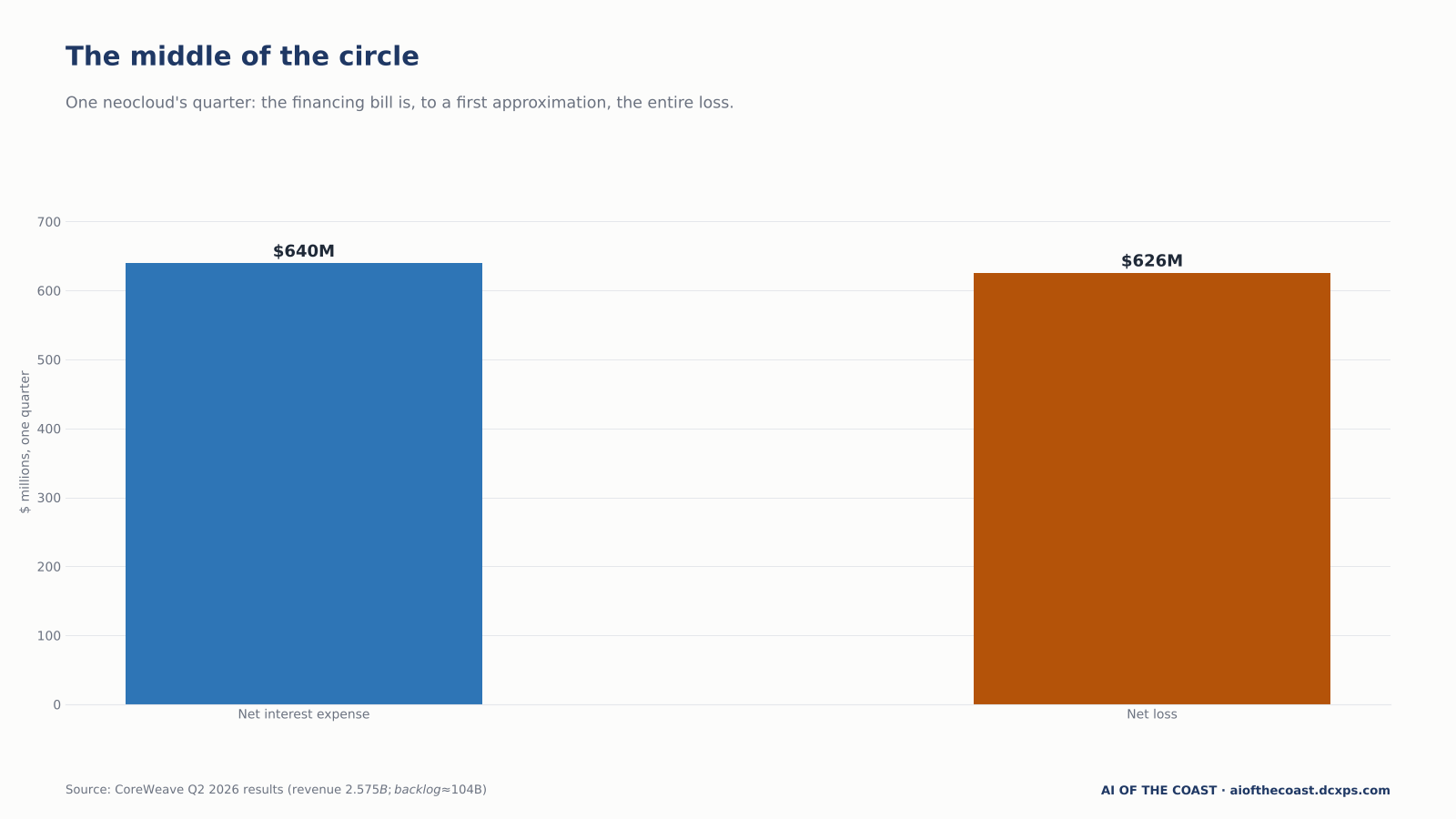
Here is the number from this earnings season that deserves the headlines the ouroboros got: CoreWeave reported about $640 million of net interest expense in a single quarter, against a net loss of $626 million.
Read it the way a lender reads it: the company’s entire quarterly loss is, to a first approximation, its financing bill. Revenue of $2.575 billion, a backlog around $104 billion, more than $25 billion in fresh commitments — and the cost of carrying the debt that builds the capacity eats the P&L before a single strategic question gets asked. This isn’t a CoreWeave-specific indictment; they’re the publicly traded instance of a structure the whole industry runs on. It’s what the middle of the circle looks like when you finance perishable silicon with hard-money coupons and sell its output on contracts that assume everything commissions on time.
Now stack the asymmetry on top. The commitments circulating at the top of the market ($300 billion here, $100 billion there, a $514 billion backlog at Google Cloud, roughly $725 billion of combined 2026 hyperscaler capex) are claims on future delivered compute. Skeptical readers of Noah’s piece did the napkin math: four to five trillion dollars of expected data-center spend over five years, against OpenAI’s roughly $13 billion of annualized revenue today. That gap is the bet, and everyone knows it’s the bet. Fine. Bets are what technology transitions are made of.
But notice what every single arrow in the diagram quietly assumes: that between the commitment and the revenue stands an operator who can site, energize, commission, staff, bill, and maintain the capacity — on schedule, at margin, for years. The diagram has maybe eight names on it. The operational throughput it requires has, generously, a dozen organizations on earth currently capable of delivering it, and most of them are the same names. The circle isn’t fragile because money goes around it.
It’s fragile because it all lands on the same few org charts.
The anti-ouroboros
There is a known cure for this disease, and the energy industry spent fifty years developing it. It’s called project finance, and its core move is surgical: separate the asset’s economics from the operator’s story.
A power plant doesn’t get financed because its builder has a great narrative. It gets financed as a ring-fenced vehicle: its own revenue contracts, its own waterfall, lenders with claims on that asset’s cash flows, the owner paid before the operator, covenants enforced at the bank. If the developer dies, the plant keeps running under a replacement operator, because the asset (not the brand) is the credit. Boring. Litigated. Battle-tested through every commodity cycle since the 1970s. It’s how the world built trillions of dollars of energy infrastructure without requiring anyone to believe in a story.
AI compute is drifting there faster than the discourse has noticed, and the memory-shock economics I wrote about on Tuesday accelerate it: when your input costs can reprice 20–40% in a quarter, lenders start demanding structures where the specific asset’s contracts and costs are legible. I’d put real money on the next phase looking like this — compute-purchase agreements underwritten like power-purchase agreements, non-recourse debt at the unit level, independent operators certified against delivery metrics, and a secondary market in operating units the way there is one in gas plants.
Full disclosure, because this is the part where my book and my argument are the same thing: this is how we structured DCXPS from the first unit. Each modular intelligence factory is investor-owned in a ring-fenced vehicle; revenue splits 85/15 on Adjusted EBITDA with the asset owner paid first, from a dual-signature account enforced at the bank, with the operator’s entire cost base living inside the 15%. I didn’t invent any of it — I stole it wholesale from the energy playbook, because I’d rather borrow fifty years of other people’s scar tissue than re-earn it. The point isn’t that our structure is clever. The point is that when the owner is paid first at the asset level, nobody in the circle needs to trust the diagram.
What actually breaks, and when
So here’s my falsifiable version of the bear case, as someone building through it.
The correction, when it comes, won’t travel through the deal topology — the equity cross-holdings mark down, headlines scream, and the snake diagram gets reprinted a thousand times. That’s noise. The transmission mechanism that matters is operational: some overcommitted operator misses commissioning dates on contracted capacity, the take-or-pay penalties and refinancing math turn a backlog from an asset into a liability, and suddenly every lender in the sector reprices delivery risk (not demand risk) across the board. Demand will still be there. The $1 trillion of capex meets the operator bottleneck, and the bottleneck wins.
At which point capital does what it always does after a scare: it flees stories and buys structures. Asset-level underwriting. Ring-fenced units. Operators with commissioning track records instead of renderings. The merchant-power crash of 2001–02 didn’t end electricity demand (load grew straight through it) but it transferred the gas plants, at cents on the dollar, to whoever had the balance sheet discipline to operate them. Same mechanism, new commodity.
The ouroboros is a distraction with excellent graphic design. Watch the org charts in the middle of the circle. Count the operators who can actually turn a commitment into a commissioned megawatt, divide the pledged trillions by that number, and you’ll know exactly where the system snaps.
The snake doesn’t die of eating its tail.
It dies of indigestion.
I run DCXPS, an AI-native infrastructure operator — ring-fenced units, 85/15 operating agreements, owner paid first. In other words: I’m long the “structures beat stories” thesis with my own company, so audit my argument like a lender would. That’s the only way I’d want you to read it.