

Everyone in this market is underwriting GPUs. Nobody’s underwriting the queue.
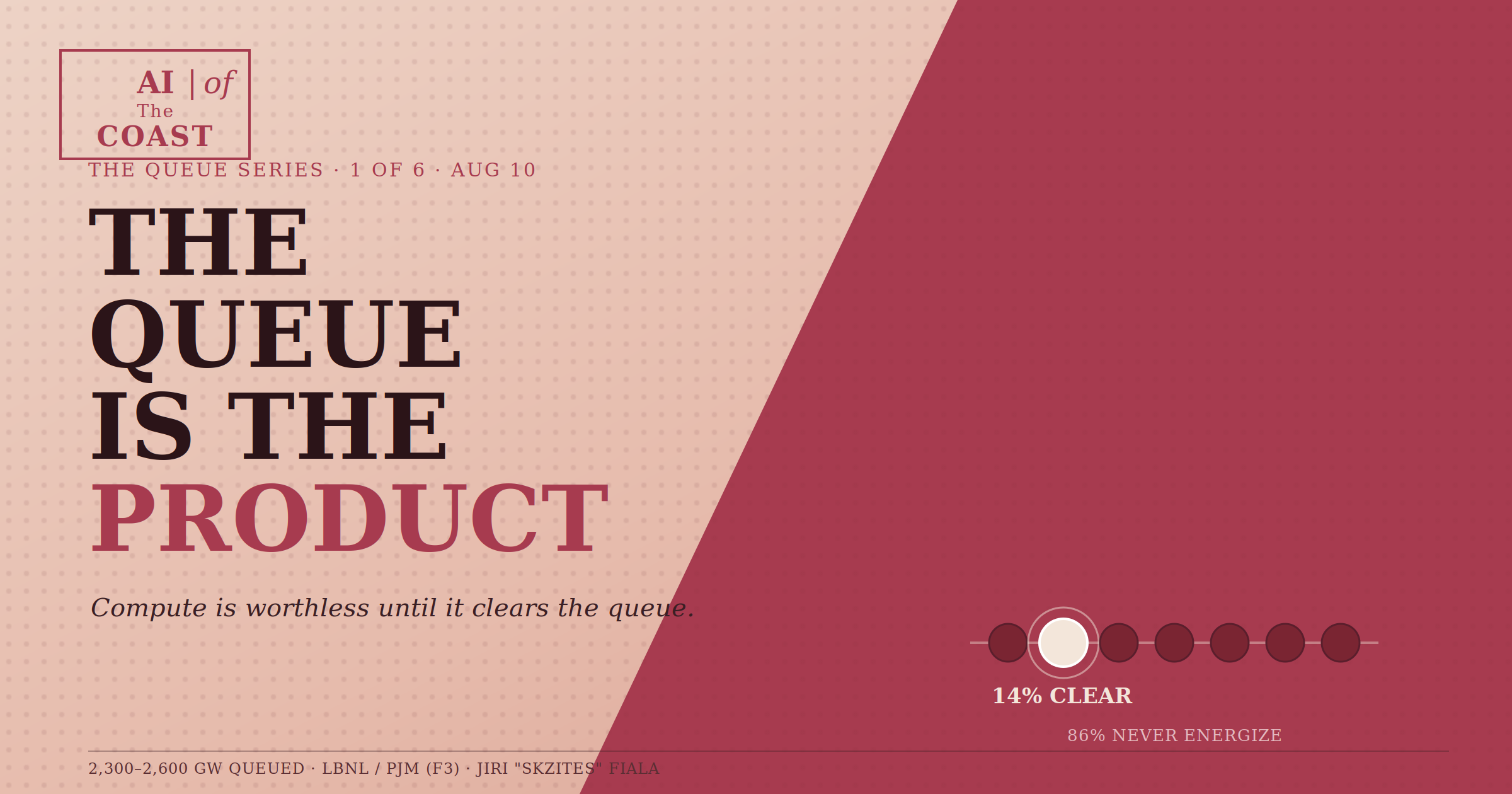
Here’s the number that should be on the wall of every allocator looking at AI infrastructure right now: 2,300 to 2,600 gigawatts of generation capacity is sitting in U.S. interconnection queues today. Historically, 14% of that ever reaches commercial operation.
Sit with that. Not “14% is delayed.” 14% is the ceiling. The other 86% doesn’t slip a quarter and recover. It dies, usually years after the capital behind it already committed.
So when a deck lands on your desk with chip allocations, power-purchase letters, a rendered site plan, you’re looking at the wrong asset. The GPUs are a commodity. Anyone with capital and a relationship with NVIDIA can buy silicon. What nobody can buy on the open market is a cleared queue position, because that’s adjudicated by a utility or an ISO on a timeline nobody writing the check controls.
Compute capacity that hasn’t cleared interconnection isn’t an asset. It’s an option on an asset. And most options in this market expire worthless.
Here’s where it gets interesting for pricing. PJM’s capacity auction cleared at $28.92 per megawatt-day for the 2024-25 delivery year. One auction cycle later, for 2026-27, it cleared at $329.17. Eleven times higher. That’s not inflation. That’s a market waking up to how much of its queued supply was never going to show up, and repricing the supply that did.
The framing that’s about to change: “AI infrastructure exposure” as a category. It’s not one thing. It’s a spectrum from “chips on paper” to “watts on the grid,” and almost all the actual value sits at the far end of that spectrum, in a place most diligence decks don’t even ask about.
If you’re allocating into this space and your process doesn’t have a specific line asking where a project sits in the queue, right now, you’re not underwriting AI infrastructure. You’re underwriting a hope.
The queue is the product. The chips are the packaging.
Subscribe for the next piece in this series, or download the full market report for the complete grid-queue breakdown.