

The final article in this series is about where the infrastructure thesis arrives. Not a bigger version of today’s hyperscale model. A distributed network of modular, autonomous, energy-first compute facilities — what we at DCXPS call the Distributed Compute Exchange and Power System, or DDCU vision. Here is what it looks like and why it is architecturally inevitable.
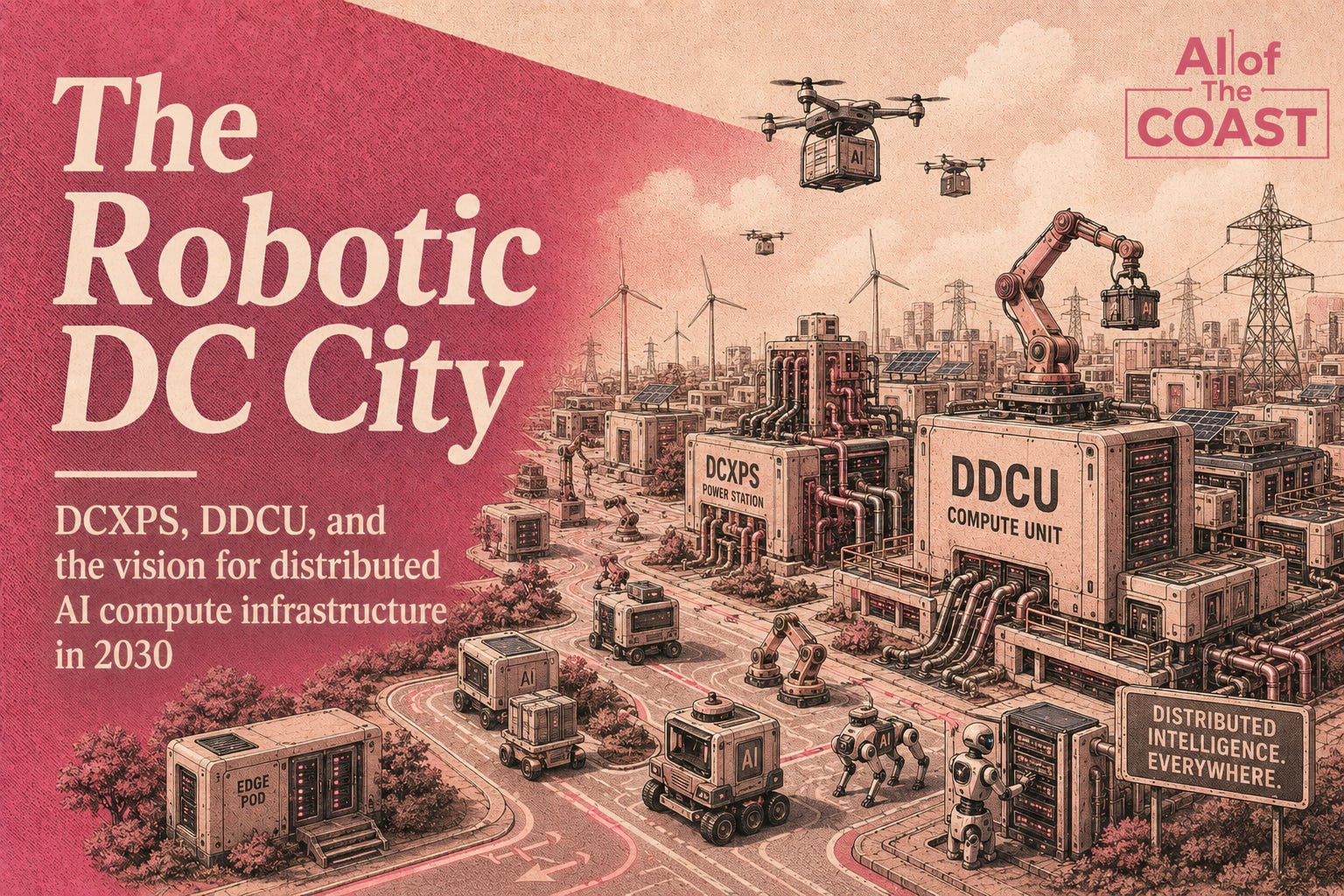
I want to be direct about something. Everything in this series — the density cliff, the grid constraints, the modular imperative, the energy-first deployment model — is not academic analysis. It is the thesis that underlies what we are building at DCXPS. I have been writing AI of the Coast for long enough that you know I call things as I see them, including when the data disagrees with my own positions. In this case, the data points in one direction and the thesis is what it is. So let me be concrete about what the destination looks like.
The DDCU Architecture
The Distributed Compute and Energy Unit — DDCU — is the architectural response to everything this series has documented. Start with the power constraints: grid interconnection takes years, transformer lead times are 160 weeks, the grid in established markets is saturated. The DDCU bypasses all of this by co-locating compute with dedicated power generation. Natural gas turbines, small modular reactors when available, stranded renewable integration — the power source is built alongside or brought to the compute facility, eliminating the grid bottleneck entirely.
Add the density requirements: current frontier AI hardware runs at 50+ kW per rack, heading toward 200 kW. The DDCU is designed from specification to power and cool that density tier. Liquid cooling is not an add-on. It is designed in from the first engineering drawing. The structural floor loading, the coolant distribution system, the heat rejection infrastructure — all specified for the density range the hardware will actually operate at.
6-18mo
Target deployment timeline from commitment to operational
250 kW
Target rack density design envelope for DDCU units
Energy-1st
Site selection logic: power availability first, location second
Modular
Incremental scaling without stranded capital commitment
Add the deployment speed requirement: AI demand is growing faster than any conventional construction timeline can serve. The DDCU is modular — pre-fabricated in factory conditions, shipped to site, connected to power generation, and operational. The target is 6-18 months from commitment to operational status, compared to 4-7 years for conventional hyperscale construction. That is not a marginal improvement. It is the difference between building infrastructure that serves current-generation hardware versus infrastructure that comes online into the next-next hardware generation.
The Robotic City Vision
The “Robotic DC City” framing is not marketing language. It describes an operational architecture that is a prerequisite for operating modular data centers at scale in remote or semi-remote locations where the energy is. You cannot staff a 100 MW compute deployment in West Texas at the same labor intensity as a Northern Virginia campus served by a deep technical talent pool. The economics do not work.
The answer is automation at the facility operations level. Robotic hardware replacement. AI-driven predictive maintenance. Autonomous cooling management. Remote monitoring with exception-based human intervention. The operational model of a DDCU deployment is not a data center with fewer people. It is a data center designed from the start for near-zero routine human presence — the same way a modern oil pipeline operates without someone physically checking every valve.
This is not science fiction. The technology for automated hardware management, predictive failure detection, and remote infrastructure management exists today and is deployed in hyperscale facilities at smaller scale. Applying it as the primary operational model for modular AI compute facilities co-located with power generation is the next architectural evolution.
“The Robotic DC City is not a data center with robots instead of technicians. It is an autonomous compute utility — the same way a modern power plant is not a furnace with engineers watching it constantly but an automated system with exception-based human oversight.”
The Distributed Network
The ultimate destination is a distributed network of DDCU deployments — not one large centralized facility, but many deployments each sized to the available power at their specific location, connected by a software orchestration layer that routes workloads to available compute capacity across the network. A customer accessing the network does not need to know or care which physical facility their inference workload is running on. The network routes it to available capacity, executes it, and returns the result.
This is the compute utility model made operational. The electrical grid does not tell you which power plant generated the electrons in your outlet. The compute utility does not need to tell you which DDCU facility executed your inference request. The abstraction layer handles the routing. The customer gets metered access to AI compute capacity, billed by consumption, without managing infrastructure.
The network effects compound over time. Each new DDCU deployment adds capacity to the network and makes the network more valuable to customers who need both compute availability and geographic distribution. The switching costs for customers deeply integrated into the network increase with integration depth. The capital required to replicate the network grows with each new deployment. These are the structural characteristics of a utility — and they are achievable in AI compute infrastructure in a way they were not in the fiber buildout, because the demand is arriving faster and the operational model is more capital-efficient.
The Open Question
I do not think we are guaranteed to win. Infrastructure investment is hard, capital-intensive, and takes longer than anyone projects. The hyperscalers have advantages in capital, customer relationships, and operational scale that no startup can match in head-to-head competition for the same workloads.
But the hyperscalers are not positioned to serve the workloads that the DDCU model is designed for: high-density AI compute deployed at the speed the market requires, at the locations where power is available, for customers who need compute capacity that is not available in the existing hyperscale footprint. Those workloads are real, growing, and structurally underserved by every architecture currently deployed at scale.
The utility transition in AI compute is happening. The only question is what architectures survive to deliver it. My bet — the bet I have been building toward for four years and will continue building — is that the energy-first, modular, high-density, distributed model is the architecture that serves the full demand. Not because it is elegant in theory, but because the physics and the economics leave no other option.
The electricity transition of the 19th century created the modern economy. The AI compute transition of the 21st century will define the next one. The infrastructure layer is where that transition will be won or lost. Build accordingly.