


There is a moment in every industry’s adolescence when the mythology cracks and the plumbing shows through. For AI, that moment arrived in Memphis, Tennessee — the unlikely capital of the coming infrastructure reckoning — where Anthropic, the company that has spoken more eloquently than anyone about the risks of concentrated AI power, quietly signed a lease on 220,000 NVIDIA GPUs housed in a facility built by xAI, operated by SpaceX, powered by 300+ megawatts of electricity that does not ask about your Constitutional AI policy before it flows.
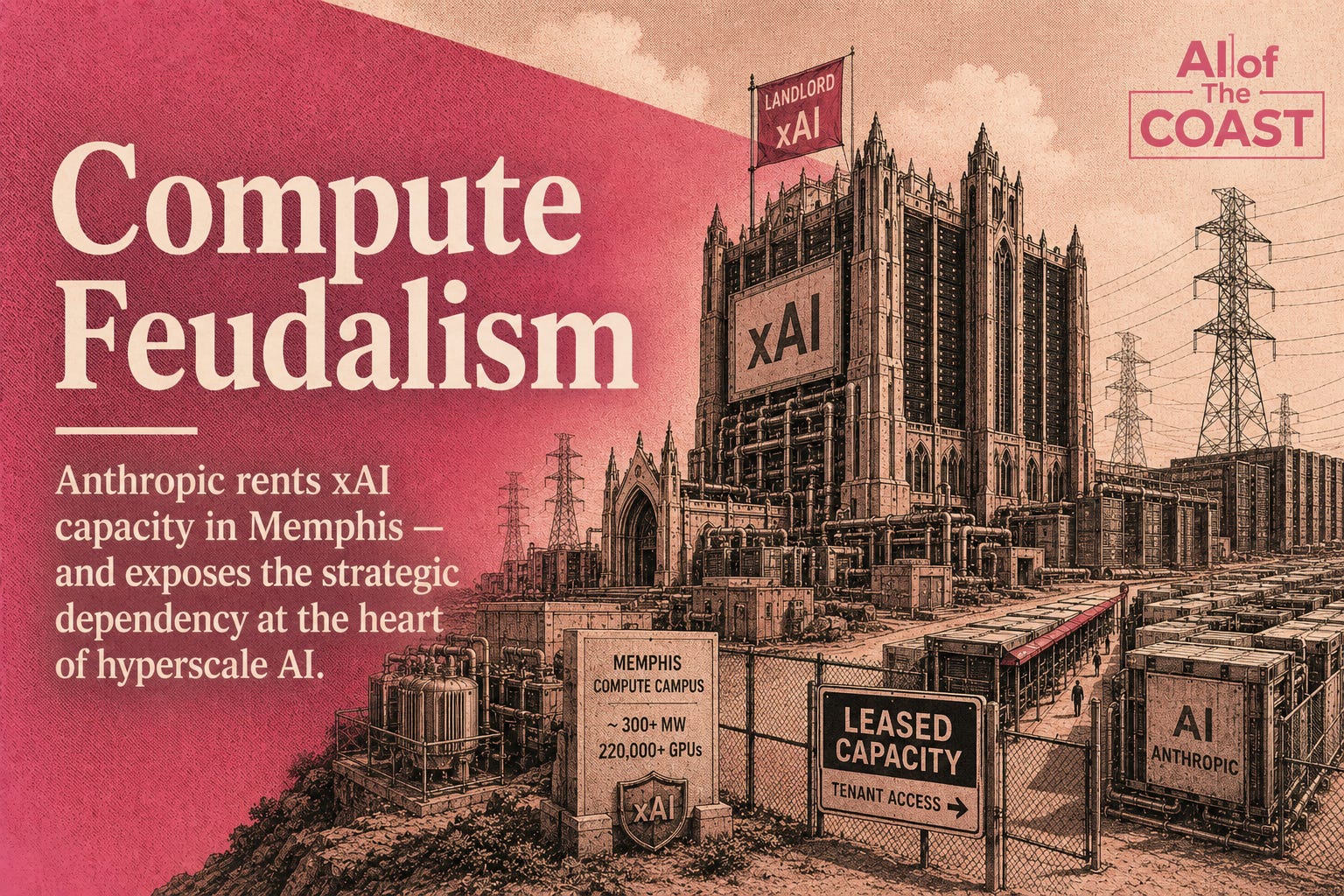
The deal happened because xAI migrated training to the adjacent Colossus 2. Colossus 1 sat humming, idle, a cathedral nobody was praying in. Anthropic’s users had been hitting usage limits for weeks — not edge cases, not power users gaming the system, but ordinary subscribers who paid for a product and found it rationed. The physics of the situation wrote the contract.
The most sophisticated AI assistant on the planet became a frustration at 2pm on a Tuesday. Not because the model failed. Because the cathedral ran out of room and there was no annex.
Strip the narrative of its drama. What the Memphis deal actually diagnoses is compute feudalism — a structural condition in which frontier AI companies do not own their critical infrastructure, cannot build it fast enough to meet demand, and therefore become tenants in someone else’s kingdom at the moment of maximum vulnerability. Anthropic discovered in May 2026 that its product destiny was temporarily hostage to the availability of a competitor’s idle cluster.
The sidebar buried in the announcement — that both companies are now discussing “multiple gigawatts of orbital AI compute capacity” — reads like the logical endpoint of the centralized model taken to its absurd conclusion. When you can’t get the land, the water, the power, or the political permission on Earth anymore, you propose building the data center in space. The escape hatch, designed in real time, in the press release.
The Modular Answer
Anthropic’s Memphis problem has a structural solution that doesn’t require renting from a rival or planning orbital infrastructure. Modular, distributed compute — deployable in months, not years — eliminates the single-point-of-failure that hyperscale dependency creates. A sovereign compute architecture built from DDCUs across multiple sites doesn’t run out of capacity in a way that hands your product quality over to whoever happens to have idle GPUs that week. The cathedral creates dependence. The distributed network creates resilience. One of these architectures had a crisis in May 2026. The other didn’t.
For builders watching this unfold: compute scarcity is not a temporary supply chain glitch that resolves in the next hardware cycle. It is the defining constraint of this era, and it rewards whoever solved for infrastructure sovereignty before the crisis arrived. The companies that will matter in 2028 are the ones that are not, in 2026, negotiating leases with their competitors.