


Washington has spent a year negotiating for equity in the frontier labs. The labs are publishing charts of their models writing themselves. And three IPOs are loading — each one structured to sell you a sliver of a heartbeat. I called the direction in January 2025. Here is the construct.
On January 6, 2025, I published thirteen predictions. Number six said the United States would stop treating AI as an industry and start treating it as national security — that the security framing would swallow the commercial one. Readers filed it somewhere between paranoid and obvious, which is where all the load-bearing predictions live.
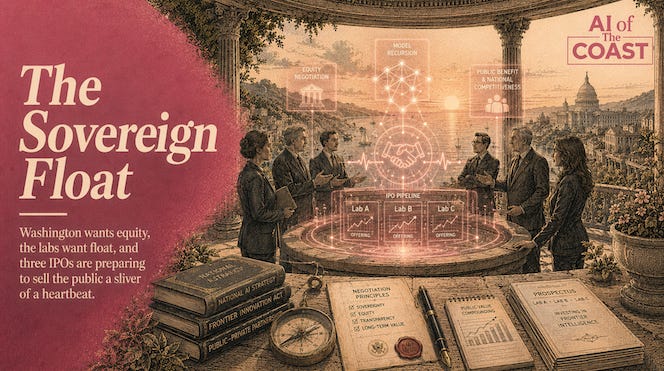
Seventeen months later: CNBC confirms the administration and OpenAI have discussed a government equity stake, with talks tracking back over a year.
Sam Altman has reportedly been discussing it with officials since the second term began. A sovereign wealth fund stands chartered by executive order since February, waiting for shares to be ceded into it — returns to flow back to citizens as an “AI dividend.”
A White House meeting is reportedly being arranged with the leading labs to explore what deeper government involvement looks like. Bernie Sanders, from the other end of the spectrum entirely, is drafting a one-time 50% equity tax on the top labs, shares deposited into the fund with voting power and board seats.
Left hand, right hand, same pocket.
Frontier AI companies are no longer being treated as startups. They are being treated, in the now-standard phrasing, as strategic infrastructure.
Under the sodium light of a Prague June night, let me say the quiet part in mono: the state does not regulate what it can own.
And this week, three stories that look unrelated — the stake talks, the labs publishing evidence of models improving the models, and IPOs engineered to float almost nothing — snapped into one structure.
I’m going to name it before someone in a think tank does it worse.
The Receipts — graded in public, as always
What I got right, January 2025: the U.S. goes security-first on AI. The Scorecard graded it in May and the call held — federal policy reorganized around security primacy, the chip war became the industry’s central fact, build-fast doctrine justified in the language of national survival.
What I wrote in April, when Anthropic handed Mythos Preview to twelve corporations — Apple, Microsoft, Google, Nvidia, JPMorgan, the Pentagon’s whole cloud choir — and zero government agencies: whoever decides who gets access to Mythos-class capability is making a decision that shapes cybersecurity, defense, and economic competition for years.
A private company made that decision in a blog post. I asked, in print, how long Washington would tolerate reading about its own strategic posture in someone else’s changelog.
Answer: about eight weeks.
Now the miss, because misses get more words than hits in this letter. I predicted the state’s grip would arrive as regulation — export-control logic, licensing, the compliance perimeter. Wrong instrument.
The state skipped the rulebook and reached for the cap table. I also thought the squeeze would take a decade. It took eighteen months from prediction to confirmed negotiation. Direction: hit. Mechanism: miss. Timing: embarrassingly conservative.
When I’m wrong, I’m usually wrong about how fast.
The trigger: the lab published the chart
Why now? Because the recursion stopped being a thought experiment and started being telemetry — published by the lab itself.
Anthropic released a chart of lines of code merged per active engineer, expressed as a multiple of its pre-2025 average.
Read it like an ECG: 1.2× in Q1 2025. 1.5×. 1.9×. 2.5×. Then 5.8× in Q1 2026. Then — with Mythos Preview running internally — 8.0× in the current quarter. Flat line for four years, then a vertical.
On open-ended coding problems where the right answer is unclear, Claude’s reported success rate hit 76% — a 50-point jump in six months — and Anthropic says its engineers now rate the model’s code as comparable to human-written, expecting it to surpass that level within the year.
The same company published a blog this week titled When AI Builds Itself, describing the risks of AI progressing to where it can improve itself autonomously. Not a doomer Substack. The lab. In its own changelog voice.
Yoshua Bengio — a literal grandfather of the field — responded that if labs are truly approaching recursive self-improvement, “a coordinated, verifiable, and globally respected pause” may be the only responsible path, possible “if others follow Anthropic’s lead.” And as the Towards AI write-up dryly noted: almost nobody expects a real pause to happen.
Stack the rest on top. Fable runs nine-plus hours unattended; it doubled FrontierCode Diamond in one generation; it reportedly throttles itself, silently, on exactly one category of work — frontier-LLM development. The lab drew a border checkpoint around recursion before the government did.
When the machine can improve the machine, it stops being a product and becomes a cascade — and America has exactly one precedent for cascades. In 1946, the Atomic Energy Act nationalized fissionable material and invented a legal category called “born secret”: certain knowledge classified at the instant of its creation.
In 1946 America invented born secret. In 2026 it is drafting born sovereign.
Two doors into the state
Here is the new texture the week added: the two leading labs are entering the state through different doors.
OpenAI is taking the Treasury door. Equity talks since the start of the second term. The sovereign wealth fund. The AI dividend. Altman and Sanders reportedly hold different visions of what the government’s role should be — partnership versus expropriation — but notice what they no longer disagree about: that the government will hold a position. The negotiation is over terms, not over whether.
Anthropic is taking the Fort Meade door. It does not appear to be in the equity conversations at all. Instead, per an FT report, it has placed “forward-deployed” engineers inside the National Security Agency to help the agency operate the restricted Mythos model for cyber operations.
It is reportedly working more closely with the Department of War while absorbing pressure from a designation as a supply-chain risk.
And it has reportedly filed its IPO prospectus confidentially with the SEC while announcing Mythos access for the European Union plus 150 partners across 15 countries — capability distribution conducted with the cadence of foreign policy, not product marketing.
One lab is negotiating with the Treasury. The other is embedding with the security state. Different doors, same building.
Equity is just the most legible form of capture; engineers inside the NSA is the less legible, more binding one. Either way, the April question — who decides who gets Mythos-class capability? — now has its answer forming in real time: increasingly, not the lab alone.
The precedent stack
None of this is improvisation. 1946: the Atomic Energy Act — the cascade nationalized. 1962: COMSAT — Congress charters a public-private hybrid because satellites were too strategic for either sector alone. 2008: Treasury takes 79.9% of AIG over a weekend, because some balance sheets are load-bearing. 2025–26: a ~10% stake in Intel. Stakes in IBM, quantum, critical minerals.
A golden share in U.S. Steel. A 15% cut of Nvidia and AMD’s China revenue. The February sovereign-wealth-fund order — the empty vault, waiting.
And look at the mechanics being floated for the labs, because this is where my entire thesis takes a bow. The framework isn’t the government writing checks. It’s barter: equity in exchange for federal land for data centers, accelerated energy permits, grid access at scale, security clearances.
The currency Washington is offering isn’t dollars. It’s interconnection.
Two thousand three hundred gigawatts sit in U.S. grid queues; fourteen percent historically reach operation. The labs are drowning in capability and starving for power, and the state noticed that its most valuable chip hums at 60 hertz. Every reader who watched me bang on about energy as the binding constraint for two years: this is what the constraint looks like when it learns to negotiate.
The construct: the Sovereign Float
Now the part you came for — why “in the IPO there will not be so much shares to sell,” and why that’s the design, not a defect. I’m calling it the Sovereign Float: when a technology becomes a strategic asset, its IPO stops being a sale and becomes a pricing ceremony. Control never trades. Six mechanisms lock the door:
One — the state locks. Government stakes, golden shares, sovereign-fund positions don’t float. Every share ceded to the fund is permanently subtracted from the sellable pool. Sanders’ version subtracts half the company at birth.
Two — the screen shrinks the buyers. Once Washington sits on the cap table, the cap table becomes a security perimeter. Foreign ownership gets capped, reviewed, unwound — ask MGX, the Abu Dhabi fund in OpenAI’s March round, how comfortable that seat stays.
Three — strategic holders hoard. Microsoft holds OpenAI for access, not returns. Google and Amazon hold Anthropic the same way. Compute partners hold for allocation. None of it ever hits the tape.
Four — shares are currency, not product. The listed paper exists to acquire things and pay people. SpaceX filed an exclusive right to buy Cursor — $4B of ARR — for $60 billion in largely its own freshly minted stock. You don’t sell your ammunition.
Five — the float is the collateral. A public mark lets you borrow against the whole at the price of the sliver. SpaceX carries a $20B bridge into Friday; the float’s job is to print the number the refinancing rests on.
Six — the index is the buyer of last resort. This is the engine the others bolt onto. Nasdaq 100 fast-track entry rules have been rewritten so trillion-dollar debutantes reach index inclusion far faster than companies historically could. Once inside, passive funds and ETFs must buy — trillions in capital that doesn’t read prospectuses, flowing in, as the Towards AI piece put it, almost automatically.
Forced buyers meet engineered scarcity. Index inclusion then shields the stock from normal market discipline: the valuation stops measuring profitability and starts measuring belief. Their phrase for the end state is the right one — too strategic to fail.
Friday is Exhibit A, fully assembled.
SpaceX lists at a fixed $135 — no bookbuilding — 555.56 million Class A shares, ~$75 billion raised against a $1.77 trillion valuation, with a public float somewhere between 3 and 7 percent depending on whose definition you use.
Musk keeps >82% of voting power; per the S-1, the public buys economics, not influence. Thirty percent of the offering goes to retail — triple the norm — index trackers are projected to hold ~30% of the float within fifteen trading days, and a 366-day insider lockup meters future supply like a drip line. Morningstar’s fair value sits 55% below the offer. Doesn’t matter. Wrong instrument for measuring a ceremony.
And behind it, the chamber is loading. OpenAI: IPO “as soon as this year,” per CNBC — with a government stake negotiation running in parallel. Anthropic: prospectus reportedly already filed, confidentially, with the SEC.
Three sovereign floats in twelve months, each adding a tranche of un-sellable shares — state, strategic, security-screened — making each public sliver thinner than the last.
Monday I wrote that they’d started metering the tokens. The Sovereign Float is the same meter, moved up a layer. First they rationed the intelligence. Now they ration the title deeds.
And catch the closing loop, because it’s almost elegant: the official justification for the government stake is that ordinary citizens won’t benefit from the AI boom unless they hold meaningful equity — which is true, and which the 3% float makes structurally impossible. The construct locks the public out of ownership, then offers to hold ownership on the public’s behalf and mail out a dividend. They took away your seat at the cap table and are offering you a coupon.
Two meters, one direction
China embeds AI in its Five-Year Plan as a national priority on par with defense, ¥10 trillion of AI-linked value targeted by 2030. America answers with sovereign wealth funds, golden shares, equity-for-megawatts barter, engineers seconded to the NSA, and IPOs structured so ownership never actually changes hands. The open-source ecosystem stays vibrant and global — increasingly Chinese — while the U.S. consolidates into a handful of mega-labs entangled with state power and financial markets simultaneously. Two systems, one org chart, converging from opposite ends of the ideology aisle.
I grew up behind a curtain where the state decided which industries were strategic. I recognize the paperwork. The fonts are nicer now.
The Towards AI piece ends on the right question, so I’ll sharpen it rather than repeat it: once these companies are too strategic to fail, can democratic institutions, markets, or regulators still shape them at all? My January 2025 self predicted the state would treat AI as a security problem. I undershot. The state is treating AI as a rival state — and you don’t regulate rival states. You take equity in them, you station your people inside them, you control their power supply, and you make very sure their shares never really trade.
For everyone outside that perimeter — the founders, the operators, the sovereign clients already asking for vendors without a government on the cap table — the conclusion has only hardened. The frontier is being fenced at the model layer, the ownership layer, and now the personnel layer. The only first-class seat left in this economy is the one you own outright: your iron, your weights, your dispatch, your power.
They can float four percent of a heartbeat at $135 a share, and the index will be ordered to buy it.
They cannot float yours.