

In 2025, Applied Digital secured 400+ MW of stranded wind power in North Dakota. Wind turbines generating electricity that had nowhere to go — transmission lines at capacity, substations full, no buyers within economic range. Applied Digital brought compute to the power source instead of power to the compute.
The grid didn’t care about North Dakota. North Dakota didn’t care about the grid.
This was not a tactical win. This was the announcement of a new architectural religion.
The Inversion That Changes Everything
For sixty years, data centers followed a simple logic: build near the grid. Build near cities. Build near the workers who maintain the hardware and the customers who consume the compute. Power comes from centralized generation, travels over transmission lines, arrives at substations, serves buildings.
This logic works beautifully when electricity is abundant and cheap and universally distributed. It fails catastrophically when the grid is overloaded, permits take years, and transmission costs $41.50 per MWh per 1,000 miles of distance.
The data point that reframes everything: moving electricity costs $41.50/MWh per 1,000 miles. Moving data costs essentially nothing.
Compute should go where power is abundant. The workloads follow over fiber. This is not a clever optimization. It is a structural inversion of sixty years of infrastructure assumption.
Every stranded wind farm becomes a potential compute node. Every underutilized biogas plant, every industrial site with spare generating capacity, every agricultural region with methane from waste that would otherwise decompose into the atmosphere — all of them become viable locations for frontier AI compute. Not because anyone decided to put them there. Because the physics of moving power versus moving data makes them the correct answer.
What “Stranded” Actually Means — And How Much of It Exists
Stranded energy is generation capacity that exists but cannot reach buyers. The transmission network — built over decades for a different demand profile, in a different economic environment, for different customers — has not kept pace with renewable buildout.
In the United States, curtailment of wind and solar power reached a record in 2024 — meaning generation that was available but literally switched off because the grid couldn’t absorb it. In Texas, curtailment events occur hundreds of times annually. In California, solar panels are routinely disconnected from the grid during peak generation periods because the grid cannot accommodate the supply.
The Lawrence Berkeley National Laboratory estimates that 40–60% of proposed renewable energy projects in the U.S. are delayed or cancelled due to interconnection challenges. This is power that wants to exist. Power that has been built, that has investors, that generates electricity when the sun shines or the wind blows, and that has no viable path to customers.
This is not a temporary condition. It is structural. The transmission infrastructure required to move renewable power from where it’s generated (Great Plains wind, Southwest solar, offshore mid-Atlantic wind) to where it’s consumed (coastal population centers, dense industrial corridors) would cost trillions of dollars and require decades of permitting.
Or you could bring the compute to the power. In 120 days. On a flatbed truck.
The Modular Unit: What It Actually Is
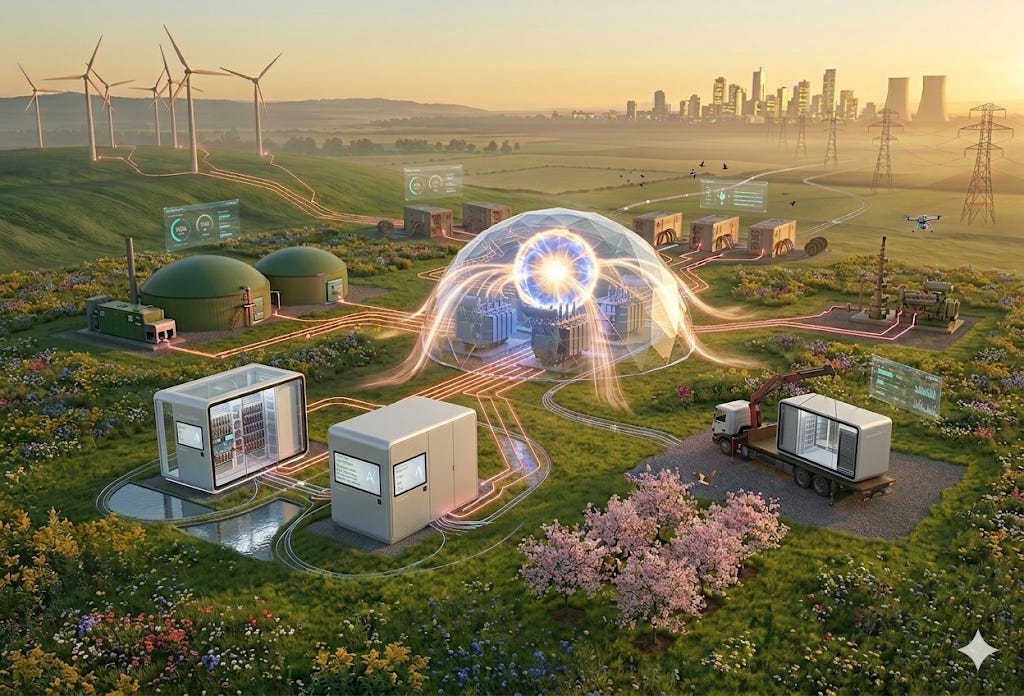
A Modular AI Data Center (MADC) at its simplest is a purpose-built container — shipping-container form factor or slightly larger — housing server racks, cooling infrastructure, and power conditioning equipment. Factory-manufactured. Transported by standard flatbed. Operational within 120 days of site selection.
No foundation excavation. No grid application. No environmental impact assessment for a temporary, relocatable structure. No 48-month construction timeline. No 60-month capital lockup.
The compute is identical to what you’d find in a hyperscale facility. NVIDIA H100s, H200s, Vera Rubin NVL72s, Cerebras wafer-scale engines — the hardware doesn’t care what kind of building surrounds it. The hardware cares about power, cooling, and network connectivity. A MADC provides all three, in a package that deploys in a fraction of the time and a fraction of the capital.
Revenue generation starts at month four or five of a ten-month total deployment cycle. For a 1 MW unit generating $20–25M in annual revenue at full utilization, that’s $8–10M in revenue in the first year — while a comparably-scoped traditional data center investment is still pouring concrete.
The Energy Flexibility Problem — And Why It’s Actually the Solution
The objection to modular deployment in unconventional locations is always the same: you can’t guarantee power availability. Wind doesn’t blow at night. Solar doesn’t shine in winter. Biogas requires agricultural feedstock management. Natural gas pipelines don’t reach everywhere.
This objection assumes a single energy source. The MADC architecture assumes a portfolio.
A unit in the Czech agricultural belt runs primarily on biogas from farm waste — the methane that would otherwise escape from decomposing organic matter. Biogas CHP delivers 85–92% capacity factor: it operates 24 hours a day, seven days a week, 365 days a year, generating both electricity and recoverable waste heat. With MAN 500 kW cogeneration units — four operational plus two reserve — a 2 MW continuous baseload is achievable at verified supplier costs of €6.43 million. Carbon-negative.
A unit in the Texas Permian Basin runs on natural gas. CHP systems achieve up to 80% total efficiency, compared to 40% for central grid generation. Chevron and GE Vernova announced a multi-gigawatt partnership for gas-powered data centers in early 2025 — validating the technology at scale.
A unit on Scotland’s coast combines offshore wind with LPG backup for grid-island transitions. A unit in the North Dakota wind belt pairs turbines with natural gas for the 60% of hours when wind speeds fall below generation threshold.
The compute is universal. The fuel is local. This is the sentence that rewrites infrastructure economics.
The Time Arbitrage: Month 5 Revenue vs. Month 60 Revenue
Capital efficiency in infrastructure is not a secondary concern. It is the primary variable that determines whether a business model is viable.
Traditional data center capital locks 100% of investment for 48–60 months before revenue begins. During that period, the capital earns nothing while incurring financing costs, opportunity costs, and the risk that market conditions change.
The modular architecture inverts this. Capital deployment begins generating revenue at month four to five of a ten-month cycle. The marginal return on a dollar deployed at month five versus a dollar deployed at month sixty — compounded over the lifetime of the investment — is the difference between a real estate business and a technology business.
Applied Digital understood this. Compass Datacenters understood this. The smaller operators who have been building modular capacity at brownfield sites across the American industrial Midwest since 2021 understood this. The hyperscalers, locked into mega-campus models by their own scale and their own investor expectations, did not.
The MADC is not a smaller version of a hyperscale data center. It is the opposite of a hyperscale data center. Different physics. Different economics. Different answer to the infrastructure question.
The Coexistence Phase: Why Both Exist Simultaneously
There is a period — we are in it now — where modular and hyperscale infrastructure coexist. Not because both are optimal, but because the transition has a timeline and capital has inertia.
The $320 billion committed to hyperscale construction in 2025 is committed. Those facilities will be built. They will generate revenue. For certain workloads — ultra-low-latency inference at consumer scale, distributed training jobs requiring petabyte-scale interconnects across thousands of GPUs — hyperscale concentration provides genuine advantages that distributed modular infrastructure cannot fully replicate.
The coexistence phase also creates the operational data that makes the next phase possible. Every MADC deployed in a brownfield industrial site teaches the industry about power management at edge locations, about cooling performance in non-ideal environments, about network reliability when the fiber backhaul isn’t Ashburn-class redundant. That operational data is the feedstock for the autonomous systems that come next.
But the coexistence is not equilibrium. It is succession. The hyperscale model serves workloads it was built for. The modular model expands to serve workloads the hyperscale model cannot economically reach. The grid crisis accelerates the transition. The hardware refresh economics accelerate the transition. The permitting environment accelerates the transition.
Applied Digital found 400 MW of stranded wind in one state. There are 50 states. There are 195 countries. Every one of them has stranded energy. Every one of them has compute demand that existing infrastructure cannot serve.
The fields are waiting. The power is already there. The question is who arrives first.