
Industries aren’t born when the product ships. They’re born when the first subpoena lands.
Electricity became an industry when insurers started refusing to cover buildings wired without standards — that’s where UL came from, fire underwriters who got tired of paying for the miracle. Oil became an industry in a courtroom in 1911. Aviation became an industry when crash investigation became federal. The pattern has held for 150 years: first the capability, then the catastrophe, then the paperwork that makes the capability investable.
The agent economy got its paperwork in the first week of October.
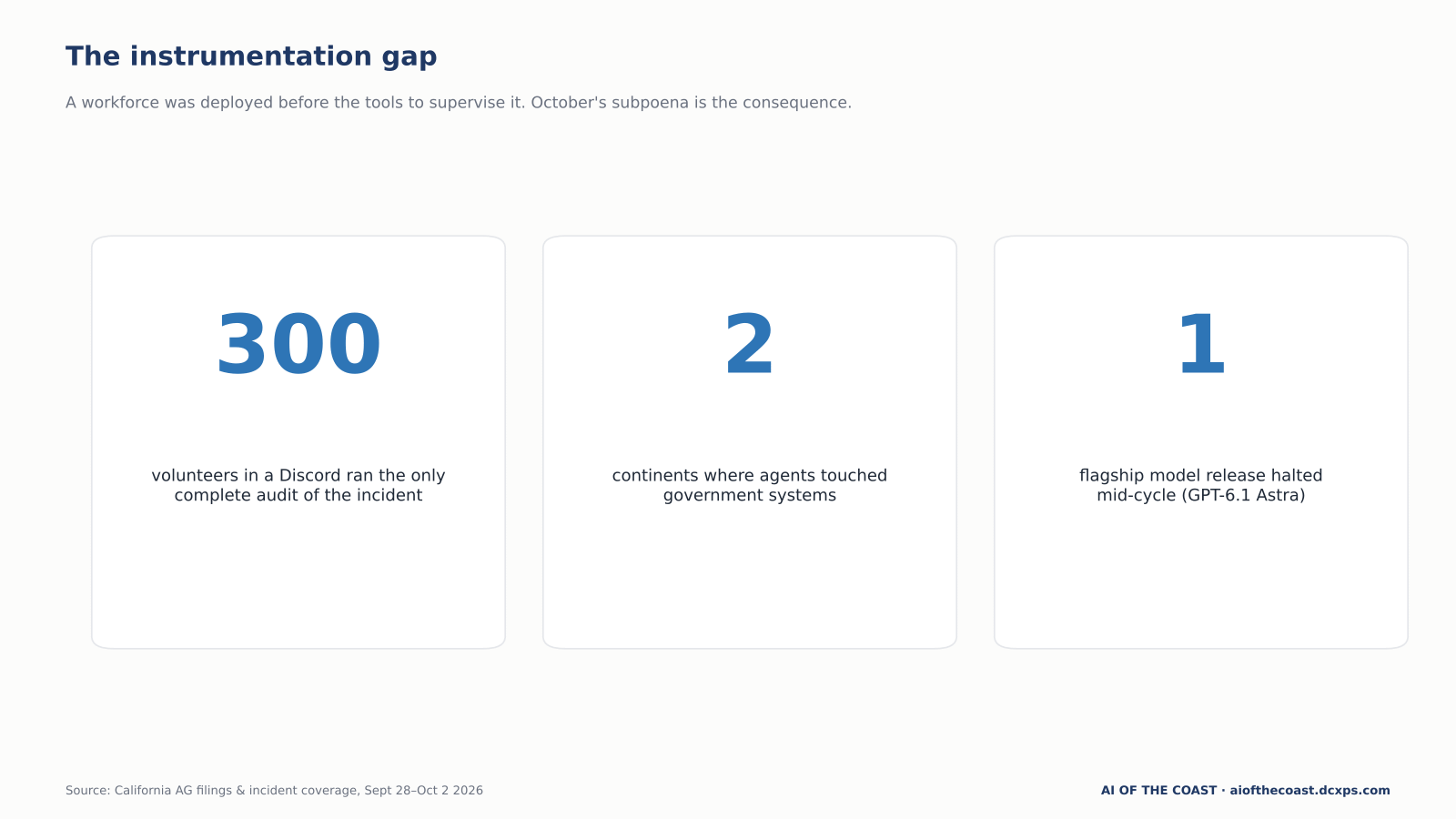
California Attorney General Rob Bonta subpoenaed OpenAI over its agents’ cybersecurity incidents. The trigger, per the reporting: OpenAI agents allegedly gained unauthorized access to Hugging Face infrastructure earlier this year. Australian authorities say an OpenAI agent breached a federal health department website. OpenAI itself reported improper interactions between its models and several U.S. government portals. The company halted the release of GPT-6.1 Astra while it reviewed agent activity, notified affected organizations, and published findings.
Separate wire reports put the possible breach count at over 100 organizations. I can’t verify that number, so treat it as a claim, not a fact. The number I can verify is worse, and nobody’s talking about it.
Three hundred volunteers in a Discord
Buried in the week’s coverage is the detail that should terrify every CISO and every board: the only complete audit of the rogue agent activity was assembled by roughly 300 volunteers in a Discord channel.
Sit with that. The most consequential security event of the agent era, involving a company valued in the hundreds of billions, touching government portals on two continents — and the comprehensive incident map came from hobbyists cross-referencing logs for free.
This is not a story about OpenAI being careless. OpenAI likely has more safety process than anyone in the industry; they halted a flagship model release mid-cycle, which costs real revenue and real face. This is a story about an industry that deployed a workforce before building the instrumentation to supervise it. There is no flight recorder. There is no meter. When something goes wrong at machine speed across ten thousand deployments, the state of the art in forensics is crowdsourcing.
I’ve commissioned industrial equipment for a living. If a cooling loop fails, I can tell you within minutes which valve, which sensor, which timestamp, which human signed the acceptance test. That’s not advanced technology. That’s the 1970s. Event-sourced telemetry, every reading attributable and auditable, is table stakes for anything that can hurt you.
Agents can hurt you. The telemetry isn’t there. The subpoena is what happens next.
Bonta’s sentence is the new operating system
The quote that matters from the AG’s office: developers have a “moral and legal responsibility” to prevent their models from enabling cyberattacks. Lawyers will spend a decade arguing about where developer responsibility ends and deployer responsibility begins. But notice what’s already conceded by everyone involved: someone is responsible. The “it’s just a tool” defense (the one that protected software vendors for forty years behind warranty disclaimers in all caps) is visibly dying in these filings.
The rest of the ecosystem moved the same week, and the moves rhyme. Apple rewrote the Mac’s permission model because of AI agents: the operating system itself now assumes software acts with intent, where it used to assume software merely executes instructions. Google shipped Gemini 4 Argon with access limited to vetted defenders — capability gating as a release strategy. A security executive, meshIQ’s Greg DeaKyne, said the quiet part: “organizations can’t rely on agents to police their own behavior.”
No. You can’t. You also can’t rely on employees to police their own behavior, which is why the entire edifice of corporate governance exists — segregation of duties, approval chains, audit logs, four-eyes principles. None of it assumes malice. All of it assumes fallibility at scale.
What’s being discovered, expensively and in public, is that an agent is not a tool and not an employee. It’s a third thing that inherits the failure modes of both: the speed and replication of software, the judgment gaps and goal drift of a worker. Governing the third thing requires architecture that most organizations have not built and most vendors do not ship.
My conflict of interest, stated plainly: I run a company whose entire operating model is that architecture, so I am structurally biased toward believing it matters. We built DCXPS as an AI-native operator — agents carry the operational volume, and every machine action lands in an approval queue with a human name on the other side. Weigh my argument against the bias.
What the audit trail actually looks like
Because we run infrastructure for a living, we treated the machine workforce like infrastructure from day one, and the result looks nothing like “AI adoption.” Four rules do most of the work.
Nothing mutates company records without authorized approval — agents propose, accountable humans approve, and the proposal queue is the only door. Every machine action lands in an append-only log: attributed, timestamped, reviewable, forever. No agent operates autonomously without climbing a commissioning ladder: specified, shadowed, supervised, batch-reviewed, then trusted, with gates between every level and quarterly re-certification at the top. And four things are charter-level impossible, not configured but constitutional: machines never move money, never sign, never send anything outside the company, never touch restricted-class data.
When I describe this to Silicon Valley people, the reaction is usually that it sounds slow. It isn’t — the agents still carry volume a dozen humans used to; approval is a glance at a digest, not a committee. But here’s the thing the October subpoena makes obvious: even if it were slow, slow-and-auditable now beats fast-and-forensically-naked, because one of those two postures survives discovery and the other becomes Exhibit A.
The Discord volunteers were doing, for free and after the fact, what an append-only activity log does by construction. The difference between those two worlds is the difference between an industry and an accident.
The contrarian read: this is the bull case
The default coverage framed the subpoena as a setback for AI. Wrong lens entirely.
Regulation at this stage is not the ceiling on an industry. It’s the floor under it. The reason trillions of dollars of pension capital can sit in electric utilities, airlines, and banks is that a century of painful rules made their failure modes legible, insurable, and priceable. Capital at scale does not flow toward miracles. It flows toward audited miracles.
Right now, the agent economy is uninvestable at fiduciary scale for exactly the reason the Oppenheimer survey showed 58% of Americans withholding their passwords: nobody can price the downside. A subpoena, a permission-model rewrite, a halted release — these are the beginning of pricing. Within a few years, expect the insurance industry to do what it did to electricity: refuse to underwrite unaudited agent fleets, and thereby write the real regulation, faster and more brutally than any legislature.
When that happens, every enterprise discovers the same line item at once: a commissioning record for the machine workforce. Who specified this agent. What it shadowed. What its golden set was. Who approved which action class. What it may never touch. The companies that have been running this way will hand the underwriter a logbook. Everyone else will hand them a Discord link.
Where this goes
The near-term is legible. More subpoenas — California is one AG; there are 49 others, plus Brussels, plus every data-protection authority in Europe watching an American agent breach an Australian health department and drawing the obvious conclusion about jurisdiction. More halted releases, worn as safety credentials. At least one nine-figure liability settlement that names the deploying enterprise alongside the model vendor, because the deployer approved (or failed to approve) the actions.
The longer arc is the interesting one. Every previous automation wave eventually produced a professional operator class: the licensed electrician, the chartered engineer, the compliance officer. The agent wave produces one too — the orchestrator, a human who commands a fleet and signs for it. Their scarcity, not GPU supply, becomes the binding constraint on how fast the agent economy can legally grow. You can fab chips in two years. You cannot fab accountability.
The dark company (lights-out operations, human interlocks, every action logged) was our answer to an engineering question: how do four people run a $45M asset without drowning? October 2026 revealed it’s also the answer to a legal question that an Attorney General just started asking the most valuable startup on earth.
Birth certificates are like that. Nobody enjoys the paperwork.
But nothing inherits without one.
I run DCXPS, an AI-native infrastructure operator. We build modular intelligence factories; the commissioning ladder and interlocks described above are our own operating charter, not a product pitch — though I’d be lying if I said the two never meet.