


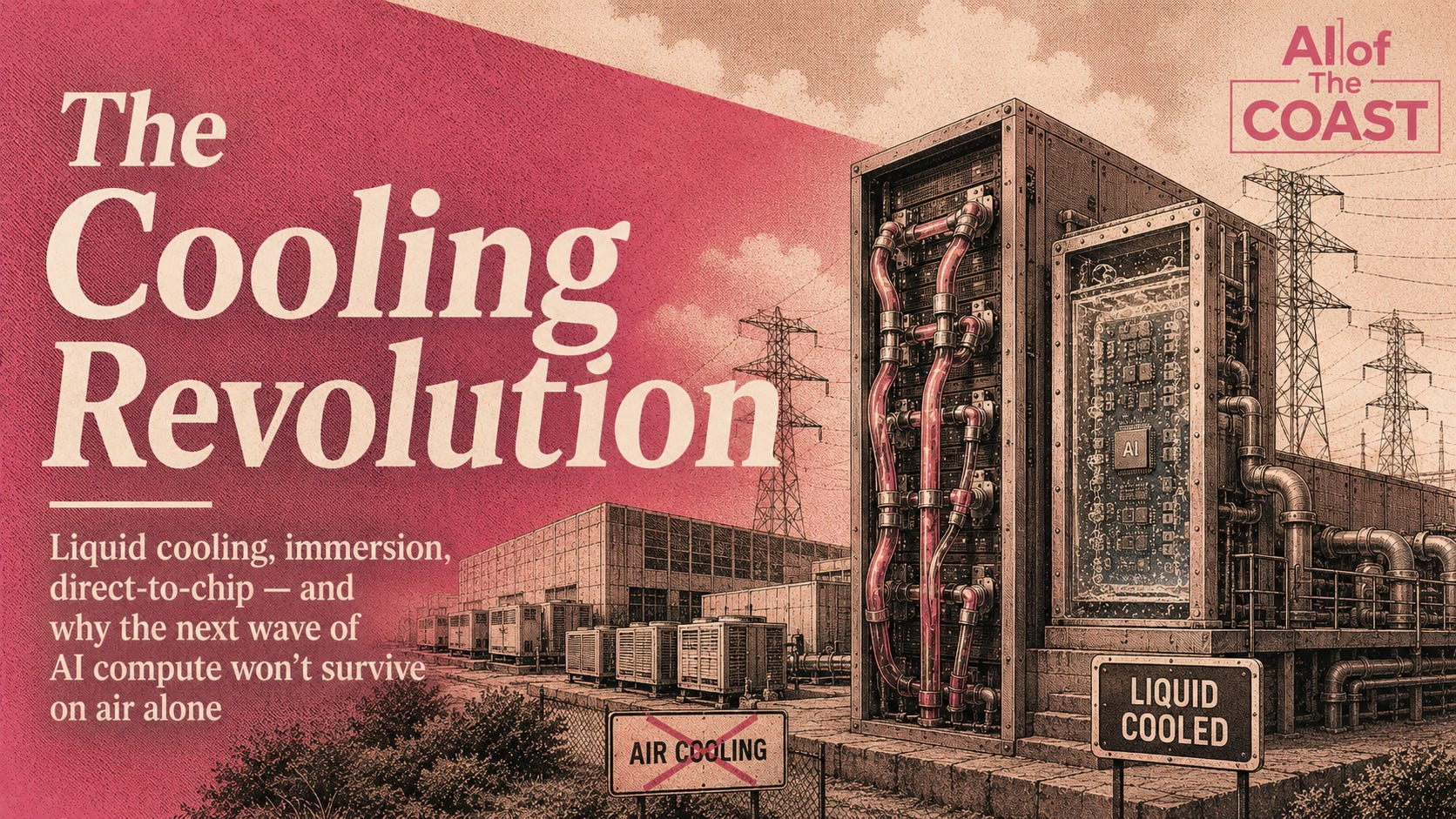
A standard air-cooled data center is a thermodynamic system built around a simple principle: push large volumes of cold air through hot equipment, capture the heated air, cool it, and circulate it again. This system works well up to roughly 30 kilowatts per rack. The physics above that threshold are unforgiving: the amount of air required to cool a 50 kW rack generates so much turbulence, noise, and pressure differential that it becomes thermodynamically inefficient and operationally impractical.
The CRAC units — computer room air conditioners — that cool conventional data centers are sized for the facilities they serve. A facility designed for 15-20 kW average rack density has CRAC units, underfloor plenums, and hot aisle/cold aisle configurations calibrated for that density. Doubling the rack density in that facility does not simply require more cooling. It requires a different cooling system — and in many cases, different structural supports for that cooling system.
The Three Approaches to High-Density Cooling
The industry has developed three main approaches to cooling racks above the air cooling threshold, each with different engineering requirements, cost profiles, and density ceilings.
Rear-door heat exchangers attach directly to server rack rear panels and contain liquid-cooled coils that capture heat from the servers before it enters the data center hot aisle. They extend the effective cooling range to roughly 40-60 kW per rack without requiring changes to the server hardware itself. They are retrofittable to existing facilities and represent the lowest-barrier entry point to liquid cooling. Their limitation is that they rely on facility-level liquid cooling infrastructure — chilled water loops — that conventional facilities may not have.
Direct liquid cooling (DLC) routes coolant directly to heat-generating components — processor heatsinks, memory modules, power supplies. At the direct-to-chip level, DLC can handle 80-100 kW per rack effectively and is the current standard for high-density GPU clusters including Nvidia’s Blackwell architecture. DLC requires modified server hardware with liquid cooling manifolds built in, and facility-level plumbing infrastructure to supply and return the coolant. It cannot be retrofitted to standard servers.
Immersion cooling submerges complete server assemblies in tanks of non-conductive dielectric fluid — either single-phase (the fluid does not change phase) or two-phase (the fluid boils at low temperatures, capturing heat as vapor and condensing it back to liquid). Immersion is capable of handling 100-200+ kW per rack and is the leading approach for the highest-density AI deployments. It requires purpose-built tanks, specialized plumbing, fluid management systems, and floor structures capable of supporting the weight of fluid-filled tanks — far heavier than standard racks.
30 kW
Air cooling practical ceiling
60 kW
Rear-door heat exchanger ceiling
100 kW
Direct liquid cooling ceiling
200 kW+
Immersion cooling capability
The Facility Design Implications
The transition from air to liquid cooling does not just change the cooling equipment. It changes the facility design from the foundation up. Standard raised-floor data centers with underfloor air plenums are the wrong starting point for immersion-cooled deployments. The floor must support immersion tank weight — potentially several tons per tank at high densities. The plumbing infrastructure must support closed-loop coolant distribution. The mechanical systems must be redesigned around liquid circuits rather than airflow volumes.
This is why new AI data centers are increasingly being designed from the ground up as liquid-cooling-first facilities — not retrofitted conventional data centers with liquid cooling added. The engineering economics favor starting fresh over retrofitting, particularly at the highest density tiers.
“The best data center for AI is one that was designed knowing from the start that it would never use air cooling. Every facility designed for air cooling first and liquid cooling second has the wrong architecture for the highest-value AI workloads.”
Modular Cooling as a Competitive Differentiator
The modular data center model has a specific advantage in the cooling transition: cooling systems can be specified and integrated at the module level, rather than as a facility-wide infrastructure. A modular AI compute unit can be designed with immersion cooling integrated into the module — the tanks, the coolant management, the heat rejection — as a self-contained assembly that deploys alongside the compute hardware.
Belden and OptiCool presented exactly this approach at Data Center World 2026: integrated rack-level infrastructure pairing connectivity, power, and modular cooling in a single deployable system. The key insight is that the cooling architecture follows the compute hardware specification, rather than the facility architecture determining what compute hardware can be deployed.
This is the opposite of the conventional model, where the facility’s cooling capacity is a fixed constraint that determines maximum rack density. In a modular liquid-cooled architecture, the cooling specification is set first based on the GPU hardware requirements, and the module is designed around it. The result is infrastructure that can match the density of whatever hardware generation is being deployed, without being constrained by a facility-level cooling decision made years earlier.
The cooling transition is not optional and it is not gradual. Above 30 kW, air cooling degrades performance. Above 50 kW, it is inadequate. Above 120 kW, it simply does not work. The hardware is already at 50+ kW for GPU clusters and heading toward 120-200 kW. The industry is not choosing liquid cooling as an efficiency upgrade. It is adopting it as a physical requirement for running the hardware that defines the frontier of AI capability.